Seal and code verified on 100% of bags
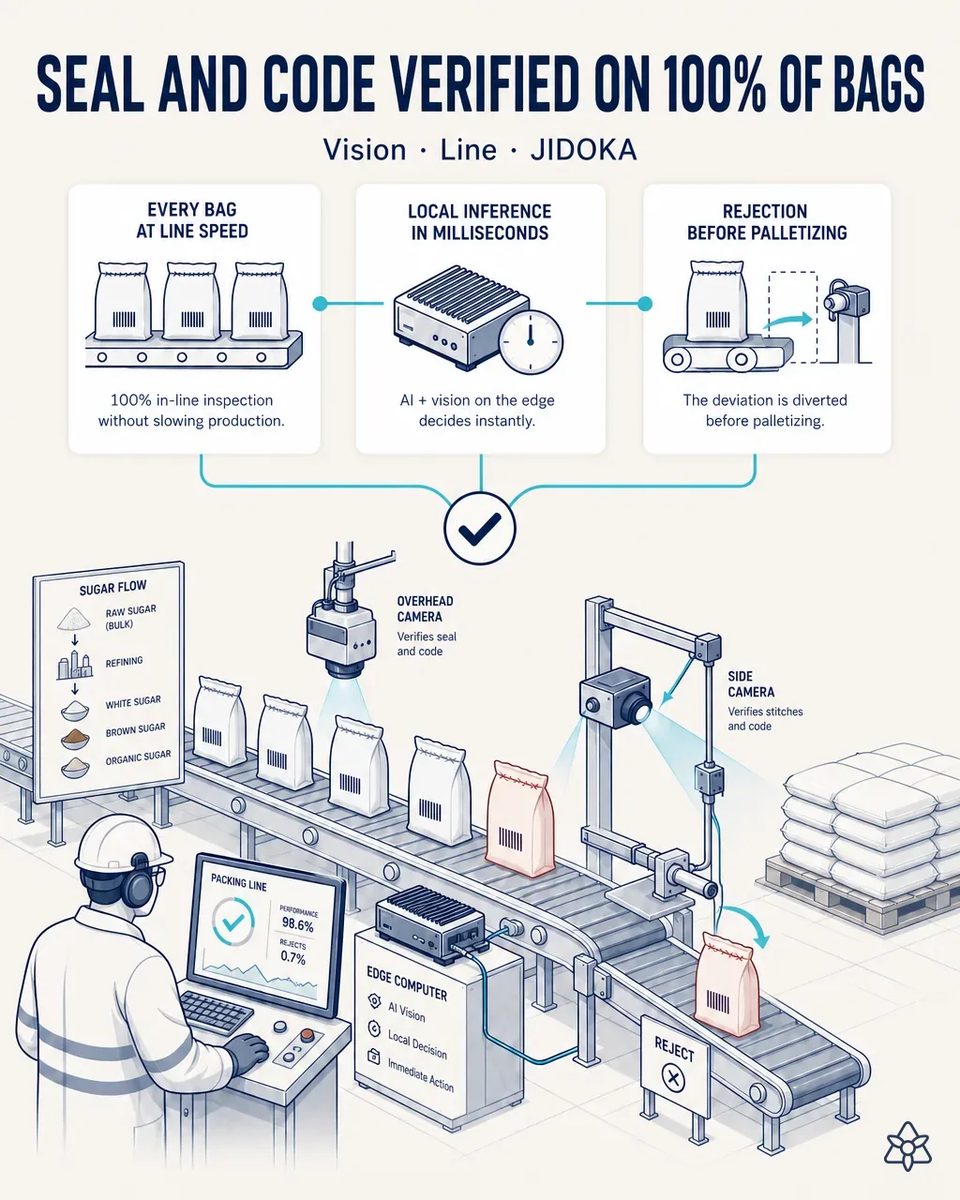
At the speed of a sugar bagging line the human eye cannot keep up. A skipped stitch, a cold heat seal, a badly folded bag corner or a lot code printed over a wrinkle all go through unseen. The defective bag bursts in the warehouse or in the truck; the illegible code is caught by the customer at receiving. Edge iLEAN puts cameras over the line, infers in milliseconds per bag and rejects the defective one before the pallet.
Closure defects arrive in bursts. That is exactly the pattern sampling does not see.
Control is by sampling and by the attention of an operator who is also doing other things. Closure defects are intermittent: they correlate with sewing head wear or with jaw temperature, so they arrive in bursts. That is exactly the pattern periodic sampling does not see. When a bag bursts there is spillage and lost product, but there is something more serious in a plant handling sugar: there is dust in suspension where there should not be any, with everything that implies for housekeeping and combustible material control. And if what fails is the printed code, nobody on the floor catches it: the customer catches it at receiving, and then it is a lot you cannot trace.
- Control is by sampling and by the attention of an operator who is also doing other things.
- Closure defects are intermittent: they correlate with sewing head wear or with jaw temperature, so they arrive in bursts.
- When a bag bursts there is spillage and lost product.
- But there is something more serious in a plant handling sugar: there is dust in suspension where there should not be.
Edge — computer vision running on the line itself, with local inference.
Edge — computer vision running on the line itself:
Inference in milliseconds per bag on local hardware. At this line speed, the latency and bandwidth of a cloud solution simply do not allow it.
- An overhead camera and a side camera over the bagging and palletizing line.
- A neural network trained on good and bad images of this plant's specific format: stitched 50 lb bag, heat-sealed bag, big bag, retail bag.
- Inference in milliseconds per bag on local hardware (such as NVIDIA Jetson Orin): at this line speed, the latency and bandwidth of a cloud solution do not allow it.
- Verification of two things in the same pass: closure integrity and printed code legibility — which closes the loop with case 8. The defective bag is rejected before it goes onto the pallet.
Closure control, before and after
| Aspect | Today | With iLEAN Edge |
|---|---|---|
| Coverage | Sampling | 100% of bags |
| Burst-pattern defects | Invisible to sampling | Caught as they start |
| Who watches | An operator doing three things | Two cameras, doing one |
| Formats covered | — | Stitched 50 lb, heat-sealed, big bag, retail |
| Dependence on network or cloud | — | None: local inference |
| Sugar dust in suspension | A consequence of every burst bag | One less source |
Impact estimate — to validate against your numbers.
The block below is an estimate to be validated against your plant's actual data. We put it forward so the committee has an order of magnitude; we refine it during the assessment.
- Estimated payback 5-12 months, depending on current defective bag and complaint rates.
- Counting lost product and avoided cleanups.
- And a dust-in-suspension exposure that goes down, which in a sugar plant is not a quality matter but a safety one.
- Estimate to be validated.
estimated payback of 5 to 12 months depending on the current defective bag and complaint rates, counting lost product and avoided cleanups. *Estimate to be validated*.
And the fair question from the production manager
"How many bad bags does it need to be trained?" — fewer than feared, because the network is trained on good and bad images of this plant's specific format, not a generic catalogue. And it does not decide: it marks, and the line operator resolves. That is the difference between a system that helps and one that gets switched off the first busy day.
[1] OpenAI paper "Why Language Models Hallucinate", 2025 — on the reliability of AI in anchored tasks.
What people ask about verifying the closure
Does it slow the line down?
No: inference runs in milliseconds per bag on local hardware, which is exactly why it is not a cloud solution. At this line speed a round trip to the cloud would not fit between two bags.
Does it cover big bags as well as 50 lb bags?
Yes — stitched, heat-sealed, big bag and retail. Each format is a different model, trained on that format as this plant actually runs it.
What does it verify besides the closure?
The printed code, which is the other thing that turns into a traceability problem downstream. Both are checked on the same pass.
What happens when the sewing head starts to wear?
That is the case it is built for: the defect rate rises in a burst before it becomes visible, and that rise is what triggers the alert instead of waiting for a burst bag.
Does it replace the operator?
No. It takes away the part a human does badly by design — watching every bag while doing three other things — and leaves the decision on what to do about it.
More cases from this series
- The audit always ready, with nothing to reconstructEvery changeover and every cleaning round generates its auditable dossier, organized by certification…
- Zero off-spec sugar leaving the plantFour coordinated verification rings, from the raw sugar certificate to the sealed tanker: if one does…
- The lot travels on its own from order to bagLot, date and spec travel from the active order to the coder and bagger via API, with nobody typing on…
- Hands busy, voice free: capturing what the shift manager knowsEarpiece plus Connect voice mode: the shift manager logs incidents without stopping and gets the…
- The lab sheet enters the ERP on its owniLEAN reads the hourly lab sheet when it is saved and, after validation, posts it to the ERP. Up to 80%…
- The raw sugar certificate of analysis, turned into an operational signaliLEAN reads the raw sugar certificate of analysis on arrival, cross-checks it against the melt plan and…
Tell us what a burst bag on your bagging line costs you today.
We work on your plant's real data, not ours. Assessment with no commitment.
Request estimated ROI within 48h ‹ See all cases of cane sugar refining See food