The raw sugar certificate of analysis, turned into an operational signal
Raw sugar does not always arrive the same. Every shipment comes with its certificate of analysis — polarization, color, ash, dextran, starch — and those figures determine how much affination syrup to move, how much activated carbon will be needed and what color can be promised on the way out. Today that certificate arrives by email to one person who reads it when they can. With iLEAN Connect the system sits on silent copy 24/7: it reads it on arrival, cross-checks it against the active melt plan and returns a concrete action before the raw sugar enters the process.
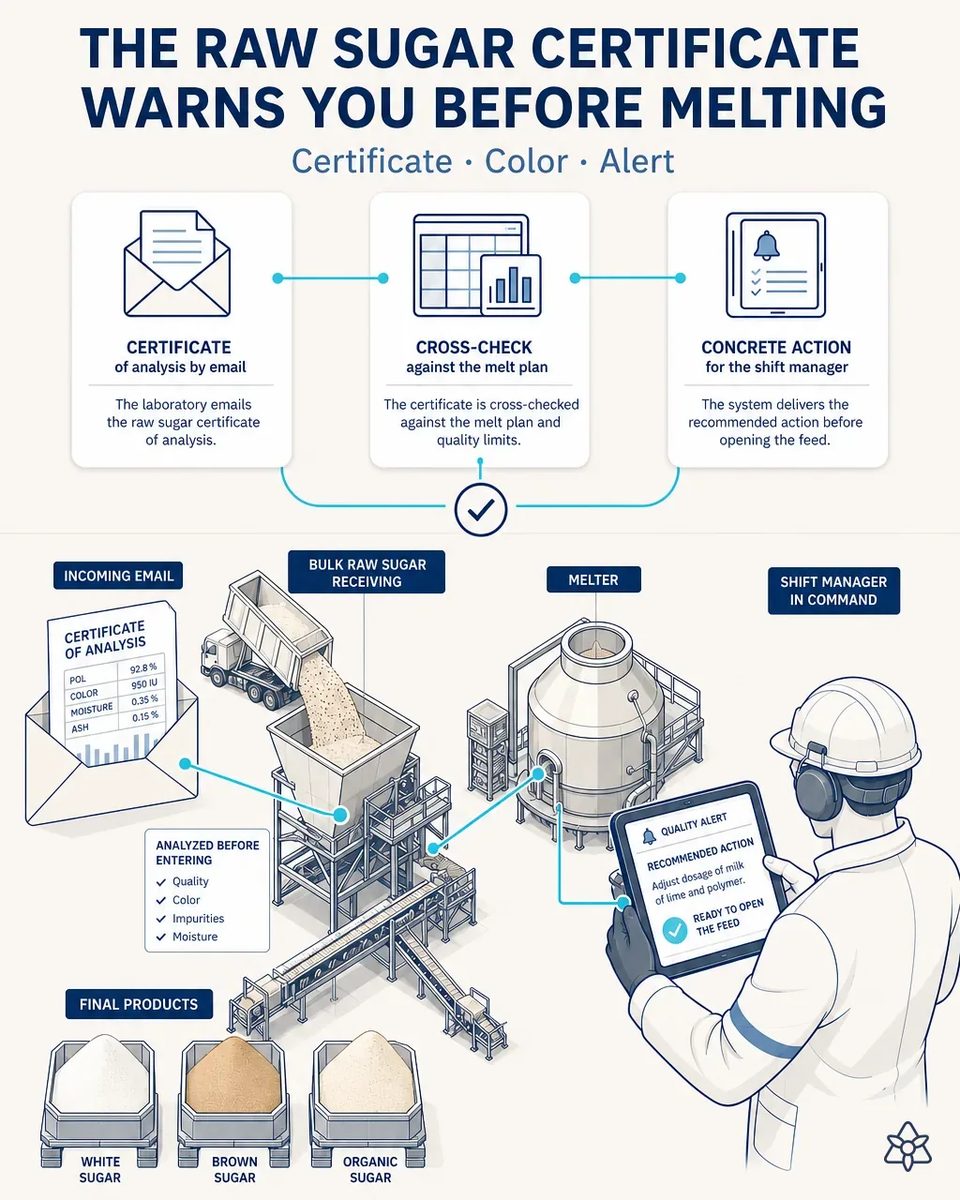
The best predictor of the next three days is being used as a filing document.
The certificate of analysis is the best available predictor of the next three days of quality problems, and today it is used as a filing document rather than as an operational signal. By the time the deviation is discovered, the liquor is already in process. Correcting it means reprocessing, extra activated carbon consumption and refining train hours. The same applies to logistics alerts: a discharge delay read three hours late is a train waiting for raw material. The structural problem is that these signals reach specific people, through different channels, and never cross-reference with live planning data.
- The certificate of analysis is the best available predictor of the next three days of quality problems, and today it is used as a filing document rather than as an operational signal.
- By the time the deviation is discovered, the liquor is already in process.
- Correcting it means reprocessing, extra activated carbon consumption and refining train hours.
- The same applies to logistics alerts: a discharge delay read three hours late is a melt plan that no longer holds.
Connect in chaotic-sources mode — and it returns an action, not a notification.
Connect in "chaotic sources" mode:
iLEAN proposes; it does not decide. What arrives at the right role is a concrete action against the melt plan, not a note saying that mail has arrived.
- A dedicated mailbox and messaging number, with iLEAN on silent copy 24 hours a day.
- The model extracts intent (raw sugar arriving, discharge delayed, analytical deviation) and entities (shipment, origin mill, polarization, color, ash, dates).
- Cross-reference against the melt plan and the ERP's active orders.
- Return of a concrete action to the right role, not a notification that mail has arrived. iLEAN proposes; it does not execute. The decision stays with the person in charge.
The incoming certificate, before and after
| Aspect | Today | With iLEAN Connect |
|---|---|---|
| What the certificate is | A filing document | An operational signal |
| When the deviation is seen | With the liquor already in process | Before opening the feed |
| Cross-reference with the melt plan | Mental, if there is time | Automatic |
| Polarization, colour, ash | Read and filed | Extracted and compared against plan |
| A discharge delay | Read three hours late | Minutes |
| What reaches the shift manager | The email | The recommended action |
Impact estimate — to validate against your numbers.
The block below is an estimate to be validated against your plant's actual data. We put it forward so the committee has an order of magnitude; we refine it during the assessment.
- Estimated payback 3-7 months, depending on shipment frequency.
- Counting avoided reprocessing, extra carbon and steam consumption, and train stoppages caused by logistics blind spots.
- From hours of latency between the external alert and the plant's reaction, to minutes.
- Estimate to be validated against your own shipment history.
estimated payback of 3 to 7 months depending on shipment frequency, counting avoided reprocessing, extra carbon and steam consumption, and train stoppages caused by logistics blind spots. *Estimate to be validated*.
And the fair question from the production manager
"Is the AI going to reply to the mill or the shipper?" — no. It does not write, does not answer and confirms nothing outwards. Extracting intent and entities from a document that is already in front of it is an anchored task [1]; what it does with that is prepare the decision and put it in front of the right role.
[1] OpenAI paper "Why Language Models Hallucinate", 2025 — on the reliability of AI in anchored tasks.
What people ask about reading the incoming certificate
Do you need access to our corporate mail?
No. It works on a dedicated mailbox and messaging number that the relevant traffic is copied to. Nobody's personal inbox is involved.
Every origin mill issues the certificate in its own format. Does that matter?
That is the normal case, and it is why the mode is called chaotic sources. No supplier is asked to change anything: what matters is the extracted entity — polarization, colour, ash, shipment — not the layout.
What does it do when a shipment has no deviation?
It says so, and that counts. Part of today's cost is that somebody has to read every certificate to find the two that matter; having the rest marked as within plan gives that reading time back.
Does it decide whether to open the feed?
No. It recommends and shows the reasoning against the melt plan. The decision to open the feed stays with the shift manager, as it does today.
Can it connect to the ERP's active orders?
Yes, and that is what gives it value: without cross-referencing against the melt plan and the active orders, a certificate is just a structured PDF.
More cases from this series
- The audit always ready, with nothing to reconstructEvery changeover and every cleaning round generates its auditable dossier, organized by certification…
- Zero off-spec sugar leaving the plantFour coordinated verification rings, from the raw sugar certificate to the sealed tanker: if one does…
- The lot travels on its own from order to bagLot, date and spec travel from the active order to the coder and bagger via API, with nobody typing on…
- Hands busy, voice free: capturing what the shift manager knowsEarpiece plus Connect voice mode: the shift manager logs incidents without stopping and gets the…
- The lab sheet enters the ERP on its owniLEAN reads the hourly lab sheet when it is saved and, after validation, posts it to the ERP. Up to 80%…
- Bulk raw sugar receiving, in one photoPhotograph the weighbridge ticket and delivery note: raw sugar enters the ERP with one tap. Trucks go…
Tell us how many hours pass today between a certificate arriving and the plant reacting to it.
We work on your plant's real data, not ours. Assessment with no commitment.
Request estimated ROI within 48h ‹ See all cases of cane sugar refining See food