Zero off-spec sugar leaving the plant
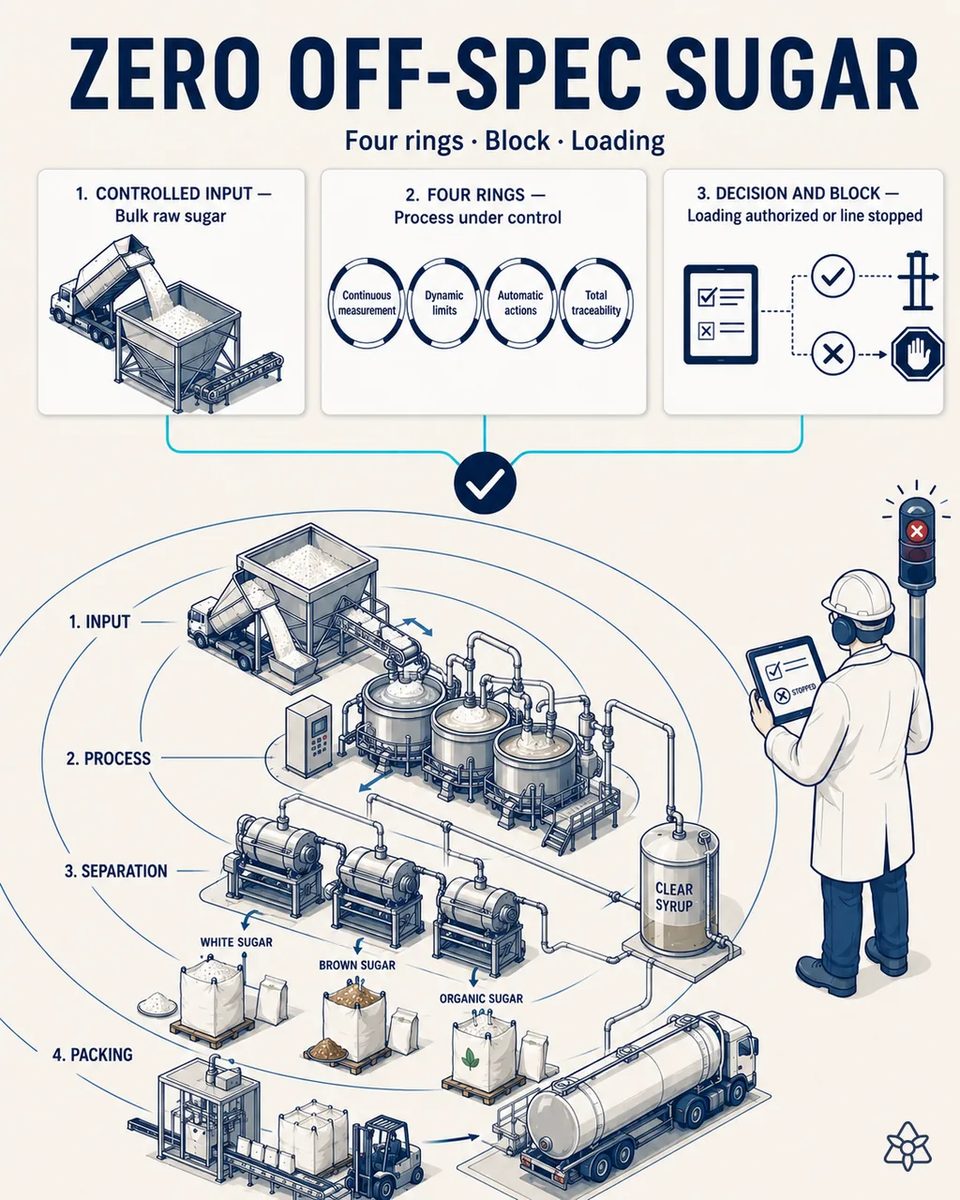
The capital pain of any cane sugar refinery serving industrial customers is always the same. A bulk tanker or a pallet of big bags with color, moisture, grain size or turbidity outside the agreed spec sheet is not just another defective product: it is a bottling or baking line stopped at the customer's site. The iLEAN flagship system coordinates the eleven previous pieces into four intersecting verification rings: if all four do not agree, the product does not leave the plant.
The direct cost of the rejection is the least of it. What you lose is the account.
Sugar is an irreplaceable ingredient with no immediate second source for the industrial customer. That is why the direct cost of the rejection is the least of it: what you lose is the account, because a buyer whose line you stopped requalifies the supplier and rarely comes back. There is a structural reason this happens: final quality is decided upstream — incoming raw sugar, affination, carbon dosing, boiling curve, drying — but measured downstream, in the lab, hours later. By the time the result says something drifted out of range, there are tonnes made. Sometimes loaded. And the whole current system depends on one person connecting, in time, signals that live in different systems: an email, a panel, a spreadsheet, a sheet of paper and a coder panel. None of those signals cross-reference on their own.
- Sugar is an irreplaceable ingredient with no immediate second source for the industrial customer.
- That is why the direct cost of the rejection is the least of it: what you lose is the account, because a buyer whose line you stopped requalifies the supplier and rarely comes back.
- There is a structural reason this happens: final quality is decided upstream — incoming raw sugar, affination, carbon dosing, boiling curve, drying.
- And it is measured downstream, in the lab, hours later, with tonnes already made.
Four rings: controlled input, process under control, decision, and evidence.
None of the eleven previous cases fixes this on its own. What fixes it is that all four rings share one central memory, so a signal from the certificate at intake can stop a loading at the far end of the plant.
- Ring 1 · Inlet (cases 3 and 7): the raw sugar certificate of analysis and the weighbridge ticket enter on their own and define what raw material is being worked and what color and polarization to expect. If the raw sugar drifts, iLEAN warns before melting.
- Ring 2 · Process (cases 1, 2 and 6): the boiling curve read from the panel, the photographed shift log and the hourly lab analysis cross- reference on the same lot. The deviation is caught while still correctable.
- Ring 3 · Packing and marking (cases 8, 9 and 10): the coder prints what the active order publishes, with no typing; the Edge camera reads what was printed and verifies bag closure; the product changeover only starts with the purge cameras reading OK. If something does not add up, JIDOKA AI stops the line.
- Ring 4 · Release and evidence (cases 5 and 11): nothing is released without a human signature on the tablet summary, and every lot leaves with its evidence pack cross-referencing the previous three rings. If a ring has not closed, loading is not authorized.
- SMED AI accelerates the product changeover so coordinating the four rings is not paid for in productivity — the legitimate objection of any plant manager running an installation designed for maximum flexibility over few machines.
The four rings, one by one
| Ring | What it secures | With what |
|---|---|---|
| 1 · Controlled input | Which raw sugar goes into which melt, and what it carries | Receiving by photo + the certificate read as a signal |
| 2 · Process under control | Continuous measurement and dynamic limits | Pan panel, shift log and lab with no lag |
| 3 · Decision and block | Loading authorised, or line stopped | JIDOKA AI + human signature at release |
| 4 · Total traceability | That all of the above can be demonstrated | Agents indexing by certification standard |
| Coordination | That upstream can stop downstream | One central memory shared by all four |
| Final decision | Authorise the shipment or stop it | Signed by a person |
Impact estimate — measured against the account, not the lot.
The block below is an estimate to be validated against your plant's actual data. We put it forward so the committee has an order of magnitude; we refine it during the assessment.
- The calculation is not the cost of the rejected lot, but the value of the account protected.
- An industrial beverage or bakery customer represents a multi-year contract whose value exceeds by orders of magnitude any single rejection.
- Estimated payback 6-12 months, measured against the first off-spec event avoided.
- And the eleven cases before this one stop being eleven separate projects and become one chain.
the calculation is not the cost of the rejected lot, but the value of the account protected: an industrial beverage or bakery customer represents a multi-year contract whose value exceeds any single incident by orders of magnitude. Estimated payback of 6 to 12 months against the first spec incident avoided. *Estimate to be validated* against the rejection history of the last 3 years.
And the fair question from the production manager
"Do we have to implement all twelve cases for this to work?" — no, and trying would be a bad idea. The rings are built in order: controlled input first, because it holds up the other three. Each ring pays on its own; what multiplies is that they share one central memory instead of living in four systems that do not talk.
[1] OpenAI paper "Why Language Models Hallucinate", 2025 — on the reliability of AI in anchored tasks.
What people ask about coordinating the four rings
Where do you start?
With the first ring, controlled input, because without knowing what came in and what it carried, the other three measure on sand. It also tends to have the shortest payback.
How long until the full chain is running?
It depends on the number of qualities and shifts, but it is not framed as a single project: each ring goes into production on its own and pays from that moment.
Does this replace our quality system?
No. It leans on it and gives it what does not reach it today. Replacing the quality system of an audited food plant is not an AI project, it is something else.
What happens if one ring fails?
The others carry on, and that is by design. What is avoided is the current situation, where a failure in one barrier is not seen by any of the others.
How do you measure whether it is working?
By how many lots leave the plant outside spec and by the response time to a customer claim. Both can be measured today, before starting.
More cases from this series
- The audit always ready, with nothing to reconstructEvery changeover and every cleaning round generates its auditable dossier, organized by certification…
- The lot travels on its own from order to bagLot, date and spec travel from the active order to the coder and bagger via API, with nobody typing on…
- Hands busy, voice free: capturing what the shift manager knowsEarpiece plus Connect voice mode: the shift manager logs incidents without stopping and gets the…
- The lab sheet enters the ERP on its owniLEAN reads the hourly lab sheet when it is saved and, after validation, posts it to the ERP. Up to 80%…
- The raw sugar certificate of analysis, turned into an operational signaliLEAN reads the raw sugar certificate of analysis on arrival, cross-checks it against the melt plan and…
- Bulk raw sugar receiving, in one photoPhotograph the weighbridge ticket and delivery note: raw sugar enters the ERP with one tap. Trucks go…
Tell us what an off-spec lot at an industrial customer has cost you.
We work on your plant's real data, not ours. Assessment with no commitment.
Request estimated ROI within 48h ‹ See all cases of cane sugar refining See food