Functional ingredient quality — viability is won or lost over weeks.
The viability of a probiotic lives in controlled conditions that last weeks, not seconds. iLEAN Tracer + Edge + Brain control them continuously and certify the ingredient — from goods-in to packing, through cold chain, blending and stability. The person validates; the agent assembles the file for EFSA and for the retailer.
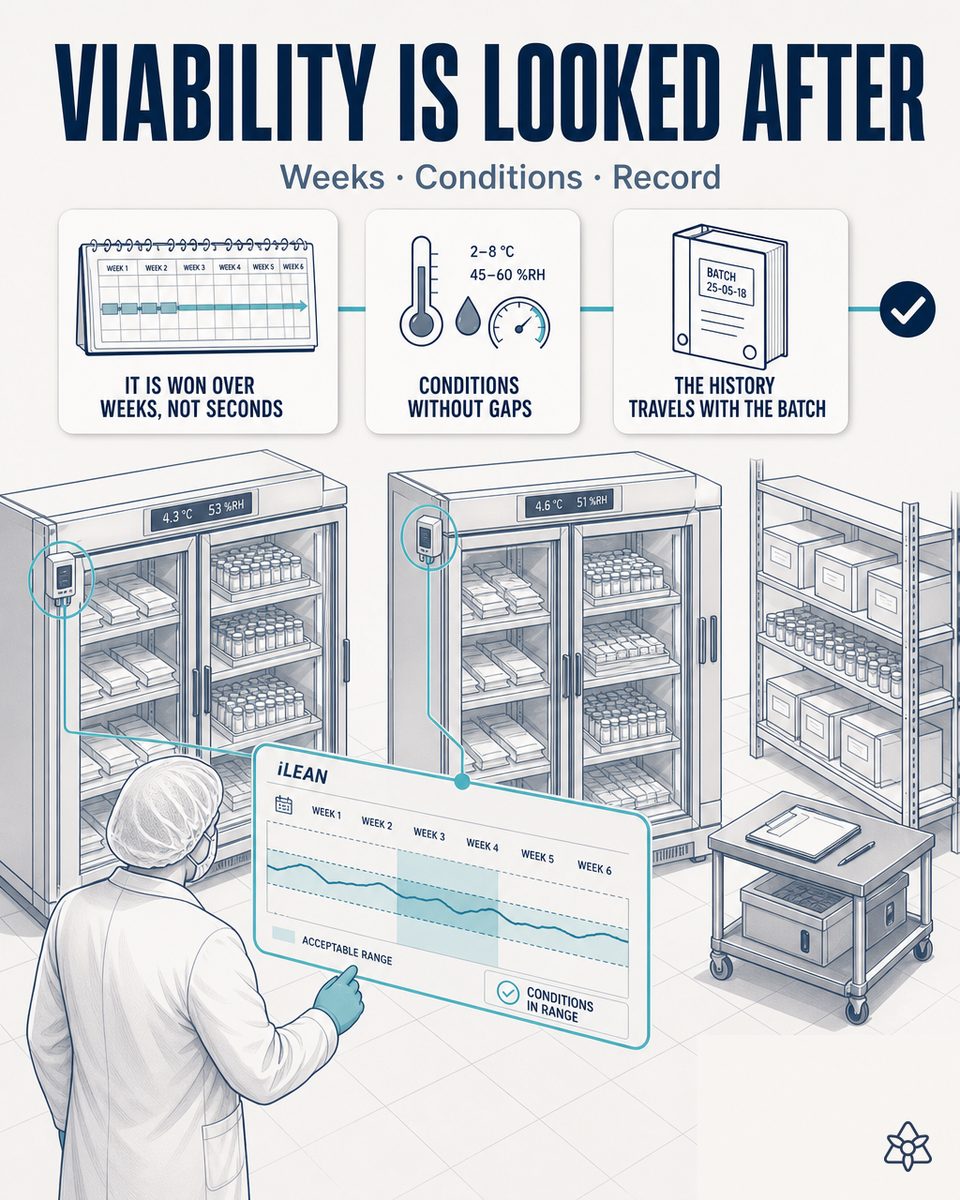
A functional ingredient is not inspected — it is looked after for weeks.
A food coloring has an analysis, a label and a certificate. It passes or it does not. A probiotic is a different animal: the strain you bought three weeks ago and the strain you are about to pack tomorrow are the same one if, and only if, the cold chain, the humidity, the residual oxygen and the pH of the carrier stayed within band the whole way. Loss of viability is not an event — it is a curve, and it slides without warning.
- Goods-in — the supplier's certificate says X CFU/g at the time of manufacture. What arrives at your dock depends on how it travelled. If the truck broke the cold chain for 3 hours at a roundabout, the certificate is worth what it is worth.
- Warehouse — freezer, chilled, dry. The data logger records, but hardly anyone ever cross-references that curve with the specific batch that came in that day.
- Blending — temperature of the base product when the strain is added, exposure time, oxygen, presence of sugar or competing acids. Viability is decided right here, in a matter of minutes.
- Packing and shelf life — the strain is still alive in the yogurt or the capsule. Your EFSA functional claim says "X CFU at the expiry date". Can you prove it?
The quality manager knows this — and works with periodic samples sent to the lab, cold chain spreadsheets and trust in the supplier. It works most of the time. When it does not, the write-off comes after packing, and the destroyed product is only half the cost; the other half is the retailer audit and the awkward question about the functional claim printed on the pack.
iLEAN does not add another data logger — it seals the cracks between all the ones you already have.
The viability problem is not a lack of measurements. It is that the measurements live in silos: the truck's data logger, the chilled warehouse logger, the probe in the blender, the supplier's certificate, the CFU count from the external lab, the accelerated stability study. iLEAN acts as the putty that crosses those silos and holds a single identity per ingredient batch — from supplier to shelf.
Tracer holds the batch identity and its viability history. Connect captures cold chain, certificates and counts. Edge intervenes at blending and packing. Brain (the agents) anticipates drift before the lab confirms it.
The iLEAN pieces applied to functional ingredients:
- Tracer — identity of the ingredient batch from the supplier certificate through to the final pack. Every step (truck, warehouse, blending room, packing, pallet, shelf) leaves a trace, and inheritance is preserved in multi-strain or multi-ingredient blends.
- Connect — captures the truck's data logger (when the supplier allows it, or via a photo of the display on arrival), the warehouse probes, the blending room control sheets, the counts from the external lab (report PDF, parsed automatically). And it captures what comes in from outside: the supplier's email about a change of carrier, the retailer's WhatsApp asking for extra evidence.
- Edge — in the blending room and at packing: integrated probes + vision where the blend justifies it (homogeneity, color, presence of agglomerates). An actuator to block packing if the blend falls outside the viability window.
- Brain (agents) — cross-references the conditions of every batch with the viability history and builds a predictive model from your own data. It anticipates the drift of the CFU count in the warehouse before the lab confirms the next milestone, and assembles the batch's EFSA file. The critical operation (releasing the batch to packing, declaring the functional claim) remains the person's.
Classic control vs. continuous control with iLEAN
| Aspect | Sheets + data loggers + sampling | With iLEAN Tracer + Connect + Edge + Brain |
|---|---|---|
| Supplier cold chain | Trust in the shipping certificate | Truck data logger read and matched to the batch |
| Batch traceability | An Excel sheet you can rebuild | Live identity from supplier to shelf |
| Lab sampling | By calendar, blind | Directed where the agent detects drift |
| Predicting final viability | Wait for the count at the next milestone | A model built on your own history that anticipates the result |
| EFSA / retailer file | Rebuilt by hand, days | Assembled automatically, batch by batch |
| Write-off at packing | Reactive decision after a later count | Preventive block if the viability window is not met |
Impact estimate for your plant — to be validated with your numbers.
The block below is an estimate to be validated with the specific data of your plant. We put it forward so the committee has an order of magnitude; we refine it during the diagnostic.
- Plant making functional yogurts, capsule supplements or fortified milks, 2-3 probiotic strains + 1-2 prebiotic ingredients, cold chain with several handovers.
- Connect + Tracer + Brain pilot on one line (integration with the warehouse data logger + blending room probes + lab PDF parsing). First value expected within a few weeks: a live batch identity from supplier to packing.
- Reduction in batch write-offs for out-of-specification viability of ≥ 30% against the baseline — the lever is anticipating drift before packing, not after.
- Indicative payback between 4 and 9 months, depending on the historical frequency of write-offs and the average cost of a destroyed batch + rework.
- Additional hard lever: defending the functional claim in a retailer or EFSA audit. A single claim challenged and pulled from the pack costs far more to relaunch than the entire pilot.
And the reasonable fear of trusting AI with something regulated
"What if the model predicts viability and gets it wrong?" — hallucination is a problem of free generation, not of anchored tasks (predicting from a real history belonging to the plant itself). And in any case, iLEAN never releases product to packing on its own — it proposes, alerts, directs sampling. Releasing the batch is still the quality manager's call. The three safety rings are there precisely for this, with the 2025 OpenAI paper showing that in anchored tasks the best models brought error below 1.5%[1].
[1] OpenAI paper "Why Language Models Hallucinate", 2025 — on the reliability of AI in anchored tasks.
What people ask about functional ingredient quality with AI
What does EFSA require for functional claims (probiotics, prebiotics)?
EFSA requires you to demonstrate the physiological effect behind the claim with scientific evidence (EU Regulation 1924/2006 on nutrition and health claims), and to keep the ingredient specification intact until the end of shelf life. For probiotics that translates into keeping the strain identified and a viable CFU count at the expiry date; for prebiotics, into keeping the functional fraction (FOS, GOS, inulin) quantified. A plant that cannot demonstrate that with plant data should not be using the claim — and retailers audit this point more and more.
How do you measure probiotic viability without waiting three weeks for a culture?
The official measurement is still the lab CFU count (48-72h for common strains, longer for some Bifidobacterium). What iLEAN adds is not a way around the lab, but a way to stop suffering it: it continuously controls the parameters that predict loss of viability — cold chain temperature, humidity, residual oxygen, pH of the carrier — and cross-references them with your history of counts to anticipate the drift before the lab confirms it. It is the Marmaris pattern: anticipating the result of the count from the conditions that determine it.
Do you still need an external lab, or does this replace it?
It does not replace it — it complements it. The external or in-house lab is still needed for the official CFU count and for strain identification. What iLEAN removes is blind sampling: instead of sending samples on a calendar and praying, iLEAN directs sampling to where the intelligence says there is drift. Fewer samples, better targeted, with an automatic file to go with them. The lab gains signal and response time.
Does it work with multi-strain blends or only single-strain?
It works with blends. Commercial functional formulations are almost always multi-strain or multi-ingredient (a functional yogurt combines L. acidophilus + Bifidobacterium + sometimes L. casei, plus prebiotics such as inulin). iLEAN Tracer keeps the identity of every ingredient from the supplier batch onwards, and the agent cross-references the expected viability of each strain with its own sensitivity to temperature/humidity/oxygen. The outgoing file documents viability strain by strain, not as an opaque aggregate.
And shelf-life stability — can it be assured before product goes on the shelf?
That is the big lever. The shelf life of a functional ingredient is determined by stability studies under accelerated and real conditions that take weeks or months. iLEAN does not remove them, it makes them more reliable: it captures every parameter of every study continuously, cross-references them with the microbiological result at each milestone, and builds a prediction model from your own history that lets you anticipate drift in the batch in production. When a series goes out of pattern in the warehouse, the agent flags it before the batch reaches the shelf.
More cases in food
- Real AI cases in frozen foodsReal AI cases in frozen foods: pallet-level cold chain, plus the cross-cutting food industry cases —…
- AI control of fruit dehydration — the drying end point should not arrive hours late.iLEAN connects the tunnel's probes and adds vision at the outfeed: the drying end point is decided by…
- FSMA for food exports to the US — seven rules, one single file, 24 hours to hand it over.iLEAN covers all seven FSMA pillars: traceability, preventive controls, food defense, importer rule. One…
- Batch startup at a food products plant — the first label is where the shift is won or lost.Connect captures the production order and the batch's first label by photo, digitizes both and guides…
- Coder and labeler integrated with iLEAN — the operator stops typing the SKU changeover.iLEAN Connect integrates directly with Markem-Imaje, Domino or Videojet. Batch, date and allergens…
- In-line human verification tablet — the person signs, in 2 taps, before the data enters the system.iLEAN Connect puts a tablet at the line so the operator confirms in seconds what the AI just captured —…
Tell us your case and in 48h we'll send you the estimated ROI of this AI project for your functional ingredient line.
We work on your plant's real data, not ours. Diagnostic with no commitment.
Request estimated ROI in 48h ‹ All ingredient cases See food industry