The lab sheet enters the ERP on its own
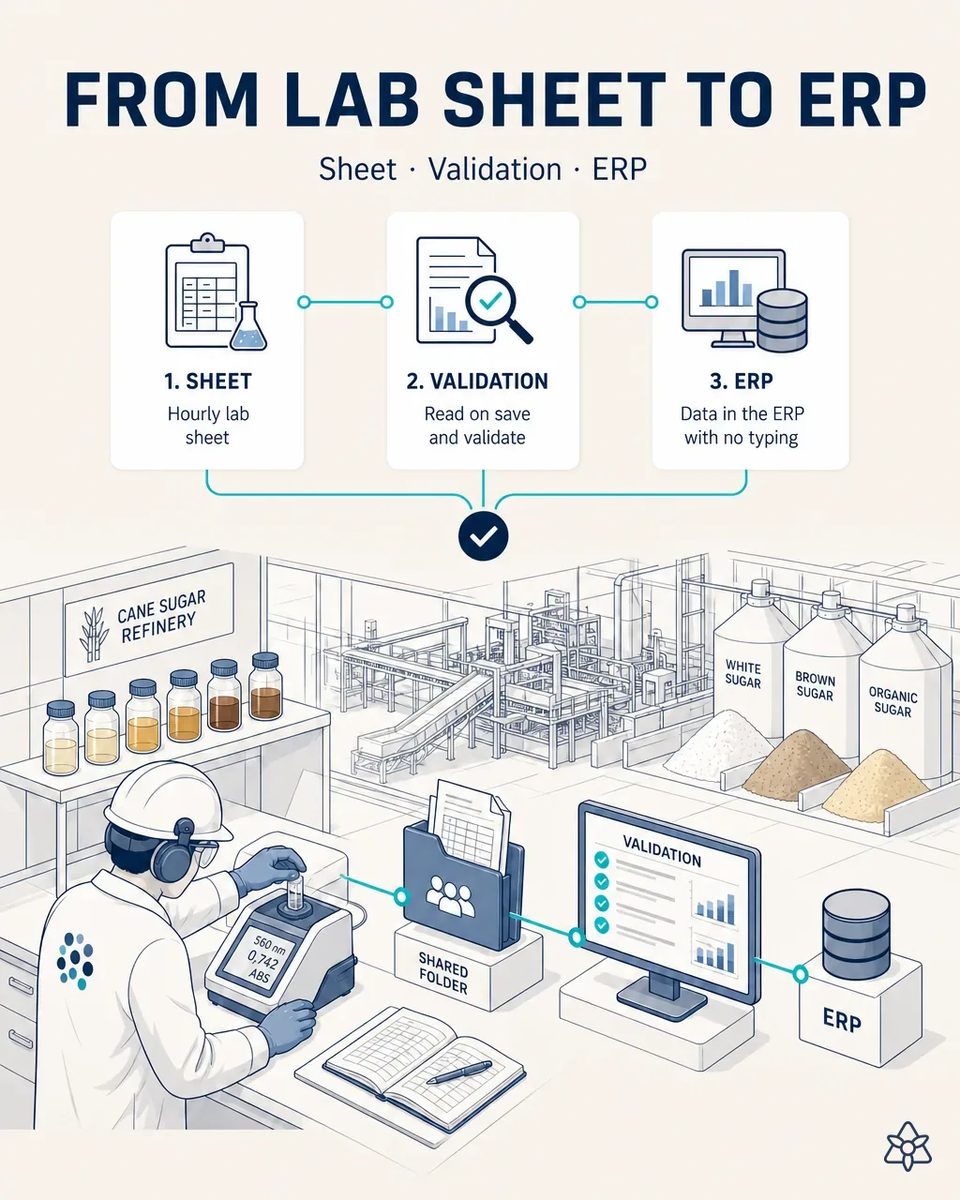
In a sugar refinery the lab tests every hour and writes it on a spreadsheet living in a shared folder: liquor color out of decolorization, polarization of the finished product, moisture after the dryer, ash, turbidity, grain size. The ERP, meanwhile, runs on whatever someone transcribes days or weeks later. iLEAN Connect observes the folder, reads the sheet as soon as it is saved and, after the quality lead validates, posts it automatically into the ERP.
The auditable system is not the real system. In a food plant, that is structural.
Two parallel worlds exist: the real sheet, with the shift's data, and the official ERP, with transcribed, lagging data containing typing errors. There is a deeper problem here than the lag. When someone has to answer a customer about the analysis of a lot from two months ago, they open the sheet, not the ERP. Which means the auditable system is not the real system. In front of a food safety scheme, that is a structural weakness. And there is a direct, recurring cost rarely accounted for: every lab person who logs into the ERP solely to enter analytical results is consuming a full named license.
- Two parallel worlds: the real sheet, with the shift's data, and the official ERP, with transcribed, lagging data containing typing errors.
- There is a deeper problem than the lag. When somebody has to answer a customer about a lot from two months ago, they open the sheet, not the ERP.
- Which means the auditable system is not the real system.
- In front of a food safety scheme, that is a structural weakness — and it is exactly the kind an auditor finds.
Listen-inward mode: it observes the shared folder — the folder, not the person.
Connect in "listen inward" mode:
The spreadsheet keeps existing and nobody learns a new tool. What disappears is the second typing, not the sheet the lab has been measuring well with for years.
- iLEAN observes the shared folder — the folder, not the person — and detects when the file is saved.
- It reads the delta and parses it with a grounded language model, respecting the sheet's structure exactly as it is.
- It shows the result on screen for the quality lead to validate.
- After validation it posts to the ERP through the API. The spreadsheet keeps existing and nobody learns a new tool.
The lab result, before and after
| Aspect | Today | With iLEAN Connect |
|---|---|---|
| Lag between measurement and ERP | Days or weeks | The moment the file is saved |
| Who types it in | Every technician | Nobody |
| Which system gets opened for an answer | The spreadsheet | Either: they hold the same data |
| ERP named licences | One per person entering results | One, the lead who validates |
| Typing errors | Inherent to the method | Removed |
| The lab spreadsheet | Everyone tries to kill it and fails | It stays |
Impact estimate — to validate against your numbers.
The block below is an estimate to be validated against your plant's actual data. We put it forward so the committee has an order of magnitude; we refine it during the assessment.
- Direct saving on ERP licences. The ERP is licensed per named active user.
- If the lab and quality team log in only to enter results, that is as many licences as people; with Connect, only the lead who validates needs one.
- The saving is immediate, recurring and depends on no improvement hypothesis: it is a cost line that goes down.
- And the auditable system becomes the real system, which is the part that matters in front of a scheme.
direct saving on ERP licenses. The ERP is licensed per named active user; if the lab and quality team logs in only to enter results, that is as many licenses as people. With Connect, only the lead who validates needs a license: typical reduction of 50-80% in quality/lab module licenses, with a recurring annual saving. Estimated payback of 4 to 9 months. *Estimate to be validated* against last year's license invoice.
And the fair question from the production manager
"What if the sheet changes format?" — listening mode does not depend on a frozen template: it reads the delta and parses it respecting the sheet's structure as it is, which is an anchored task over a document that already has that structure [1]. A new column is flagged for review rather than silently accepted.
[1] OpenAI paper "Why Language Models Hallucinate", 2025 — on the reliability of AI in anchored tasks.
What people ask about integrating the lab
Do we have to stop using the spreadsheet?
No. The spreadsheet stays, because it is the tool that lab has been measuring well with for years. What disappears is the second typing.
Is it watching what the technician does?
No. It observes the shared folder and detects that the file was saved — the folder, not the person. Nothing about who edited what is captured or reported.
Do ERP licences really come back?
It is the easiest part to check: count how many users log into the quality module only to enter results. That number is the saving, and it rests on no estimate.
Who validates before it posts?
The quality lead, on screen, before anything goes through the API. It is still a human signature; what is removed is the transcription.
How does it post: API or screen automation?
Through the API. Automating the screen looks quicker to build and breaks at the next ERP update; the API is what survives in production.
More cases from this series
- The audit always ready, with nothing to reconstructEvery changeover and every cleaning round generates its auditable dossier, organized by certification…
- Zero off-spec sugar leaving the plantFour coordinated verification rings, from the raw sugar certificate to the sealed tanker: if one does…
- The lot travels on its own from order to bagLot, date and spec travel from the active order to the coder and bagger via API, with nobody typing on…
- Hands busy, voice free: capturing what the shift manager knowsEarpiece plus Connect voice mode: the shift manager logs incidents without stopping and gets the…
- The raw sugar certificate of analysis, turned into an operational signaliLEAN reads the raw sugar certificate of analysis on arrival, cross-checks it against the melt plan and…
- Bulk raw sugar receiving, in one photoPhotograph the weighbridge ticket and delivery note: raw sugar enters the ERP with one tap. Trucks go…
Tell us how many people log into your ERP today only to enter lab results.
We work on your plant's real data, not ours. Assessment with no commitment.
Request estimated ROI within 48h ‹ See all cases of cane sugar refining See food