The lot travels on its own from order to bag
The coder that prints lot and date on every 50 lb bag and every big bag is relatively modern and has an API. So does the weigh-bagger. But both are isolated from the ERP: at every changeover someone types the new lot and reference into the panel, by hand, on the floor, wearing gloves. With iLEAN they are stitched to the ERP and lot, date, product, target weight and special marking travel automatically from the active order.
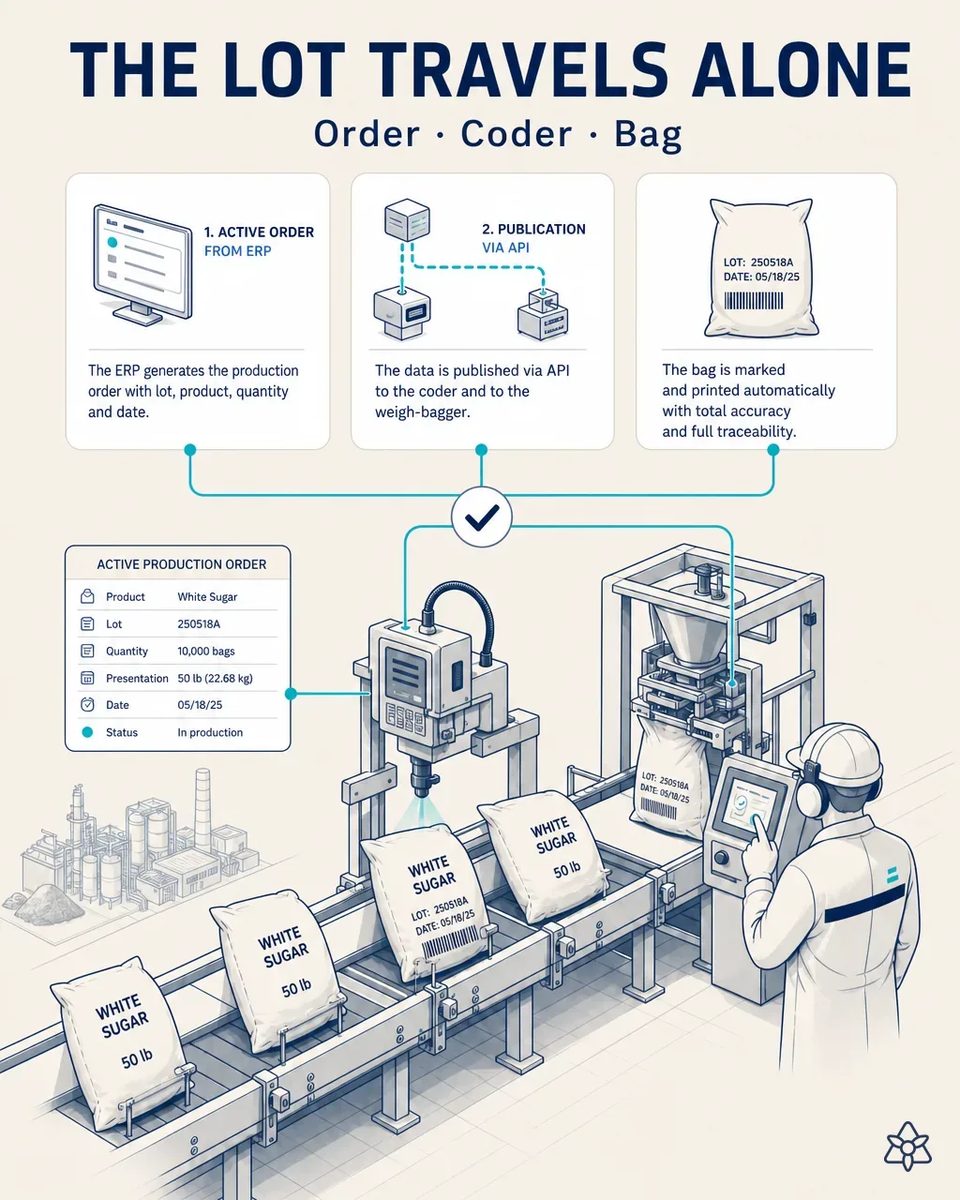
The coder is the last physical piece before the customer. And it is still typed by hand.
The coder is the last physical piece before the customer. Any error in lot, date or marking there becomes a downstream traceability problem. And yet the standard method is still typing on the panel, because "integrating it properly takes time and means stopping the line". In a plant designed with few machines and many different qualities, that typing repeats many times a day. The probability of error is not a hypothesis: it is a function of frequency. One wrong digit and half a production run goes out with the wrong lot. In a product shipped in bulk to bottling and baking plants, a wrong lot is not an ugly label: it is broken traceability that forces you to widen the scope of any recall far beyond what was necessary.
- Any error in lot, date or marking there becomes a downstream traceability problem.
- And yet the standard method is still typing on the panel, because "integrating it properly takes time and means stopping the line".
- In a plant designed with few machines and many different qualities, that typing repeats many times a day.
- The probability of error is not a hypothesis: it is arithmetic.
Connect stitches two modern systems via API, replacing neither.
Connect stitches two modern systems via API, replacing neither:
The product changeover goes from a sequence of keystrokes on two separate panels to one tap in the ERP. And no new middleware is introduced: the interfaces the machines already ship with are the ones used.
- When the ERP flags the order start, it automatically publishes product, lot, date and special marking to the coder.
- In parallel it publishes target weight and tolerances to the weigh-bagger.
- The product changeover goes from a sequence of keystrokes on two separate panels to one tap in the ERP.
- No new middleware to maintain is introduced: the interfaces the machines already ship with, and that sit unused today, are the ones being used.
The coder, before and after
| Aspect | Today | With iLEAN Connect |
|---|---|---|
| Lot, date and marking | Typed on the panel | Published from the active order |
| Target weight and tolerances | Typed on the bagger | Published in parallel |
| A product changeover | Keystrokes on two panels | One tap in the ERP |
| Risk of wrong marking | Arithmetic, with many qualities a day | Removed at source |
| New middleware to maintain | — | None |
| Line stoppage to integrate | The reason it never gets done | Not required |
Impact estimate — to validate against your numbers.
The block below is an estimate to be validated against your plant's actual data. We put it forward so the committee has an order of magnitude; we refine it during the assessment.
- Estimated payback 3-6 months.
- Drastic reduction in the risk of broken traceability from wrong marking.
- It is also the technical prerequisite for ring 2 of the complete system: without the lot travelling on its own, the rings cannot be coordinated.
- And a changeover that stops depending on who is on the panel.
estimated payback of 3 to 6 months, with a drastic reduction in the risk of broken traceability from wrong marking. It is also the technical prerequisite for ring 2 of the complete system (case 12). *Estimate to be validated* after confirming the installed models expose an API.
And the fair question from the production manager
"Does this mean another system to maintain?" — no, and that is deliberate. No middleware is introduced: what gets used are the interfaces the machines already ship with and that are already paid for. The work is stitching them to the active order, not adding a layer between them.
[1] OpenAI paper "Why Language Models Hallucinate", 2025 — on the reliability of AI in anchored tasks.
What people ask about integrating the coder
Does the line have to stop to integrate it?
No, and that is precisely why it never got done before: the perception that it means a shutdown. The interfaces are already there; what is missing is somebody publishing the active order into them.
Does it work with coders and baggers from different makers?
Yes, and it is the usual case. Each machine is stitched its own way, but what is published to them comes from the same place, which is the active order.
What happens if the ERP order is wrong?
Then the wrong marking gets published, and it is better to find that out here than at the customer. In practice this surfaces order-master errors nobody knew existed.
Who confirms the changeover?
The line operator, with one tap instead of two panels' worth of keystrokes. The confirmation stays human; what disappears is the typing.
Why is this a prerequisite for the full system?
Because ring 2 coordinates identity with process, and identity has to travel with the bag on its own. If the lot is typed, the chain has a manual link and the whole ring rests on it.
More cases from this series
- The audit always ready, with nothing to reconstructEvery changeover and every cleaning round generates its auditable dossier, organized by certification…
- Zero off-spec sugar leaving the plantFour coordinated verification rings, from the raw sugar certificate to the sealed tanker: if one does…
- Hands busy, voice free: capturing what the shift manager knowsEarpiece plus Connect voice mode: the shift manager logs incidents without stopping and gets the…
- The lab sheet enters the ERP on its owniLEAN reads the hourly lab sheet when it is saved and, after validation, posts it to the ERP. Up to 80%…
- The raw sugar certificate of analysis, turned into an operational signaliLEAN reads the raw sugar certificate of analysis on arrival, cross-checks it against the melt plan and…
- Bulk raw sugar receiving, in one photoPhotograph the weighbridge ticket and delivery note: raw sugar enters the ERP with one tap. Trucks go…
Tell us how many times a day somebody types a lot on your coder panel.
We work on your plant's real data, not ours. Assessment with no commitment.
Request estimated ROI within 48h ‹ See all cases of cane sugar refining See food