Early human verification: nothing is released unsigned
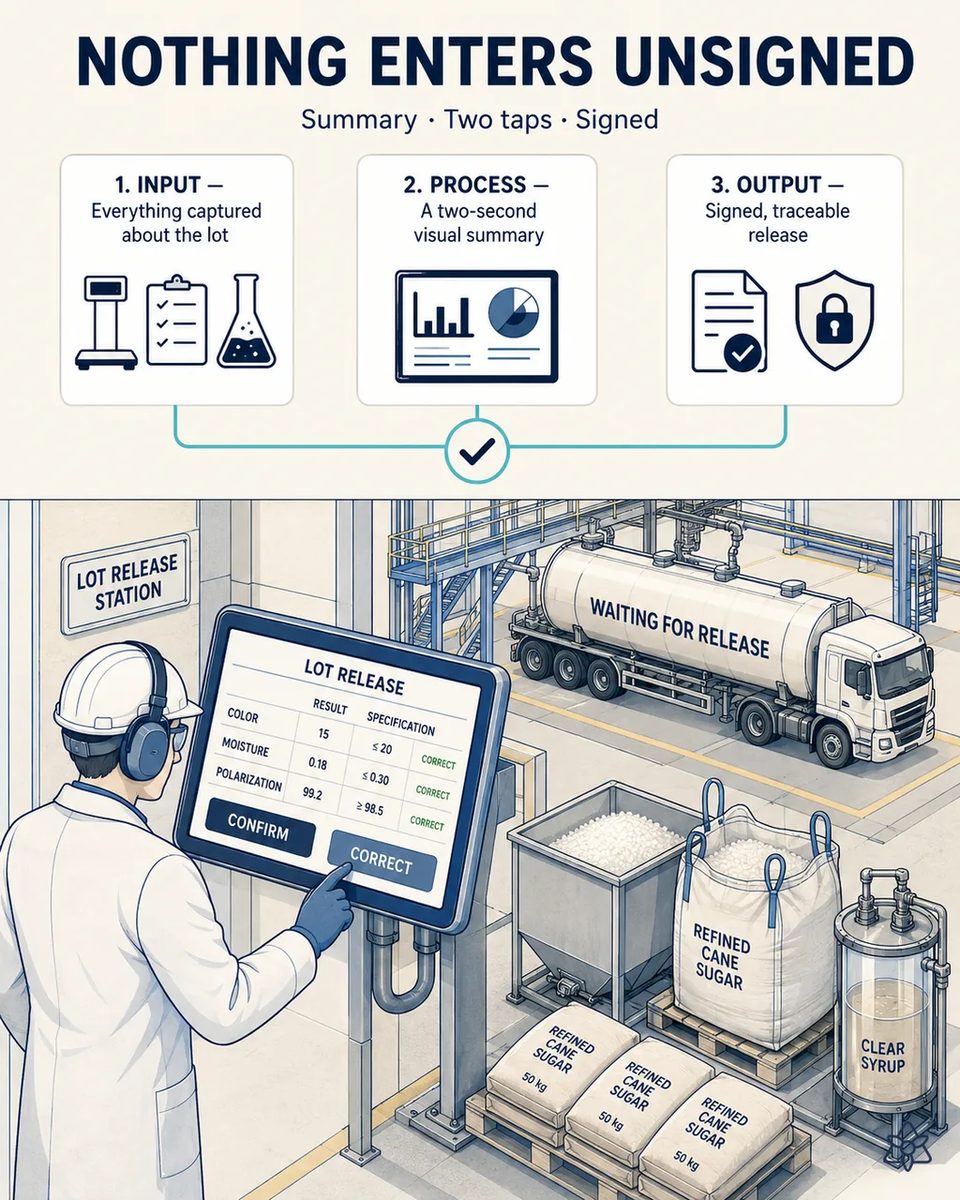
What separates iLEAN from an autonomous AI agent that writes data without a signature is that nothing iLEAN captures enters the central system without a human having seen it first. In a refinery that materializes at the most sensitive point in the plant: lot release. An industrial tablet shows a two-second visual summary — measured color against spec, moisture, polarization, grain size, shift incidents — and the lead confirms with two taps.
The real blocker is never cost. It is the fear that AI writes data on its own.
The real cultural blocker to digitalizing a plant is never cost: it is the well-founded fear that AI will write data on its own and someone will then have to clean the ERP master. In an audited food plant there is a second fear: that an unsigned record is exactly the one the auditor challenges. But operators and leads do not want to type either. Any solution that adds administrative work to their day is abandoned within weeks, however good the technology behind it. Without solving both of these at once, the rest of the capture pieces do not get signed, do not survive an audit and do not get adopted.
- The well-founded fear is that AI will write data by itself and somebody will then have to clean the ERP master.
- In an audited food plant there is a second fear: that an unsigned record is exactly the one the auditor challenges.
- But operators and leads do not want to type either.
- Any solution that adds administrative work to their day is abandoned within weeks, and the plant goes back to the parallel spreadsheet.
Everything captured, anywhere, arrives as a two-second visual summary. Two taps.
Connect in "early human verification" mode:
The signature carries a timestamp and a link to the original source. Humans in command, literally: the system does not write to the master without a human signing it.
- An industrial tablet at the lot release station, next to the lab or bulk loading.
- Everything iLEAN captures by any route — shift log, raw sugar certificate, lab analysis, boiling curve, voice dictation — arrives there as a two-second visual summary.
- The lead confirms with two taps: ✓ releases and the data enters the ERP, or ✏️ corrects it before it enters.
- The signature carries a timestamp and a link to the original evidence, which is exactly what an auditor asks for.
Data entry into the ERP, before and after
| Aspect | Today | With iLEAN Connect |
|---|---|---|
| Who validates before the ERP | Whoever types it in | The lead, in two seconds |
| Unsigned records | The ones the auditor challenges | There are none |
| Administrative work added | The reason solutions get abandoned | Two taps, no typing |
| Where the captured data comes from | — | Log, certificate, lab, curve, voice |
| Traceability of the signature | A name on paper | Timestamp and link to the source |
| Fear of the ERP master being polluted | Founded | Nothing enters without a signature |
Impact estimate — an enabling piece, and it is worth saying so.
The block below is an estimate to be validated against your plant's actual data. We put it forward so the committee has an order of magnitude; we refine it during the assessment.
- This is an enabling piece for the whole matrix and is not defended with a payback of its own.
- Its job is to let the other eleven pieces be signed and survive an audit.
- Strategic and compliance value: without this gate, the rest is hard to defend in front of a food safety scheme.
- And it is what stops the plant from going back to the parallel spreadsheet, which is where projects die.
an enabling piece for the whole matrix. It is not defended with its own payback: its job is to let the other eleven pieces be signed and survive an audit. Strategic and compliance value. *Estimate to be validated*.
And the fair question from the production manager
"If a person has to look at it anyway, what do we gain?" — looking is not typing. What they get is a two-second visual summary, and the anchored extraction work is already done [1]. You go from transcribing a screen of fields to confirming one. And the real gain is that the data lands in seconds instead of at shift close.
[1] OpenAI paper "Why Language Models Hallucinate", 2025 — on the reliability of AI in anchored tasks.
What people ask about early human verification
Does it slow down lot release?
It is two taps on a summary designed to be read at a glance with gloves on. The seconds it adds are measured against the cost of a wrong figure in the ERP master.
Who should sign: the operator or the quality lead?
Anything going to a quality master is better signed by the role that already owns that responsibility today. Changing who signs is a bigger cultural change than digitising the capture.
Can the signature be skipped when there is pressure?
No, and that is the point. What can be tuned is which fields require it: asking for a signature on everything ends with people signing out of habit, which is worse than not asking.
Do the corrections do anything?
Yes. The correction is stored and feeds the tuning of the anchored model, so the fields corrected most in the first weeks are the ones that stop needing correction.
Is this enough for a food safety audit?
It is the piece that makes the rest auditable: every record has an author, a timestamp and a link to its original source. Whether the scheme is satisfied depends on the scheme, but the gap it closes is exactly the documentary one.
More cases from this series
- The audit always ready, with nothing to reconstructEvery changeover and every cleaning round generates its auditable dossier, organized by certification…
- Zero off-spec sugar leaving the plantFour coordinated verification rings, from the raw sugar certificate to the sealed tanker: if one does…
- The lot travels on its own from order to bagLot, date and spec travel from the active order to the coder and bagger via API, with nobody typing on…
- Hands busy, voice free: capturing what the shift manager knowsEarpiece plus Connect voice mode: the shift manager logs incidents without stopping and gets the…
- The lab sheet enters the ERP on its owniLEAN reads the hourly lab sheet when it is saved and, after validation, posts it to the ERP. Up to 80%…
- The raw sugar certificate of analysis, turned into an operational signaliLEAN reads the raw sugar certificate of analysis on arrival, cross-checks it against the melt plan and…
Tell us what would have to be true for you to let a system write to your ERP master.
We work on your plant's real data, not ours. Assessment with no commitment.
Request estimated ROI within 48h ‹ See all cases of cane sugar refining See food