The refinery shift log, digital from second zero
In a cane sugar refinery the control system runs the process, but a sheet of paper runs the shift. The refining operator writes down by hand what the control system does not capture: why the strike took longer, which purge came out cloudy, when the centrifugal screen was changed, which bag of activated carbon was opened. That paper defines what actually happened to the lot, and today it ends up in a folder until someone collects it. With iLEAN Connect the operator takes one photo as he closes each block of the shift and those readings exist in the central system immediately, tied to the lot in process.
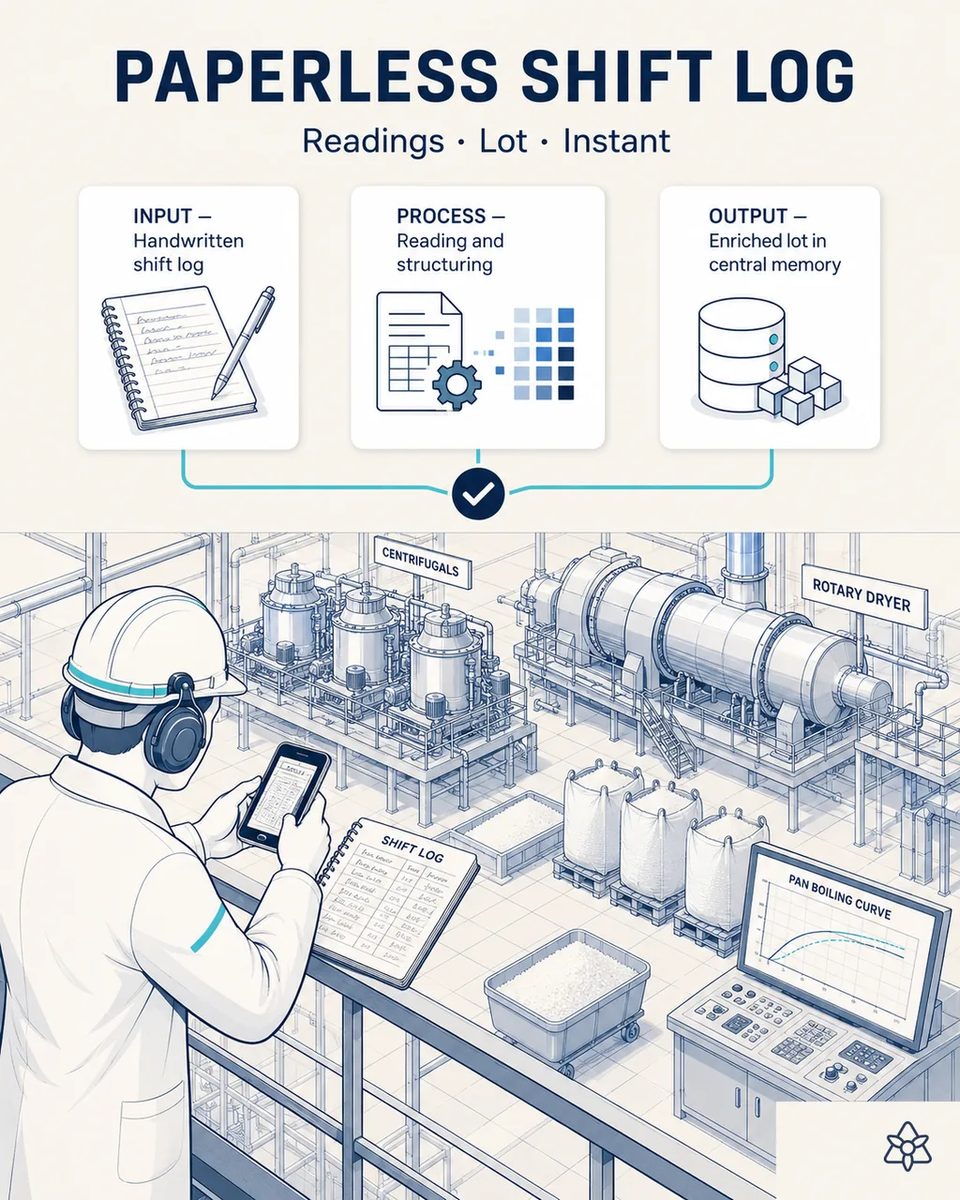
Two parallel truths live in a modern refinery. Only one of them is queryable.
Two parallel truths coexist in a modern refinery. The control system's — process variables, precise and automatic — and the paper's, which holds the human context: the why. The second is what explains a color deviation three days later, and it is precisely the one that sits in no queryable system. The shift log ends up in a folder in the shift manager's office and does not exist for any system until someone collects it: eight to twelve hours later, at best. When the lab finds that a lot has drifted on moisture, reconstructing what happened means hunting for a piece of paper and calling someone who is already off shift. The result is that root cause analysis, which should be a procedure, is in practice an exercise in collective memory. And as the number of lots and changeovers grows, that memory fails more often.
- The control system's truth — process variables, precise and automatic — and the paper's truth, which holds the human context: the why.
- The second is what explains a colour deviation three days later, and it is precisely the one that sits in no queryable system.
- The shift log ends up in a folder in the shift manager's office and does not exist for any system until somebody collects it — eight hours later, or at the end of the shift.
- By then the answer to "what happened on that strike" is a conversation, not a record.
Connect in photo-of-the-analog mode — the operator keeps writing by hand.
Connect in "photo of the analog" mode. Step by step:
Nothing in his routine changes. That is the whole design constraint: a refinery shift manager will not stop mid-round to fill in a form on a screen, and any solution that asks him to is dead by month three.
- The operator photographs his log with a phone or industrial tablet as he closes each block of the shift. Nothing in his routine changes: he keeps writing by hand.
- A grounded language model extracts the structured fields: reading, unit, equipment, time, incident.
- iLEAN links those fields to the active lot and shift, cross-referencing them with what the control system already records.
- The data lands in iLEAN's central memory, queryable by lot, with the photo of the original document linked as evidence.
The shift log on paper vs. the shift log captured
| Aspect | On paper today | With iLEAN Connect |
|---|---|---|
| When the data exists for the system | 8 h later, or at shift close | Second zero |
| The human context — the why | Only on paper | Structured and tied to the lot |
| Explaining a deviation three days later | A conversation | A query by lot or shift |
| Cross-reference with the control system | None | Automatic |
| An illegible or mislaid sheet | The context is lost | The photo remains as evidence |
| Operator habit | — | Unchanged: still writing by hand |
Impact estimate — to validate against your numbers.
The block below is an estimate to be validated against your plant's actual data. We put it forward so the committee has an order of magnitude; we refine it during the assessment.
- Estimated payback 4-9 months, depending on the number of lots and shifts per day.
- From 8 h of latency between the reading and the system, to second zero.
- The shift's human context becomes queryable, which is what every later root-cause analysis rests on.
- Estimate to be validated against the plant's real volumes.
estimated payback of 4 to 9 months depending on the number of lots and shifts per day. *Estimate to be validated* against the plant's real volumes.
And the fair question from the production manager
"What if it misreads a reading and a wrong figure gets in?" — reading fields off a log with a known structure is an anchored task, where the best models drop below 1.5% error [1]. But the real answer is the other one: the extracted summary goes to the tablet and somebody confirms or corrects it before it crosses into the system. Nothing enters on its own.
[1] OpenAI paper "Why Language Models Hallucinate", 2025 — on the reliability of AI in anchored tasks.
What people ask about digitising the shift log
Does the shift log itself have to change?
No, and that is the condition. The log is tuned to how that refinery runs, and every attempt to replace it with a form on a screen ends with the operator writing on paper anyway and typing it up later. Vision reads the structure of the document as it is.
Does it work with handwriting from several shifts?
Yes, because the model is not asked to guess: it is asked to fill fields on a form it already knows. A field that comes back with low confidence is flagged on the tablet for a person to confirm, instead of slipping through.
Does it replace what the control system already records?
No, it complements it. The control system has the process variables and has them well; what it does not have is the human context that explains them. The value comes from having both tied to the same lot.
Do we need coverage across the whole plant?
Not for this. The photo is taken on a phone or tablet and syncs when there is signal. What cannot wait for the network is process control, and that lives in Edge, with local inference.
Where do you start?
With one shift and one part of the train, usually the pan floor, because that is where the context that explains later deviations is generated. Extending to the rest is short once the field mapping is defined.
More cases from this series
- The audit always ready, with nothing to reconstructEvery changeover and every cleaning round generates its auditable dossier, organized by certification…
- Zero off-spec sugar leaving the plantFour coordinated verification rings, from the raw sugar certificate to the sealed tanker: if one does…
- The lot travels on its own from order to bagLot, date and spec travel from the active order to the coder and bagger via API, with nobody typing on…
- Hands busy, voice free: capturing what the shift manager knowsEarpiece plus Connect voice mode: the shift manager logs incidents without stopping and gets the…
- The lab sheet enters the ERP on its owniLEAN reads the hourly lab sheet when it is saved and, after validation, posts it to the ERP. Up to 80%…
- The raw sugar certificate of analysis, turned into an operational signaliLEAN reads the raw sugar certificate of analysis on arrival, cross-checks it against the melt plan and…
Tell us how many hours pass today between a reading being written down and reaching the system.
We work on your plant's real data, not ours. Assessment with no commitment.
Request estimated ROI within 48h ‹ See all cases of cane sugar refining See food