No order starts with another order's kit
Before a server order is built, the warehouse picks a kit with everything that configuration takes: boards, memory, drives, power supplies and power cords. Because cardboard is not allowed in the production area, material is unpacked in the warehouse and travels in trays and carts, already without its box label. When two nearly identical orders run at the same time, differing only in a power cord for one region or another, or in a memory capacity, a mix-up is a matter of time, and the server ships with an accessory that does not match its destination. iLEAN Edge validates the order changeover: cameras over the kit cart check that the parts are the ones for that order, others confirm that no material from the previous order remains on the line, and the start waits until everything conforms and the lead signs.
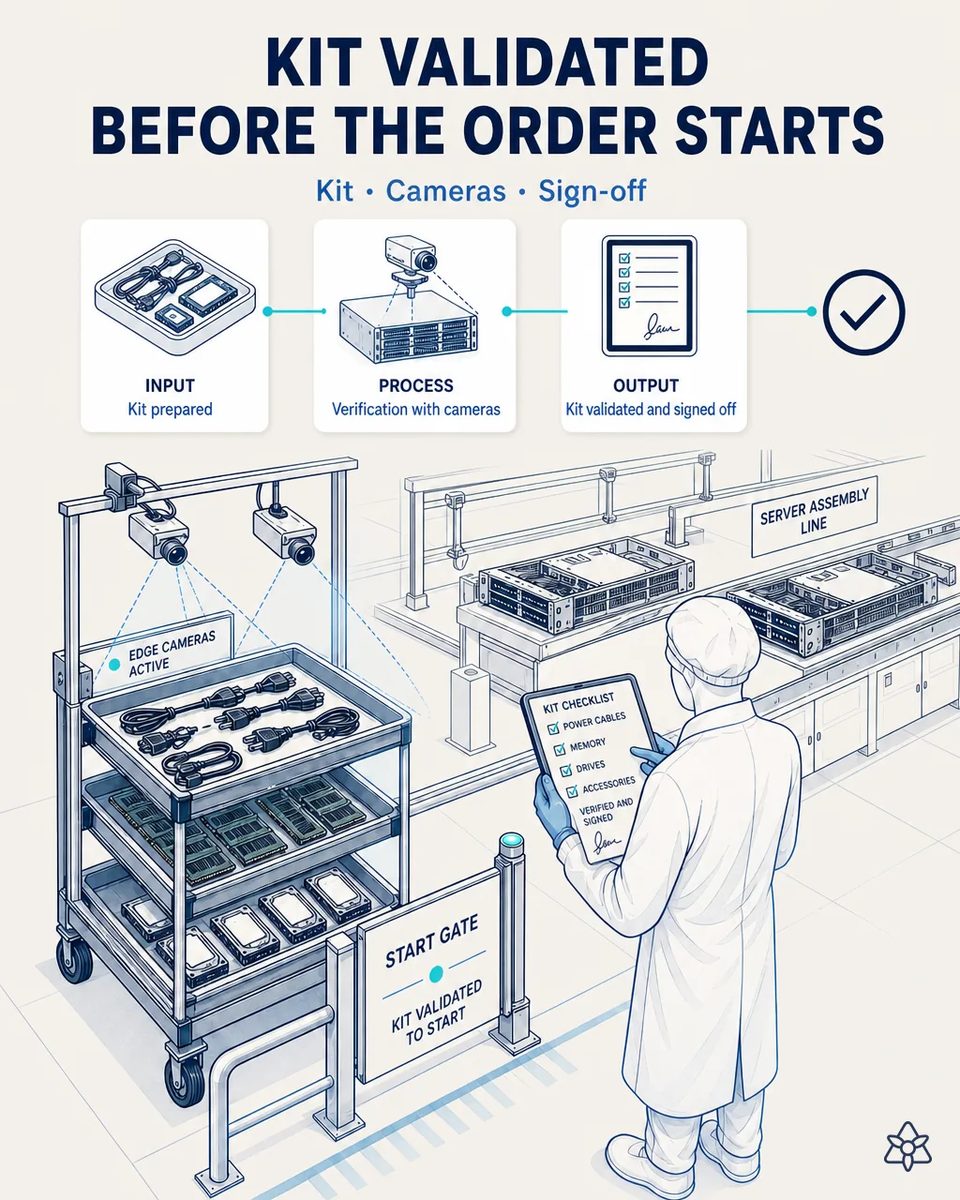
Two orders that differ by one power cord will eventually swap it.
Line clearance and kit verification depend on a checklist signed with no objective evidence. The parts that get confused look alike, yet are distinguishable to someone who knows what to look at: the plug on a cord, the label on a module. The error does not affect functional test, so nothing stops it until the customer opens the box.
- Before an order is built, the warehouse picks a kit with everything that configuration takes: boards, memory, drives, power supplies and power cords. Because cardboard is not allowed on the floor, parts travel in trays and carts without their box label.
- When two nearly identical orders run at the same time — differing only in a power cord for one region or another, or in a memory capacity — a mix-up is a matter of time. It does not take carelessness, only two carts parked side by side.
- Line clearance and kit verification rely on a checklist signed with no objective evidence. The parts that get confused look alike, but are distinguishable to someone who knows to look at the plug or the module label.
- The error does not affect functional test, so nothing stops it until the customer opens the box and finds an accessory that does not match its destination.
Edge with JIDOKA AI — the order starts on a conforming kit, a cleared line and a signature.
Edge + JIDOKA AI. Cameras recognize each part of the kit by its shape, its connector and its label, and compare it with the order's bill of materials published by the execution system. At changeover, other cameras compare the state of the line with the "cleared" reference. Start is conditional on a conforming kit, a cleared line and sign-off by quality or the lead. Changeover time gets shorter because verification is no longer a manual count (SMED AI).
The camera does not replace the lead's judgment; it replaces the manual count the lead signs under pressure. The start waits for a conforming kit and a cleared line, and the lead signs on evidence rather than on trust, with the images stored next to the signature. And because the count is automatic, changeover gets shorter, not longer.
The kit checklist signed today versus the kit checked by camera
| Aspect | Today | With iLEAN Edge |
|---|---|---|
| Kit against the order's bill of materials | Manual count, signed | Each part recognized and compared |
| Power cord for the wrong region | Found by the customer | Stopped before start |
| DIMM capacity swapped between orders | Passes functional test unnoticed | Caught by its label at the cart |
| Leftover parts from the previous order | Checklist box ticked | Line compared with its cleared reference |
| Proof of the kit at order start | A signature | Stored image per point |
| Changeover time spent counting | Minutes of manual count | Seconds of verification (SMED AI) |
Checklist signed with no evidence → point-by-point visual validation with stored image. Mix-ups between similar orders found by the customer → stopped before start. Manual kit count → verification in seconds.
Impact estimate — to be validated with your numbers.
The block below is an estimate to be validated against your plant's actual data. We put it forward so the committee has an order of magnitude; we refine it during the assessment.
- Payback estimated at 4-10 months.
- It eliminates accessory mix-ups between similar orders, each of which means a formal complaint, an expedited shipment and a corrective action.
- Changeover gets shorter because verification stops being a manual count (SMED AI), so more orders per shift fit without adding risk. In a high-mix plant with several changeovers per line and shift, those minutes add up.
- And every order start leaves stored images of its kit and its cleared line, which answer the customer's question if a box is ever disputed, and feed the dossier by serial number.
Estimated payback of 4 to 10 months; it eliminates accessory mix-ups between similar orders, each of which means a formal complaint, an expedited shipment and a corrective action. *Estimate to be validated*.
And the fair question from the production manager
“A North American cord and a European cord look almost identical on a cart. Can a camera really tell them apart?” — it can, because it looks at what a trained person looks at: plug shape, connector and label. Recognizing a known part against the order's bill of materials is an anchored task, where the best models stay below 1.5% error [1]. If a part cannot be identified with confidence, the start waits for the lead to check it, not for the model to guess. The lead's decision is stored and the reference improves.
[1] OpenAI paper "Why Language Models Hallucinate", 2025 — on the reliability of AI in anchored tasks.
What people ask about validating server kits at changeover
What exactly do the cameras check on the kit cart?
Each part against the order's bill of materials: board, memory, drives, power supplies and power cords, recognized by shape, connector and label. Quantities are checked too, so a missing drive is as visible as a wrong one.
How is the line clearance checked?
Other cameras compare the state of the line with its cleared reference, so a leftover cord, tray or drive from the previous order is flagged before the start. It is the step a rushed checklist skips most often.
Does it make changeover longer?
It usually makes it shorter: the check takes seconds and replaces a manual count. That is the SMED AI part of the case: verification moves from counting to confirming.
Can the start be forced when the line is behind?
An exception can be signed by quality or the lead and is recorded as such. What cannot happen is a start with no trace of who decided.
What happens when a new configuration is introduced?
Its parts are added to the reference set during the first order, with the lead confirming each one on the tablet. From then on it is checked like the others, and the reference grows with every new order.
More cases from this series
- When a complaint comes in, that unit's evidence in minutesImages, test records and validations for each server indexed by serial number: the dossier for a…
- Zero configuration complaints: verified from order to palletFour AI verification rings — material, kit, cabling and packout — so no server ships with the wrong…
- The veteran test equipment that now hands over its dataAn external camera reads the burn-in chamber and safety tester panels and ties the curve to each serial…
- The engineering change reaches the line before the error doesiLEAN reads the customer's engineering change notice, cross-checks open orders and kits, and alerts…
- The quality walk that no longer depends on a notebookThe quality supervisor dictates findings while walking the lines; iLEAN logs them by line, order and…
- The label comes from the active order, not from the keyboardSerial, box and pallet labels print from the active order, with no keying or manual templates, and are…
Tell us which two configurations get confused in your plant and we will test with them.
We work on your plant's real data, not ours. Assessment with no commitment.
Request estimated ROI within 48h ‹ See all cases of server assembly See electronics