The veteran test equipment that now hands over its data
The test area of a server plant usually lives with veteran equipment: the burn-in chamber where racks spend hours under load and temperature, or the electrical safety tester at end of line. They work, they are validated by the customer and nobody wants to touch them, but their proprietary panel has no data output: zone temperature, cycle time or test result stay on the screen or in a handwritten note. With iLEAN Connect an external camera pointed at the panel is enough: the equipment stays the same, but now each cycle's curve is recorded and linked to the serial numbers that were inside.
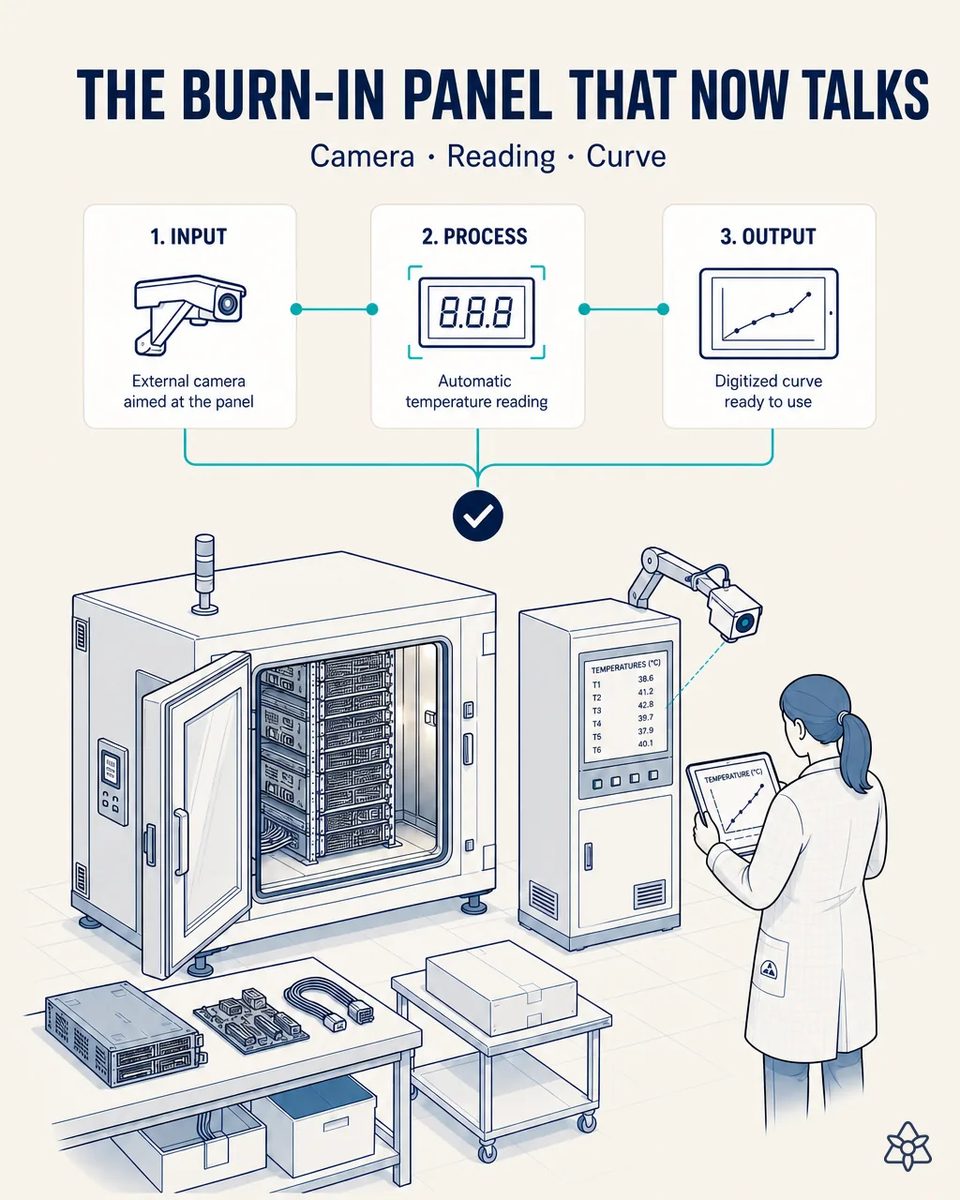
The burn-in chamber knows how hot the cycle ran and tells nobody.
When a unit fails in the field, the immediate question is whether its burn-in cycle was complete and at the specified temperature. Today the answer depends on a log sheet or the technician's memory. Replacing the equipment means high investment, downtime and process revalidation with the customer.
- The burn-in chamber where servers spend hours under load and temperature, and the hipot and ground-bond safety tester at end of line, often run on veteran equipment with a proprietary panel and no data output.
- Zone temperature, elapsed cycle time and pass or fail stay on the screen or in a handwritten log, if the technician has time to fill it in. On a busy night shift, that time is exactly what is missing.
- When a unit fails in the field, the first question is whether its burn-in ran complete and at the specified temperature. Today the answer depends on a log sheet or on memory.
- Replacing the chamber or the tester means a large investment, downtime and a process revalidation that the customer has to approve again. So the equipment stays, and so does the blind spot.
Connect in photo mode on the panel — the chamber and its validation stay untouched.
Connect photo mode on a panel. A fixed industrial camera reads the screen every few seconds; a grounded model interprets the values and builds the time curve of each cycle. iLEAN cross-references it with the execution system to know which serial numbers were in the chamber. Neither the control nor the validation of the equipment is touched.
The equipment the customer validated keeps doing exactly what it did. What changes is that its screen stops being the only witness: each cycle becomes a curve, and each curve knows which serial numbers were in the chamber. When a server comes back from the field, the first question already has an answer.
Burn-in logged by hand versus burn-in read from the panel
| Aspect | Today | With iLEAN Connect |
|---|---|---|
| Burn-in cycle record | A line in the log sheet | Full time-temperature curve per cycle |
| Which servers were in the chamber | Reconstructed from memory | Crossed with the execution system |
| Early-life field failure question | Days of doubt | Evidence in minutes |
| Cycle cut short or zone out of spec | Seen only if someone was watching | Visible on the curve |
| Safety tester results | Pass or fail on paper | Read and tied to each serial |
| Chamber replacement and revalidation | In next year's budget | Deferrable |
Manual log per cycle → full curve per cycle and per serial number. Doubts after a field failure → evidence in minutes. Test equipment replacement → deferrable.
Impact estimate — to be validated with your numbers.
The block below is an estimate to be validated against your plant's actual data. We put it forward so the committee has an order of magnitude; we refine it during the assessment.
- Payback estimated at 5-10 months.
- Investment in a new burn-in chamber or tester, and the customer revalidation that comes with it, avoided or deferred. The money goes where the chamber really falls short, not where it simply lacks a data port.
- Early-life failure analysis gets shorter, because the burn-in curve of the returned serial is already on file. Ruling burn-in in or out takes minutes instead of a week of emails between quality, test and the customer's failure analysis team.
- And an incomplete cycle stops being invisible: it shows up on the curve the same shift, not in a field return months later, when the only option left is a costly investigation with the customer.
Estimated payback of 5 to 10 months; investment in new equipment and its revalidation is avoided or deferred, and early-life failure analysis gets shorter. *Estimate to be validated*.
And the fair question from the production manager
“A camera reading digits off a screen — would the customer accept that as burn-in evidence?” — the panel is fixed, the values sit in known positions and must fall in physical temperature ranges, which makes it an anchored task where the best models stay below 1.5% error [1]. On top of that, any reading outside the possible range is discarded instead of stored, so the curve never carries an impossible point. A gap is shown as a gap, which is what an honest record looks like.
[1] OpenAI paper "Why Language Models Hallucinate", 2025 — on the reliability of AI in anchored tasks.
What people ask about reading burn-in and safety tester panels
Does the burn-in chamber have to be revalidated with the customer?
No. The camera is external: nothing is installed in the chamber controller and no port is opened, so its validation stays as it is. That is usually what gets the case approved by the customer's quality team.
How does it know which servers were inside during a cycle?
It crosses the cycle start and end with the execution system, which knows which serial numbers were loaded into that chamber or rack position. The curve is then stored against every one of them.
Can it read the hipot and ground-bond tester at end of line too?
Yes, with the same approach: a camera on the panel and the result tied to the serial that was connected at that moment. It is often the second piece of equipment added, once the chamber is running.
How often does it read the screen?
Every few seconds, enough to build the cycle curve and catch a zone drifting or a cycle stopped before its specified time. Reading more often adds nothing, because chamber temperature moves slowly.
What if the panel pages between several screens?
The reading recognizes which page is showing and assembles the values of each one into the same cycle record. The pages are mapped once at commissioning with your test technician.
More cases from this series
- When a complaint comes in, that unit's evidence in minutesImages, test records and validations for each server indexed by serial number: the dossier for a…
- Zero configuration complaints: verified from order to palletFour AI verification rings — material, kit, cabling and packout — so no server ships with the wrong…
- The engineering change reaches the line before the error doesiLEAN reads the customer's engineering change notice, cross-checks open orders and kits, and alerts…
- The quality walk that no longer depends on a notebookThe quality supervisor dictates findings while walking the lines; iLEAN logs them by line, order and…
- The label comes from the active order, not from the keyboardSerial, box and pallet labels print from the active order, with no keying or manual templates, and are…
- The quality spreadsheet reaches the ERP with nobody re-keying itiLEAN reads yield and audit spreadsheets on save and writes them to the ERP after human validation.…
Tell us which burn-in or test equipment in your plant gives you no data today.
We work on your plant's real data, not ours. Assessment with no commitment.
Request estimated ROI within 48h ‹ See all cases of server assembly See electronics