The label comes from the active order, not from the keyboard
Several labels are printed when a server is packed: the chassis serial number label, the box label with configuration and destination, and the pallet label. The printers and their label software are modern and networked, but in practice the operator selects the template, types or scans data and launches the print. With similar orders running side by side, one wrong template or one leftover label from the previous order on the bench is enough for a box to ship with the wrong identification, or with none. iLEAN stitches the printer to the execution system and the ERP: the label is generated from the active order and the serial number that has just passed test, with no keying in between.
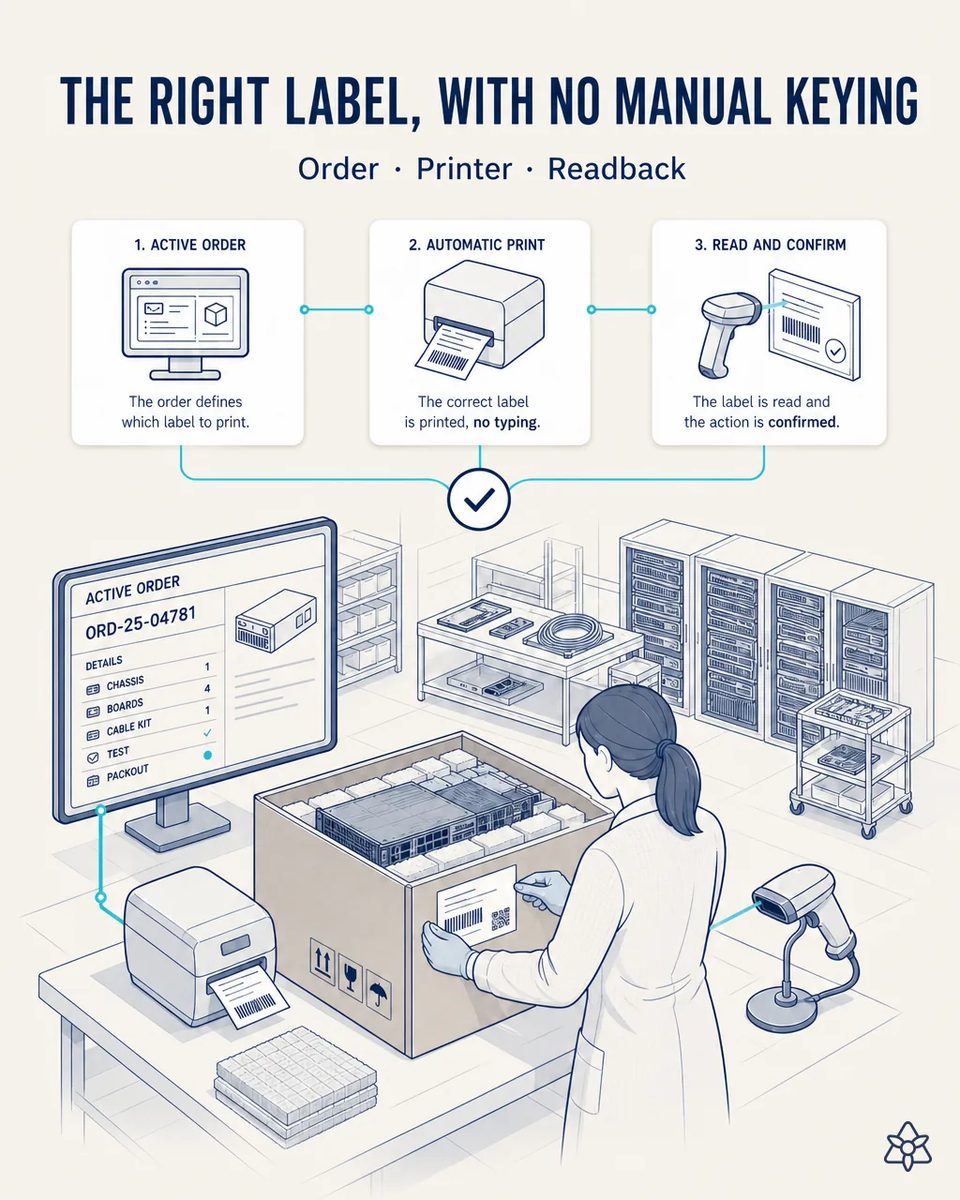
The last thing applied is the first thing the customer reads.
The label is the last thing applied before shipping and the first thing the customer reads in their warehouse. A label error becomes a formal complaint even if the server is perfect. Today, consistency between order, serial and label depends on the operator's attention at the most pressured moment of the shift.
- Packing a server means several labels: the chassis serial label, the box label with configuration and destination, and the pallet label. The printers and label software are modern and networked.
- Yet the operator still selects the template, types or scans data and launches the print, at the most pressured moment of the shift, often while the next unit is already waiting on the conveyor.
- With nearly identical orders running side by side, one wrong template or one leftover label from the previous order on the bench is enough for a box to ship misidentified, or with no label at all.
- A label error becomes a formal complaint even when the server inside is perfect, because the customer's receiving dock reads the label, not the hardware. In a business with a few very large customers, each of those complaints is remembered.
Connect stitches the printer to the execution system through their APIs — neither is replaced.
Connect stitches two modern systems via API. When the execution system releases a unit to packout, it publishes the label data of the active order to the printer; the operator only confirms. A scanner verifies the printed label against the order before the box is closed. Reprints are logged with reason and owner.
Nothing new has to be bought: the printer and the execution system already exist and both have interfaces. What changes is who carries the data between them. Today it is a person typing; with iLEAN it is the released order itself. The operator confirms instead of composing, and the scanner confirms the operator.
Labels typed at packout versus labels issued by the order
| Aspect | Today | With iLEAN Connect |
|---|---|---|
| Choosing the label template | Operator picks it | Set by the active order |
| Chassis serial on the label | Typed or scanned by hand | The serial that just passed test |
| Spare labels on the packout bench | Common between orders | One label per released unit |
| Check before the box is closed | The operator's eye | Scanner against the order |
| Reprinted labels | Not logged | Logged with reason and owner |
| Printer and label software | — | Kept as they are |
Manual template selection and typing → printing from the active order. Spare labels on the bench → one label per released unit. Unlogged reprints → traced reprints.
Impact estimate — to be validated with your numbers.
The block below is an estimate to be validated against your plant's actual data. We put it forward so the committee has an order of magnitude; we refine it during the assessment.
- Payback estimated at 3-6 months.
- It removes manually originated label errors, one of the most frequent causes of customer complaints at packout, and the corrective actions that follow each one.
- Spare labels disappear from the bench: each label exists only because a unit was released, and every reprint has a reason and an owner. A leftover label has nowhere to come from.
- And the operator's attention goes back to the box contents and the handling, instead of retyping data the system already had. The packout bench stops being the place where order data gets rewritten by hand.
Estimated payback of 3 to 6 months; it removes manually originated label errors, one of the most frequent causes of customer complaints at packout. *Estimate to be validated*.
And the fair question from the production manager
“If the scanner reads the label and compares it to the order, what is left for AI?” — very little, and that is deliberate: this case is mostly API stitching, not interpretation. Where reading is involved — checking a printed label against the order — it is an anchored task, where the best models stay below 1.5% error [1], and a mismatch stops the box from being closed until a person resolves it. The scanner check is the second net, and it costs the operator one beep.
[1] OpenAI paper "Why Language Models Hallucinate", 2025 — on the reliability of AI in anchored tasks.
What people ask about labeling servers from the active order
Do we have to replace our label printers or label software?
No. iLEAN uses the interfaces they already have; if a printer has no usable interface, we look at it with you before committing. Most networked label printers in a server plant already expose one, and so does the execution system.
What happens when a label has to be reprinted?
The operator asks for the reprint, gives a reason and the system logs it with who did it. Reprints stop being invisible, and a station that reprints far more than the others becomes something to investigate.
Does it cover customer-specific box label formats?
Yes. Each customer's format is set up once against the order data, so the template is chosen by the order, not by the operator. A new customer format is a setup task, not a training task for every shift. Destination-specific fields come from the order as well.
Can a label be printed for a unit that has not passed test?
No. The label is issued when the execution system releases the unit to packout, which only happens after it passes. A label for an untested unit simply has nowhere to come from, which closes one of the quieter routes to a complaint.
Does the pallet label come from the same flow?
Yes. When the pallet is closed, its label is built from the serials actually packed on it and checked like the box labels. A box from the wrong order on the pallet is caught before the stretch wrap goes on.
More cases from this series
- When a complaint comes in, that unit's evidence in minutesImages, test records and validations for each server indexed by serial number: the dossier for a…
- Zero configuration complaints: verified from order to palletFour AI verification rings — material, kit, cabling and packout — so no server ships with the wrong…
- The veteran test equipment that now hands over its dataAn external camera reads the burn-in chamber and safety tester panels and ties the curve to each serial…
- The engineering change reaches the line before the error doesiLEAN reads the customer's engineering change notice, cross-checks open orders and kits, and alerts…
- The quality walk that no longer depends on a notebookThe quality supervisor dictates findings while walking the lines; iLEAN logs them by line, order and…
- The quality spreadsheet reaches the ERP with nobody re-keying itiLEAN reads yield and audit spreadsheets on save and writes them to the ERP after human validation.…
Walk us through your packout labeling and we will find where manual keying still gets in.
We work on your plant's real data, not ours. Assessment with no commitment.
Request estimated ROI within 48h ‹ See all cases of server assembly See electronics