The quality spreadsheet reaches the ERP with nobody re-keying it
In any server plant, the quality indicators people actually use live in spreadsheets: first-pass yield by station, the defect Pareto, the out-of-box audit before shipment, incoming inspection. Engineers fill them in every shift in a shared folder, and then someone enters them again in the ERP quality module for the official customer report. Two parallel worlds, days apart. iLEAN Connect observes the folder, reads each file when it is saved, interprets it and, once the owner validates, writes it to the ERP via API. The engineer keeps using the spreadsheet; the re-keying disappears.
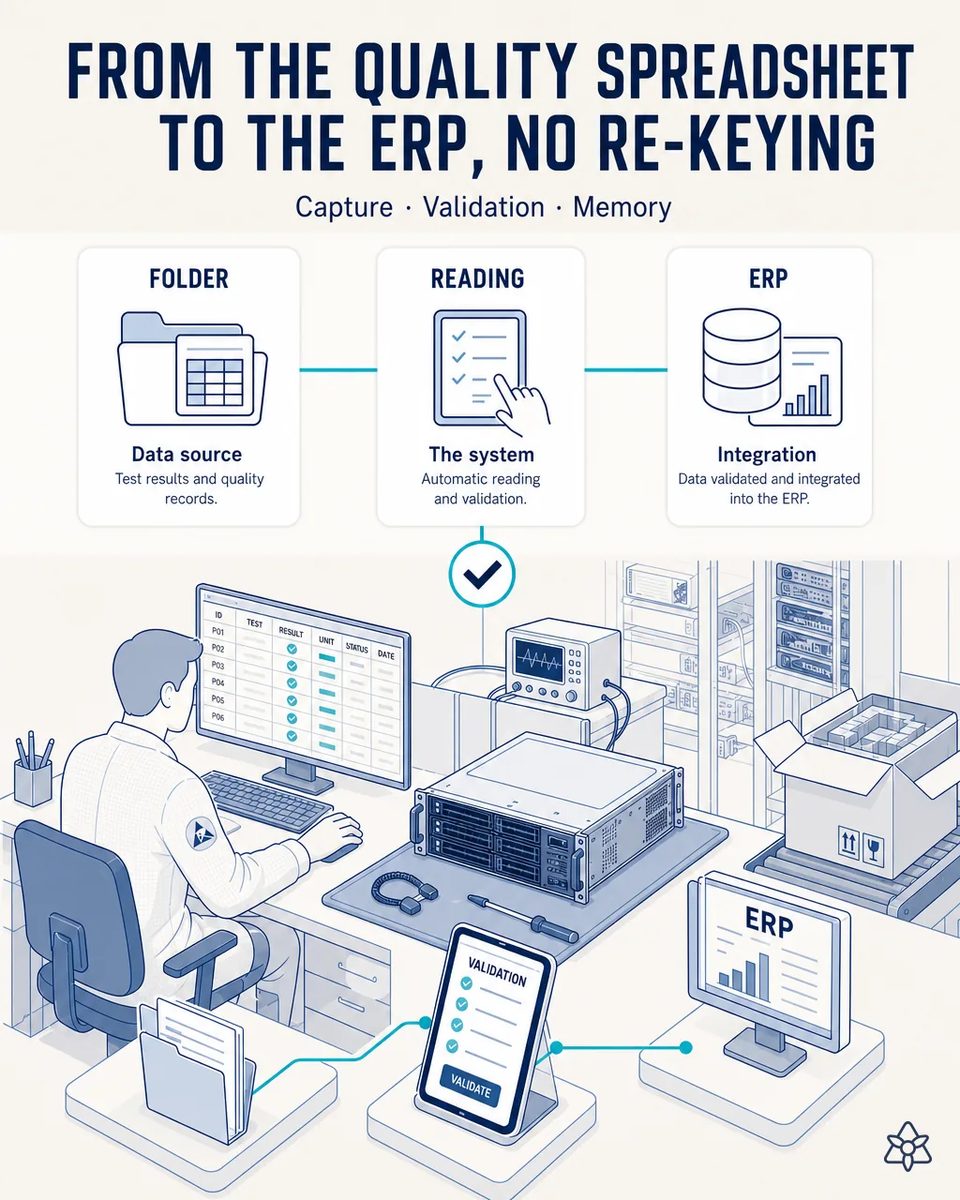
The live quality data and the official data are days apart.
The spreadsheet holds the live data and the ERP the official data, entered late by people who spend hours every week copying and pasting. The weekly customer report is assembled by hand. And every person who logs in to the ERP only to enter quality data consumes a license.
- The indicators people actually use live in spreadsheets: first-pass yield by station, the defect Pareto, the out-of-box audit before shipment, incoming inspection of consigned material.
- Engineers fill them in every shift in a shared folder, and then someone enters them again in the ERP quality module for the official record the customer sees. The two versions drift apart within days.
- Hours every week go into copy and paste, and the weekly customer report — yield, audit results, open corrective actions — is assembled by hand from both worlds.
- And every person who logs in to the ERP only to type quality data consumes a named license the plant pays for every year. Often five or more people hold a seat for nothing else.
Connect in inward listening mode — it reads the file on save, not the person.
Connect "inward listening": it observes the shared folder (the file, not the person), reads the change on save, interprets it with a grounded model, presents it for validation and writes it to the ERP via API. The central memory keeps the history for trend analysis by station, shift and configuration.
The engineers keep their spreadsheet, because that is where the work actually happens. What disappears is the second copy: the re-keying, the days of lag and the licenses bought only so someone can type into the quality module. The official record finally matches what the floor already knew.
The yield spreadsheet today versus the spreadsheet feeding the ERP
| Aspect | Today | With iLEAN Connect |
|---|---|---|
| Lag from yield sheet to ERP | Days | Minutes after save |
| Weekly re-keying hours | Several per engineer | Zero |
| Out-of-box audit results | In a tab nobody else opens | Validated and in the ERP |
| Weekly customer quality report | Assembled by hand | Generated from validated data |
| Yield trend by station and configuration | Rebuilt for each review | Kept in the central memory |
| ERP seats held only to key yield data | One per person who types | The validating owner's |
Days of lag between spreadsheet and ERP → minutes. Weekly hours of re-keying → zero. Customer report assembled by hand → generated from validated data.
Impact estimate — to be validated with your numbers.
The block below is an estimate to be validated against your plant's actual data. We put it forward so the committee has an order of magnitude; we refine it during the assessment.
- Payback estimated at 4-9 months.
- CFO angle — direct savings on ERP licenses: if five or more quality people log in today only to enter data, the validating owner's seat is enough. A typical 50-80% reduction in quality-module licenses, a recurring annual saving of several thousand to tens of thousands of dollars depending on the vendor's pricing.
- Weekly re-keying hours drop to zero and the lag between spreadsheet and ERP goes from days to minutes, so the official record shows this shift's yield, not last week's.
- And the customer report stops being assembled by hand: it comes out of data that a named owner has already validated. Friday afternoons stop going into copying yield figures into slides.
Estimated payback of 4 to 9 months. CFO angle — direct savings on ERP licenses: if five or more quality people log in to the ERP today only to enter data, with Connect the license of the validating owner is enough; a typical 50-80% reduction in quality-module licenses, a recurring annual saving of several thousand to tens of thousands of dollars depending on the vendor's pricing. *Estimate to be validated*.
And the fair question from the production manager
“Our yield sheets have been edited by a dozen engineers for years — merged cells, tabs added, notes in the margins. Will it cope?” — that is the expected case: the reading interprets columns, units and notes instead of depending on fixed cell positions. It is an anchored task, where the best models stay below 1.5% error [1], and the owner validates each change before anything is written to the ERP. If a value looks out of place against the history of that station, it is highlighted for a second look.
[1] OpenAI paper "Why Language Models Hallucinate", 2025 — on the reliability of AI in anchored tasks.
What people ask about moving server quality spreadsheets into the ERP
Do the engineers have to switch to a standard template?
No, and it is better not to ask. The spreadsheet that exists today is read in the format it has, and it can keep evolving without breaking the flow. When an engineer adds a column for a new test, the reading picks it up.
Does it watch what people do on their computers?
No. It observes the file in the shared folder and reacts when it is saved; nobody's screen or keyboard is monitored. It is the file that is read, not the person who edits it.
Which server quality data is usually connected first?
First-pass yield by station and the out-of-box audit, because they feed the customer report directly. Incoming inspection of consigned material and the defect Pareto by station follow, once the team has seen the first flow working.
How solid is the license saving?
It depends on your ERP contract, which is why we frame it as an estimate to check against the last invoice. The logic is simple: whoever logs in only to type stops needing a seat, while whoever validates keeps theirs.
Does it help when the customer asks for yield history on a program?
Yes. The central memory keeps the history by station, shift and configuration, including the out-of-box audit results, so the answer is a query rather than a weekend rebuilding charts before the quarterly business review.
More cases from this series
- When a complaint comes in, that unit's evidence in minutesImages, test records and validations for each server indexed by serial number: the dossier for a…
- Zero configuration complaints: verified from order to palletFour AI verification rings — material, kit, cabling and packout — so no server ships with the wrong…
- The veteran test equipment that now hands over its dataAn external camera reads the burn-in chamber and safety tester panels and ties the curve to each serial…
- The engineering change reaches the line before the error doesiLEAN reads the customer's engineering change notice, cross-checks open orders and kits, and alerts…
- The quality walk that no longer depends on a notebookThe quality supervisor dictates findings while walking the lines; iLEAN logs them by line, order and…
- The label comes from the active order, not from the keyboardSerial, box and pallet labels print from the active order, with no keying or manual templates, and are…
Bring your ERP license invoice and we will work out the quality-module saving together.
We work on your plant's real data, not ours. Assessment with no commitment.
Request estimated ROI within 48h ‹ See all cases of server assembly See electronics