The engineering change reaches the line before the error does
In server assembly the product changes constantly: the customer sends an engineering change notice that replaces a part number, modifies a cable routing or updates a firmware version, and does it by email with a PDF attached. That email reaches a program engineer who reads it between meetings, while on the floor there are open orders and kits already picked to the previous revision. With iLEAN Connect in silent copy, the notice is read the moment it arrives, cross-checked against open orders and inventory, and quality and production receive the concrete action: which orders to hold, which kits to reopen and which material to segregate.
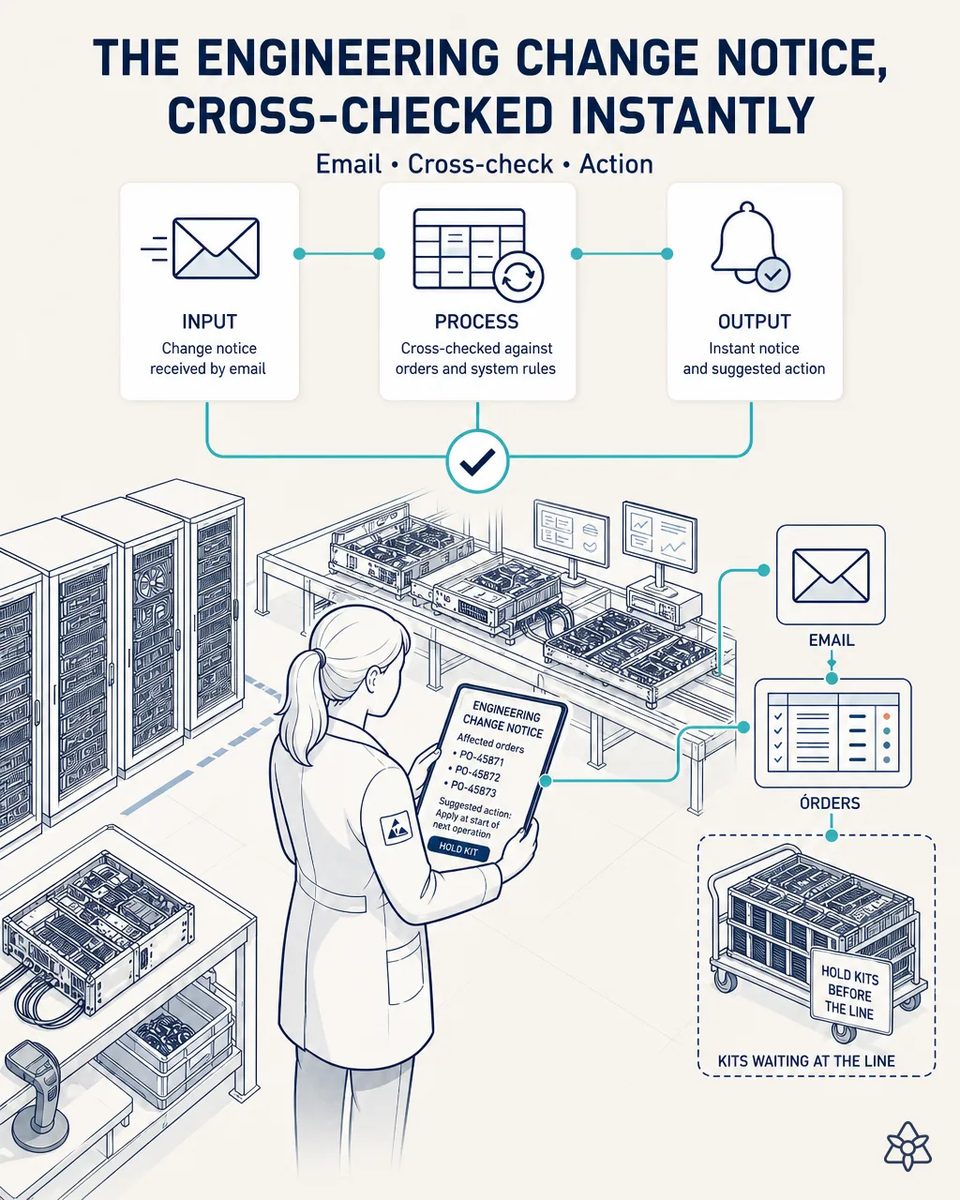
The change notice lands in an inbox while the line builds the old revision.
Between the notice arriving and the work instruction being updated, hours or a full shift go by. In that gap, units are built to the old revision and then have to be found and reworked, or they reach the customer and come back as a complaint. The same happens with a supplier quality alert about a component lot already received.
- The customer replaces a part number, reroutes a cable or moves the firmware or BIOS baseline, and announces it by email with a PDF attached to a program engineer who reads it between meetings.
- Meanwhile the floor has open orders in assembly and kits already picked to the previous revision.
- Between the notice arriving and the work instruction changing, hours or a whole shift go by. Every unit built in that gap has to be found and reworked, or reaches the customer and comes back as a complaint.
- A supplier quality alert on a component lot already received travels the same way, and gets the same delay. By the time someone checks, part of that lot may already be inside finished servers.
Connect in chaotic-sources mode — a mailbox in silent copy that reads every notice on arrival.
Connect chaotic-sources mode. A dedicated mailbox receives a copy of the notices; the grounded model extracts the intent (change, deviation, alert), the part numbers and the effectivity date, and cross-checks them with the ERP and the execution system. The alert to the owner includes the list of affected orders and locations. The decision to hold or continue always belongs to the person.
The notice is not hard to understand; it is hard to act on in time. What iLEAN shortens is the gap between the PDF arriving and someone holding the right orders, and it leaves the decision to hold or continue with a person. In a plant that receives changes every week, that gap is where most avoidable rework is born.
The change notice in an inbox versus the change notice cross-checked
| Aspect | Today | With iLEAN Connect |
|---|---|---|
| Notice to work instruction | Hours or a full shift | Minutes |
| Orders still on the old revision | Searched by hand | Listed automatically |
| Kits picked before the change | Found at the line, or not at all | Flagged with cart and location |
| Firmware or BIOS baseline change | Depends on who read the email | Matched to orders not yet imaged |
| Supplier lot alert | Same delay as any email | Crossed with received and kitted stock |
| Hold or release decision | Whoever happens to know | The owner, with the list in hand |
Hours or a shift of latency → minutes. Units built to the old revision → containment before the line. Manual search for affected orders → automatic list.
Impact estimate — to be validated with your numbers.
The block below is an estimate to be validated against your plant's actual data. We put it forward so the committee has an order of magnitude; we refine it during the assessment.
- Payback estimated at 3-7 months, depending on how often the customer issues changes.
- Less mass rework: units built to a superseded revision are contained before the line instead of being hunted down afterwards in test, in packout or at the customer's dock.
- Lower risk of shipping a server to an old revision, which in this business is a complaint, a corrective action and a mark on the supplier scorecard.
- And the list of affected orders, kits and locations arrives with the alert instead of being rebuilt by the program engineer from the ERP, the warehouse and the floor, usually under pressure.
Estimated payback of 3 to 7 months depending on change frequency; less mass rework and less risk of shipping a superseded revision. *Estimate to be validated*.
And the fair question from the production manager
“Change notices are dense PDFs — what if it reads the wrong part number or effectivity date?” — pulling part numbers, revision and effectivity from a document that states them explicitly is an anchored task, where the best models stay below 1.5% error [1]. And the second net is the person: the alert shows the extracted fields next to the original notice, and nothing is held or released without the owner deciding. The model shortens the search; it never makes the call.
[1] OpenAI paper "Why Language Models Hallucinate", 2025 — on the reliability of AI in anchored tasks.
What people ask about cross-checking customer change notices
Does it tell a real engineering change from a deviation or a simple question?
Yes. It classifies the intent of each message — change, temporary deviation, supplier alert — and only raises an action when there is something to contain. Routine correspondence stays in the inbox where it was.
How does it know which server orders are affected?
It crosses the part numbers and effectivity date with open orders in the ERP and the execution system, and with kits already picked in the warehouse. The alert says which carts and which locations, not only which order numbers, so the warehouse knows exactly what to reopen.
Does it update the work instruction by itself?
No. It tells the owner what has to change and where; updating the instruction and holding orders stays a human decision. What disappears is the hour spent finding out what is affected.
Do customers have to send notices in a new format?
No. A copy of the existing mailbox is enough; the notice is read as it comes, PDF attached or in the email body. Each customer keeps writing the way it always has.
Can it catch a firmware baseline change before units are imaged?
Yes, if the imaging step is in the execution system: orders not yet imaged appear in the list, so they get the new baseline instead of a reflash later. Units already imaged are listed separately for the engineer to decide whether a reflash is needed before packout.
More cases from this series
- When a complaint comes in, that unit's evidence in minutesImages, test records and validations for each server indexed by serial number: the dossier for a…
- Zero configuration complaints: verified from order to palletFour AI verification rings — material, kit, cabling and packout — so no server ships with the wrong…
- The veteran test equipment that now hands over its dataAn external camera reads the burn-in chamber and safety tester panels and ties the curve to each serial…
- The quality walk that no longer depends on a notebookThe quality supervisor dictates findings while walking the lines; iLEAN logs them by line, order and…
- The label comes from the active order, not from the keyboardSerial, box and pallet labels print from the active order, with no keying or manual templates, and are…
- The quality spreadsheet reaches the ERP with nobody re-keying itiLEAN reads yield and audit spreadsheets on save and writes them to the ERP after human validation.…
Send us a recent change notice and we will show you which orders it would have flagged.
We work on your plant's real data, not ours. Assessment with no commitment.
Request estimated ROI within 48h ‹ See all cases of server assembly See electronics