Zero configuration complaints: verified from order to pallet
The capital pain of a plant that assembles servers for third parties is not the functional defect, which test catches, but the customer complaint about something test cannot see: a component that was not the one for that configuration, a power cord for another region, a connector in the wrong port, a box with mixed contents or a missing label. Every complaint opens a formal corrective action, weighs on the supplier scorecard and, in a business with a few very large customers, puts the award of the next program at stake. iLEAN Agents coordinates the previous pieces into four verification rings that follow the unit from receiving to the pallet: if at any of them the physical reality does not match the order, the process stops there, inside the plant.
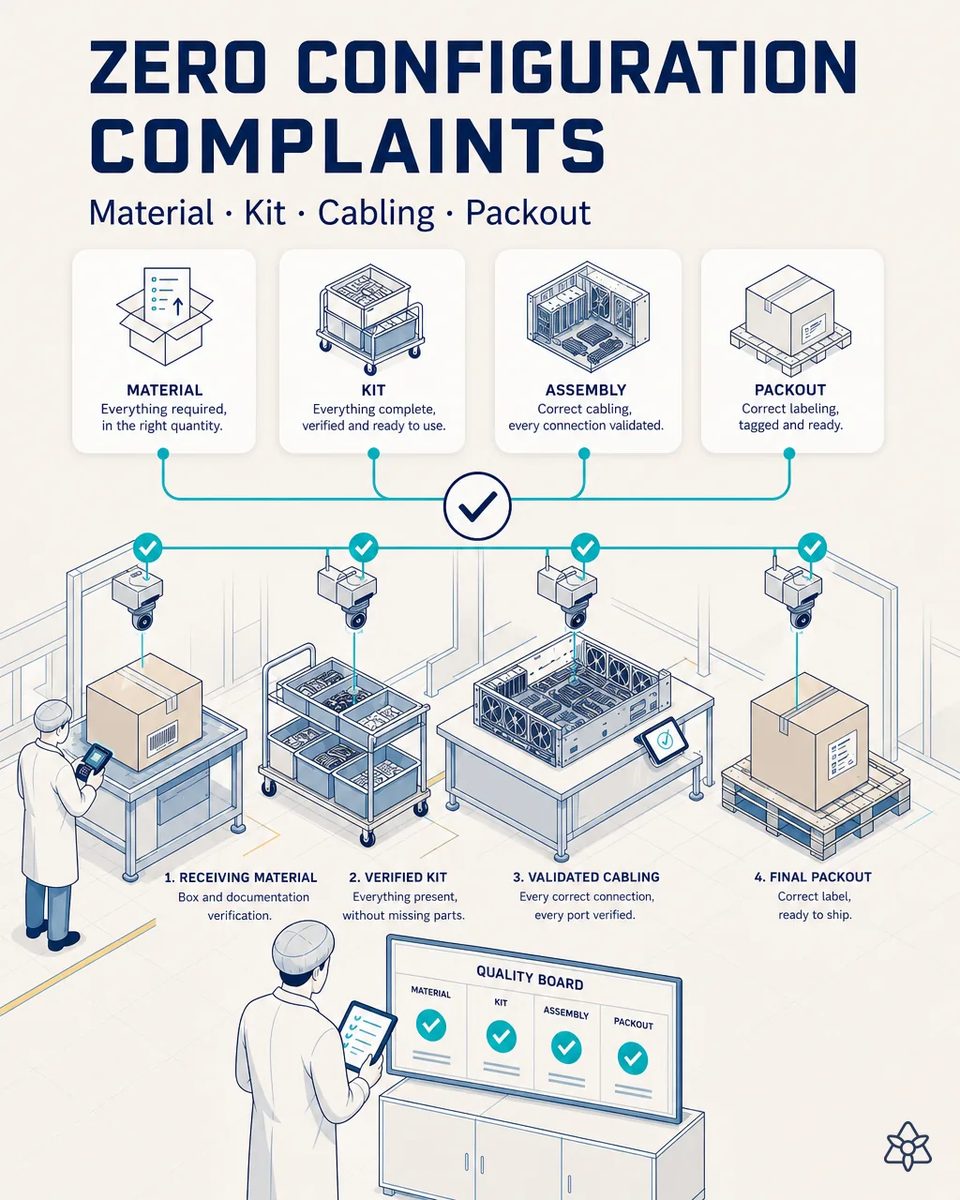
What hurts a server plant is the complaint about what test cannot see.
The causes are spread across the whole flow: material identity lost at receiving, kits mixed between similar orders, engineering changes arriving late, cabling errors, manually originated labels. Each area has its own control, but nobody cross-checks the order against physical reality at every point, and a large plant spread over several buildings makes it hard to hold the same standard everywhere.
- Functional test catches the electrical defect. The complaint comes from what test cannot see: a component that was not the one for that configuration, a power cord for another region, a connector in the wrong port, a box with mixed contents or a missing label.
- Every complaint opens a formal corrective action and weighs on the supplier scorecard. With a few very large customers, it puts the award of the next program at stake.
- The causes are spread across the whole flow: identity lost at receiving, kits mixed between similar orders, engineering changes arriving late, cabling errors, labels typed by hand.
- Each area has its own control, but nobody cross-checks the order against physical reality at every point, and a plant spread over several buildings struggles to hold one standard.
Four rings coordinated by Agents — the previous cases, working as one system.
Four rings coordinated by Agents, each already described in this series. Ring 1 — Material: the identity of each component is born at receiving, and engineering change notices are cross-checked with open orders. Ring 2 — Kit: Edge vision validates the kit against the order and line clearance before start. Ring 3 — Assembly: every cable in its port, verified at the station. Ring 4 — Packout: label generated from the order, box contents photographed before closing and a dossier by serial number. JIDOKA AI stops the flow on any mismatch; SMED AI keeps verification from lengthening changeovers; early human verification keeps people in command at every ring.
No single ring removes configuration complaints, because each cause slips through a different gap. What closes them is the same question asked at four points — does the physical reality match the order? — and the process stopping inside the plant the first time the answer is no.
The four rings, and the complaint each one prevents
| Ring | Cases it draws on | Complaint it prevents |
|---|---|---|
| Ring 1 · Material identity | Receiving (7) + change notice (3) | Wrong or superseded component in the server |
| Ring 2 · Kit and line clearance | Kit validation (10) | Power cord or DIMM from another order |
| Ring 3 · Assembly | Cable and port check (9) + rework sheet (1) | Connector in the wrong port |
| Ring 4 · Packout | Labeling (8) + evidence by serial (11) | Missing label or mixed box contents |
| Human gate on every ring | Tablet verification (5) | AI writing records nobody confirmed |
| Status across buildings | Quality walk by voice (4) + yield sheet (6) | One building drifting from the standard |
Isolated controls by area → four rings cross-checking order and physical reality. Mismatch found by the customer → found inside the plant. Days of investigation → immediate dossier. Monthly quality dashboard → live status by order and by building.
Impact estimate — to be validated with your numbers.
The block below is an estimate to be validated against your plant's actual data. We put it forward so the committee has an order of magnitude; we refine it during the assessment.
- Target: cut customer complaints about configuration, accessories and labeling by an order of magnitude, because every mismatch is found inside the plant instead of at the customer's dock.
- Payback estimated at 6-12 months against the cost of avoided complaints: corrective actions, expedited shipments and rework at the customer's site.
- Protection of the supplier scorecard, which is what conditions the award of the next program. To be validated with your quality director and general management.
- And the monthly quality dashboard becomes live status by order and by building, with a dossier ready for any unit. The standard stops depending on which building the server was built in.
The target is to cut customer complaints about configuration, accessories and labeling by an order of magnitude; estimated payback of 6 to 12 months against the cost of avoided complaints (corrective actions, expedited shipments, rework at the customer's site) and protection of the supplier scorecard. *Estimate to be validated* with the quality director and general management.
And the fair question from the production manager
“Do we need all twelve cases before this does anything?” — no. The rings are built in layers and each case pays on its own; receiving and kit validation alone already close the two most frequent sources of configuration complaints. Each check inside a ring is an anchored task — comparing physical reality against an order that is known — where the best models stay below 1.5% error [1], and JIDOKA AI stops on a verifiable mismatch, never on model doubt. Early human verification keeps a person in command at every ring.
[1] OpenAI paper "Why Language Models Hallucinate", 2025 — on the reliability of AI in anchored tasks.
What people ask about the four-ring system against configuration complaints
Which ring do server plants usually build first?
Ring 1 or Ring 2: receiving and kit validation have few dependencies and attack the most frequent complaints, wrong component and wrong accessory. The other rings are added on top as each one proves itself, without stopping the line to deploy them or changing how operators work at each station.
What does coordinating the rings add over four separate controls?
Each control sees its own step. Coordinated, the order is checked against physical reality at every point, and a mismatch found at the kit can be traced back to receiving. That cross-check is what isolated controls cannot give.
Will the checks lengthen changeovers on a high-mix line?
They are designed not to: verification replaces manual counts and checklists (SMED AI), so a changeover with the rings is usually shorter than one without.
What happens when a ring reports a mismatch that turns out to be wrong?
JIDOKA AI stops only on a verifiable discrepancy between order and reality. When the doubt belongs to the model, the case goes to a person, and the decision is stored so the same doubt does not return.
Can each ring's return be sized against our complaint history first?
Yes. With your complaint history, the cost of the last corrective actions and the number of changeovers per week, each ring's return is sized during an AI Discovery, before deciding the order in which to build them.
More cases from this series
- When a complaint comes in, that unit's evidence in minutesImages, test records and validations for each server indexed by serial number: the dossier for a…
- The veteran test equipment that now hands over its dataAn external camera reads the burn-in chamber and safety tester panels and ties the curve to each serial…
- The engineering change reaches the line before the error doesiLEAN reads the customer's engineering change notice, cross-checks open orders and kits, and alerts…
- The quality walk that no longer depends on a notebookThe quality supervisor dictates findings while walking the lines; iLEAN logs them by line, order and…
- The label comes from the active order, not from the keyboardSerial, box and pallet labels print from the active order, with no keying or manual templates, and are…
- The quality spreadsheet reaches the ERP with nobody re-keying itiLEAN reads yield and audit spreadsheets on save and writes them to the ERP after human validation.…
Schedule an AI Discovery at your plant to size the four rings on your real flow.
We work on your plant's real data, not ours. Assessment with no commitment.
Request estimated ROI within 48h ‹ See all cases of server assembly See electronics