The reversed cable is caught at the station, not at test
A data center server has dozens of internal connections: power, data, signal, fans, accelerator cards. The most common assembly defects are not component defects but workmanship ones: a reversed cable, a connector in the neighboring port, a plug that did not fully seat. With configurations changing from one order to the next, human visual inspection saturates, and the error is found at functional test, after hours of cycle time, or at the customer's installation. iLEAN Edge places cameras over the cabling station and compares what was built with the pattern for the active configuration: if a cable is not where it should be, it alerts the operator right then, when fixing it costs seconds.
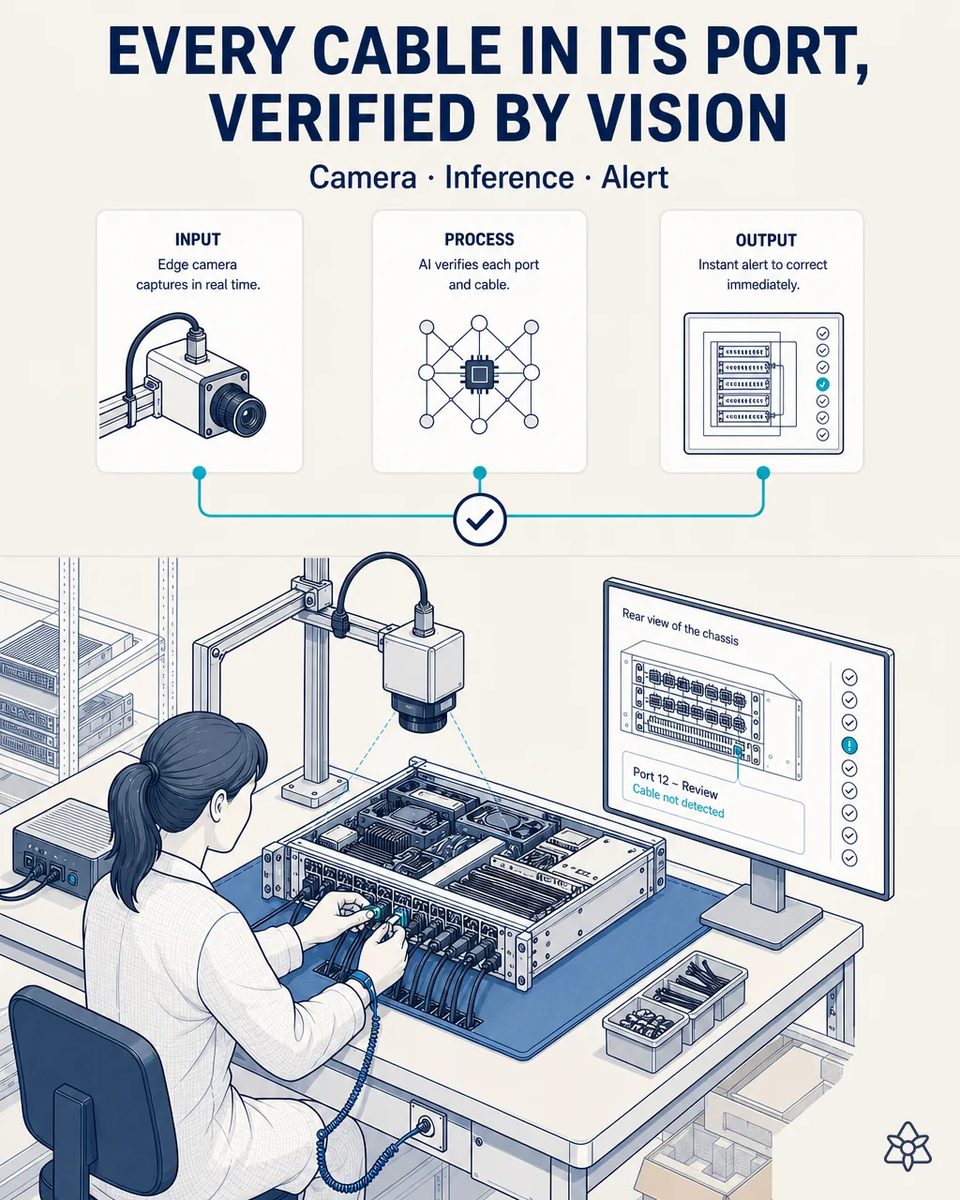
The defect that costs a full test cycle is a cable in the neighboring port.
One-hundred-percent inspection by a second person does not scale with configuration variety or staff turnover. The defect that escapes costs a full test cycle, a debug and a rework; the one that reaches the customer costs a complaint and a formal corrective action.
- A data center server has dozens of internal connections: power, data, signal, fans, riser and accelerator cards. The most common assembly defects are workmanship, not components: a reversed cable, a connector in the next port, a plug that did not fully seat.
- With configurations changing from one order to the next, human visual inspection saturates. What an experienced assembler catches by habit, a new one misses in their second week.
- The error surfaces at functional test, after hours of cycle time, or worse, at the customer's installation. The one that escapes costs a test cycle, a debug and a rework; the one that reaches the customer costs a complaint and a formal corrective action.
- Putting a second person on one-hundred-percent inspection does not scale with configuration variety or with turnover. The second inspector gets tired too, and is just as new as the assembler after a hiring wave.
Edge — a camera over the cabling station, local inference, the active configuration as reference.
Edge: vision with a convolutional neural network running locally, with no images leaving the plant. The model is trained with correct and incorrect examples of each product family and receives the active configuration from the execution system. If it detects a mismatch, it highlights the connector on screen and, if the plant so decides, does not let the unit move on until it is corrected (JIDOKA AI). Faces are blurred at source.
The cheapest moment to fix a cable is while the operator's hands are still inside the chassis. Edge moves detection from functional test, hours later, to the station, seconds later, and leaves an image of every assembly stored against its serial. When a connection complaint arrives months later, that image is the first piece of evidence.
Cabling checked at test versus cabling checked at the station
| Aspect | Today | With iLEAN Edge |
|---|---|---|
| Where a reversed cable is found | At functional test or later | At the cabling station, in seconds |
| Plug not fully seated | Intermittent fault in burn-in | Flagged before the lid closes |
| Reference for a new configuration | The assembler's experience | Pattern from the execution system |
| Image of the internal cabling | None | Stored by serial number |
| Unit moving on with a mismatch | Allowed until test | Held if the plant decides (JIDOKA AI) |
| Assembly images leaving the plant | — | Never, inference is local |
Error found at functional test or hours later → found at the station in seconds. Inspection dependent on experience → objective pattern per configuration. No image of the assembly → image stored by serial number.
Impact estimate — to be validated with your numbers.
The block below is an estimate to be validated against your plant's actual data. We put it forward so the committee has an order of magnitude; we refine it during the assessment.
- Payback estimated at 5-12 months, depending on your current first-pass yield.
- At least a 30% reduction in functional test failures attributable to cabling, which frees test and debug capacity for real defects. Fewer units loop between test and the debug station.
- Fewer customer complaints about connections, and fewer corrective actions opened for a cable that could have been fixed in seconds.
- And every server ships with an image of its internal cabling on file, which the complaint dossier uses later when a customer reports a connection problem.
Estimated payback of 5 to 12 months depending on current first-pass yield; at least a 30% reduction in test failures attributable to cabling and fewer customer complaints about connections. *Estimate to be validated*.
And the fair question from the production manager
“A camera flagging cables that are actually fine would stop the line for nothing.” — false positives are the real risk of any vision system, which is why the model is trained on correct and incorrect examples of your product families under that station's lighting. Comparing what is built against a known configuration is an anchored task, where the best models stay below 1.5% error [1], and a doubtful case is shown to the operator with the connector highlighted, not silently rejected. Every decision the operator makes on a doubtful case goes back into training.
[1] OpenAI paper "Why Language Models Hallucinate", 2025 — on the reliability of AI in anchored tasks.
What people ask about vision at the server cabling station
How does the camera know which cabling is right for this server?
The execution system sends the active configuration, and the model compares the assembly with the pattern for that configuration and product family.
Does it slow the cabling station down?
No. Inference runs locally next to the station and answers in well under a second; the operator only notices it when something is wrong. It does not depend on the plant network or on the cloud, so a network incident does not stop the cabling station.
How many example units are needed per product family?
Fewer than usually feared, because cabling errors repeat. What matters is that they are real units from your families, correct and incorrect, photographed at the station where the model will work. New families are added as they enter production.
Do images of our customers' servers leave the plant?
No. Inference and storage are local, and faces are blurred at source, so the images never leave your network. That point usually matters as much to your customer as to you, especially on programs under strict confidentiality.
Does it replace functional test or burn-in?
No. Test still catches the electrical defect; this catches the workmanship defect earlier, so test stops spending cycles on a cable in the wrong port. Burn-in and test capacity go to the defects only they can find.
More cases from this series
- When a complaint comes in, that unit's evidence in minutesImages, test records and validations for each server indexed by serial number: the dossier for a…
- Zero configuration complaints: verified from order to palletFour AI verification rings — material, kit, cabling and packout — so no server ships with the wrong…
- The veteran test equipment that now hands over its dataAn external camera reads the burn-in chamber and safety tester panels and ties the curve to each serial…
- The engineering change reaches the line before the error doesiLEAN reads the customer's engineering change notice, cross-checks open orders and kits, and alerts…
- The quality walk that no longer depends on a notebookThe quality supervisor dictates findings while walking the lines; iLEAN logs them by line, order and…
- The label comes from the active order, not from the keyboardSerial, box and pallet labels print from the active order, with no keying or manual templates, and are…
Let us record one of your cabling stations and show you a prototype on your own servers.
We work on your plant's real data, not ours. Assessment with no commitment.
Request estimated ROI within 48h ‹ See all cases of server assembly See electronics