Every server's rework sheet, in the system in seconds
In a plant that assembles data center servers, every unit that fails functional test ends up at a debug station with a handwritten reject tag and rework sheet: symptom, part replaced, who repaired it and the outcome. That paper is the real memory of why the product fails, yet it travels taped to the chassis and lands in a binder someone keys in days later, once the same pattern has already hit twenty more units. With iLEAN Connect the technician takes a photo when closing the repair and the defect is tied to the serial number in the central system right then, with no change to the routine.
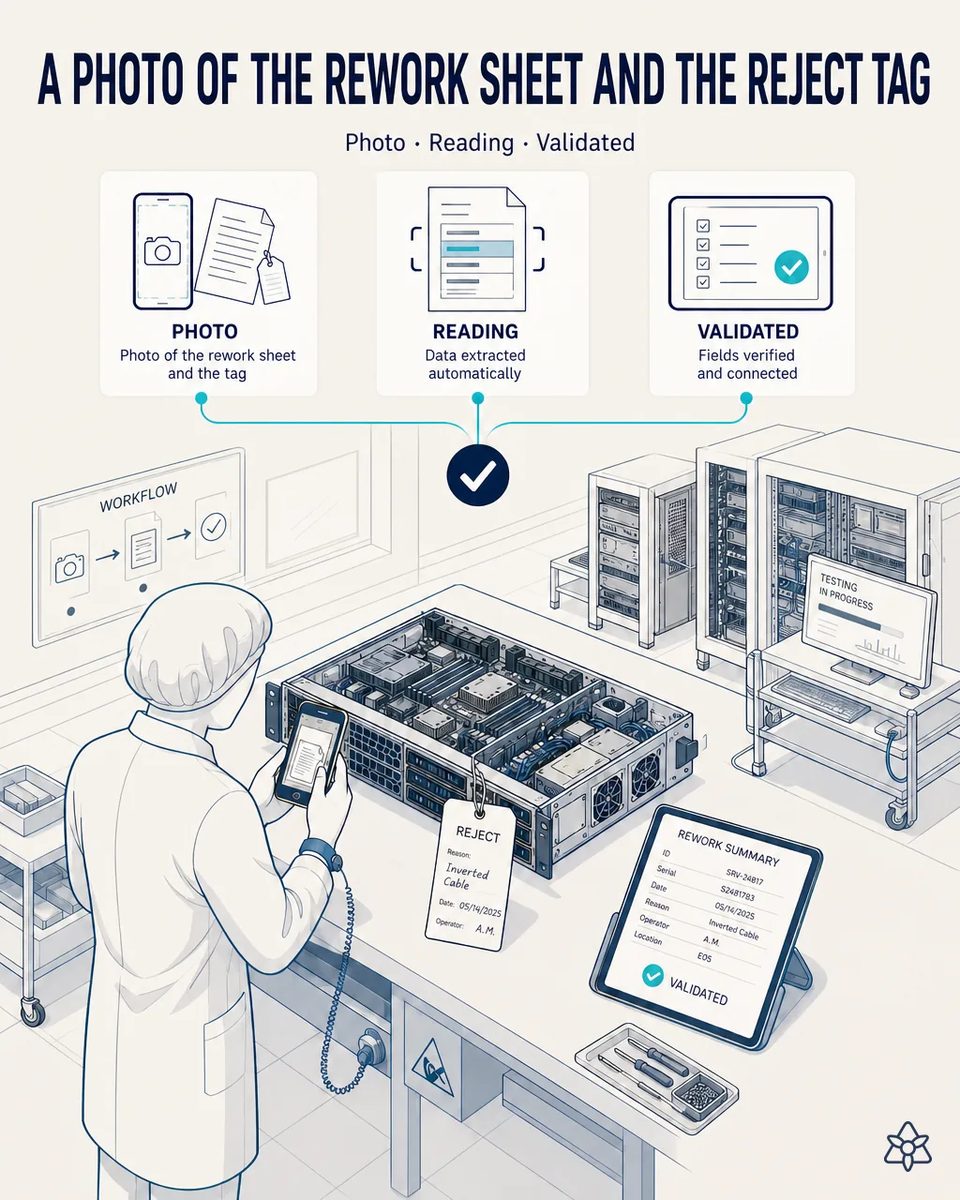
The reason a server failed test travels taped to the chassis.
The shop-floor system records that the unit failed and later passed, but the reason lives on the handwritten sheet. With dozens of reworks per shift and configurations that change with every order, root-cause analysis arrives late: the quality engineer gets the Pareto once the lot has shipped. When the customer asks for the history of a specific unit, someone has to dig the sheet out of a filing cabinet.
- The shop-floor system knows the unit failed functional test and later passed. Why it failed — symptom, defect code, the DIMM or riser swapped, who repaired it — lives only on the handwritten rework sheet.
- That sheet rides on the chassis through debug and ends up in a binder that someone keys in one to several days later, when the same failure mode may already have hit twenty more units of the same configuration.
- With dozens of reworks per shift and a bill of materials that changes from order to order, the quality engineer gets the defect Pareto once the lot has already shipped.
- When the customer asks for the repair history of one serial number, somebody opens a filing cabinet and starts turning pages. If the sheet was lost on the way, the honest answer is that nobody knows.
Connect in photo mode — the debug technician closes the repair with one picture.
Connect photo mode. A grounded language model reads the sheet as it is, with no form redesign, extracts serial number, station, symptom, defect code, replaced component and signature, and proposes them to the technician to confirm with two taps. The validated data feeds the iLEAN central memory and, via API, the plant's execution or quality system. IRIS is the category; iLEAN is the system that implements it here.
The rework sheet is the most honest record in a server plant: it says what really broke and what was swapped. Today it is also the least queryable. One photo at the close of the repair turns it into a live Pareto by station, component supplier and configuration, while the order that produced the failures is still being built.
The rework binder versus the rework sheet being read
| Aspect | Today | With iLEAN Connect |
|---|---|---|
| Repair reason in the system | One to several days late | Seconds after the debug closes |
| Swapped DIMM, drive or riser | Handwritten, rarely keyed | Tied to the unit serial and the supplier lot |
| Debug-station defect Pareto | Weekly, after shipment | Live by station, supplier and configuration |
| Repeat failure across a configuration | Spotted after twenty units | Flagged on the second or third |
| Customer asks for one unit's repairs | Search the filing cabinet | Query by serial number |
| Rework sheet layout | — | Unchanged, read as it is |
Data entry one to several days late → recorded in seconds. Weekly defect Pareto → live Pareto by station, component supplier and configuration. Hunting through binders for a unit's history → query by serial number.
Impact estimate — to be validated with your numbers.
The block below is an estimate to be validated against your plant's actual data. We put it forward so the committee has an order of magnitude; we refine it during the assessment.
- Payback estimated at 4-9 months, depending on the number of reworks per shift.
- Transcription hours handed back to the debug and quality teams, who today key the binder at the end of the week. Debug engineers spend that time on root cause instead of data entry.
- Faster reaction to a repeating defect: a failing riser or a lot of marginal DIMMs shows up while the order is still on the floor, not after it ships.
- And the repair history of any serial number stops being archaeology and becomes a query the customer can get the same day, with the photo of the original sheet attached as proof.
Estimated payback of 4 to 9 months depending on reworks per shift; transcription hours recovered and faster reaction to a repeating defect. *Estimate to be validated*.
And the fair question from the production manager
“Debug technicians write in a hurry — will it read a defect code scrawled next to a part number?” — reading known fields on a sheet with a fixed structure is an anchored task, where the best models stay below 1.5% error [1]. And it never writes alone: the technician sees serial, symptom, code and replaced component on the screen and confirms or corrects with two taps before anything reaches the quality system.
[1] OpenAI paper "Why Language Models Hallucinate", 2025 — on the reliability of AI in anchored tasks.
What people ask about capturing server rework sheets
Do we have to redesign the reject tag or the rework sheet?
No. The reading adapts to the sheet your debug stations already use, including the free-text margin where technicians describe what they actually found. Asking debug to fill in a new form is the quickest way to stop them filling in anything at all.
Can it link the swapped component to its own serial or lot?
Yes, when the technician writes or photographs it. That is what lets you see whether a drive, power supply or memory lot keeps reappearing in the rework Pareto, and take it to the supplier with the serials in hand.
What happens with a unit that loops through debug several times?
Each pass is recorded against the same serial number, so the history shows how many cycles the unit took and what was tried at each one before it passed. Units that need three passes are usually where the real root cause is hiding.
Does the debug station need a new terminal?
No. A phone or the tablet the station already has is enough to take the photo and confirm the fields. The photo is taken at the bench, in the same moment the technician closes the repair.
Can the validated data go into our shop-floor or quality system?
Yes, through its API once the case has shown value. Until then it lives in iLEAN's central memory and is already queryable by serial, so the Pareto works from the first week without waiting for an integration project.
More cases from this series
- When a complaint comes in, that unit's evidence in minutesImages, test records and validations for each server indexed by serial number: the dossier for a…
- Zero configuration complaints: verified from order to palletFour AI verification rings — material, kit, cabling and packout — so no server ships with the wrong…
- The veteran test equipment that now hands over its dataAn external camera reads the burn-in chamber and safety tester panels and ties the curve to each serial…
- The engineering change reaches the line before the error doesiLEAN reads the customer's engineering change notice, cross-checks open orders and kits, and alerts…
- The quality walk that no longer depends on a notebookThe quality supervisor dictates findings while walking the lines; iLEAN logs them by line, order and…
- The label comes from the active order, not from the keyboardSerial, box and pallet labels print from the active order, with no keying or manual templates, and are…
Tell us how many days pass between a server repair and its reason reaching your system.
We work on your plant's real data, not ours. Assessment with no commitment.
Request estimated ROI within 48h ‹ See all cases of server assembly See electronics