Every component identified from receiving, even after it loses its box
Much of a server's material arrives consigned by the customer: processors, memory, drives, power supplies, cables. At receiving, each part has two identities, the customer part number and the manufacturer part number, and both do not always appear on the label. When the outer box is the only thing carrying the customer number and cardboard is not allowed in the production area, the identity is lost the moment the part is unpacked. With iLEAN Connect the receiver photographs the packing list and the labels; the system reads manufacturer part number, lot and date code, cross-references them with the customer reference and the purchase order, and after one validation tap posts the receipt in the ERP and prints the internal identification that will travel with the part once the cardboard is gone.
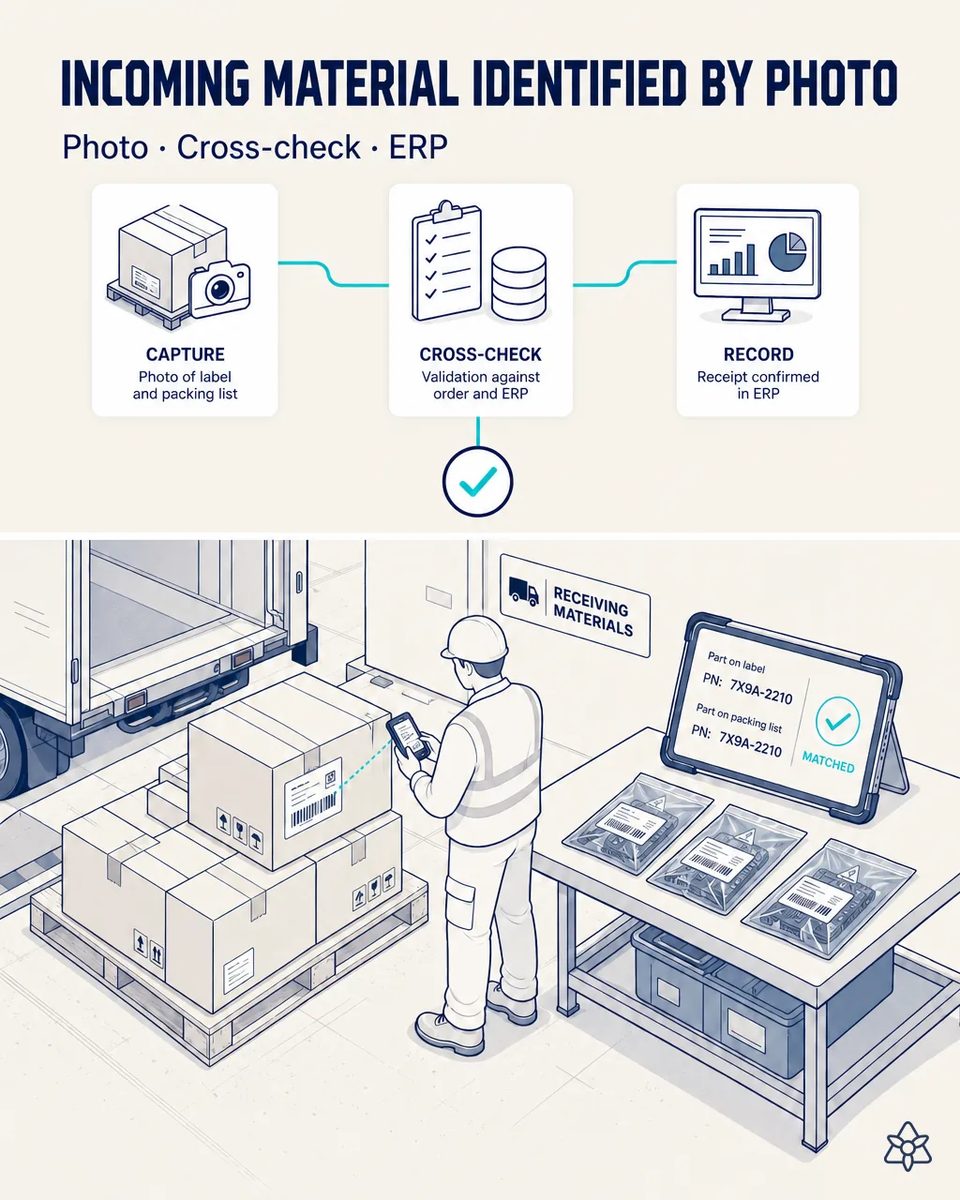
A consigned part's identity is lost the moment it leaves its box.
The receiver keys in line after line in the ERP while the carrier waits, and decides by eye which internal number matches each part. A wrong match is invisible at receiving: it shows up weeks later as an incorrect component in a kit or as a customer complaint. When the supplier's label format changes, the risk multiplies.
- Much of a server's material arrives consigned by the customer: processors, memory, drives, power supplies, cables. Each part has two identities, the customer part number and the manufacturer part number, and the label does not always carry both.
- Often only the outer box carries the customer number, and cardboard is not allowed in the production area, so the identity disappears when the part is unpacked.
- The receiver keys line after line into the ERP while the carrier waits, and decides by eye which internal number matches each part. That judgment lives in one or two experienced people.
- A wrong match is invisible at receiving. It shows up weeks later as the wrong component in a kit or as a customer complaint, and it gets worse every time a supplier changes its label format without telling anyone.
Connect in photo mode — packing list and labels read as they come, in any format.
Connect photo mode. Vision with a grounded model reads the packing list as it comes and labels in any format (barcode, 2D matrix or plain text). iLEAN maintains the cross-reference table between manufacturer and customer part numbers and flags whatever does not match the purchase order. The receiver validates on the tablet; the receipt is written to the ERP via API and the internal label is generated for the unpacked material.
Everything downstream — the kit, the build, the genealogy, the complaint investigation — depends on one decision made at the dock under time pressure. Reading the labels and cross-referencing both part numbers there is the cheapest place in the plant to prevent a wrong component. Every later check inherits whatever identity was created at the dock.
Consigned receiving by hand versus receiving from a photo
| Aspect | Today | With iLEAN Connect |
|---|---|---|
| Booking in a consigned shipment | 15-30 minutes of typing | A few minutes |
| Customer versus manufacturer part number | Matched by eye | Cross-referenced, mismatch flagged |
| Lot and date code of each component | Often skipped | Read from the label |
| Identity after unpacking | Lost with the cardboard | Internal label printed at receiving |
| Supplier changes its label layout | Risk multiplies | Read as it comes |
| ERP receiving-module seats | One per person keying | One per shift |
Manual entry of 15-30 minutes per shipment → a few minutes. Identity lost when cardboard is removed → internal label from receiving. Part number matching left to individual judgment → automatic cross-reference with validation.
Impact estimate — to be validated with your numbers.
The block below is an estimate to be validated against your plant's actual data. We put it forward so the committee has an order of magnitude; we refine it during the assessment.
- Payback estimated at 3-8 months.
- CFO angle — direct savings on ERP licenses: the receiver validates on the tablet without logging in to the ERP, which allows going from several receiving and warehouse seats to one per shift — a typical 50-70% reduction and a recurring annual saving of several thousand dollars depending on the vendor's pricing.
- Booking a shipment drops from 15-30 minutes to a few, and the carrier waiting charges go away with it. The dock clears trucks faster at exactly the hours when several arrive together.
- And a wrong part number match is caught at the dock, not weeks later in a kit or in a customer complaint, when tracing which servers received the part means opening finished units.
Estimated payback of 3 to 8 months. CFO angle — direct savings on ERP licenses: the receiving and warehouse module today needs one license per person entering data; with Connect the receiver validates without logging in to the ERP, which allows going from several licenses to one per shift, a typical 50-70% reduction and a recurring annual saving of several thousand dollars depending on the vendor's pricing. Carrier waiting charges also go away. *Estimate to be validated*.
And the fair question from the production manager
“Supplier labels are a mess — barcodes, 2D codes, plain text, sometimes all three. What if it pairs the wrong customer number?” — reading printed codes and fields from a label is an anchored task, where the best models stay below 1.5% error [1]. And the pairing is checked against the cross-reference table and the purchase order: anything that does not match is flagged for the receiver instead of being posted. The receiver still decides; the system just makes sure the doubt is visible.
[1] OpenAI paper "Why Language Models Hallucinate", 2025 — on the reliability of AI in anchored tasks.
What people ask about receiving consigned server components by photo
Who maintains the table between customer and manufacturer part numbers?
iLEAN keeps it and grows it with every validated receipt. When a new pairing appears, the receiver confirms it once and it is reused from then on. The table becomes a plant asset instead of the memory of one experienced receiver.
Do we need handheld scanners to book in consigned components?
No. A phone or a tablet reads barcodes, 2D matrix codes and plain text from the same photo, together with the packing list, so the receiver does not juggle two devices with a box in hand.
What is printed on the internal label?
The identity the part needs after the cardboard is gone: customer and manufacturer part numbers, lot, date code and the receipt reference, in the format your kitting uses. That label is what lets the kit validation recognize the part later, after the box with the customer number has gone to recycling.
What happens if the packing list and the purchase order disagree?
The line is flagged on the tablet with the difference visible. The receiver decides whether to post, hold or call the buyer, and the decision is recorded with the receipt.
Can receiving be the first server case we deploy?
Often it is, because it is the start of the genealogy and it pays on its own. The kit validation and complaint dossier cases later build on the identity created here, so it pays twice.
More cases from this series
- When a complaint comes in, that unit's evidence in minutesImages, test records and validations for each server indexed by serial number: the dossier for a…
- Zero configuration complaints: verified from order to palletFour AI verification rings — material, kit, cabling and packout — so no server ships with the wrong…
- The veteran test equipment that now hands over its dataAn external camera reads the burn-in chamber and safety tester panels and ties the curve to each serial…
- The engineering change reaches the line before the error doesiLEAN reads the customer's engineering change notice, cross-checks open orders and kits, and alerts…
- The quality walk that no longer depends on a notebookThe quality supervisor dictates findings while walking the lines; iLEAN logs them by line, order and…
- The label comes from the active order, not from the keyboardSerial, box and pallet labels print from the active order, with no keying or manual templates, and are…
Bring three difficult supplier labels and we will read them live.
We work on your plant's real data, not ours. Assessment with no commitment.
Request estimated ROI within 48h ‹ See all cases of server assembly See electronics