Mold changeover validated with evidence
In connector housing molding, a badly released mold change compromises the first boxes of the new lot. iLEAN Edge compares first parts and mold against their reference, JIDOKA AI holds release until conformity and quality sign-off, and SMED AI measures every change to shorten it.
A changeover that starts badly fills boxes before anyone notices.
In housing molding, every multi-cavity mold or insert change is a critical moment: blocked cavities, incomplete resin purge, the wrong insert. If it starts badly, the first boxes of the new part number are already compromised. Today release depends on a first-piece sign-off and the molding technician's experience. Between waiting for the lab and starting in a rush, either time or quality is lost.
- In housing molding every multi-cavity mold or insert change is critical: a blocked cavity, incomplete resin purge, the wrong core pin or insert for the part number. With high mix, that happens several times a shift.
- If it starts badly, the first boxes of the new lot are already compromised, and with fine-pitch housings the defect may only show up at terminal insertion, when the terminal will not seat.
- Today release rests on a first-piece sign-off and the molding technician's experience, with no objective evidence behind the signature. A signature is not a measurement, and when something goes wrong the investigation finds a ticked box and no proof. It is not bad faith; it is the lack of evidence.
- Between waiting for the lab and starting in a rush, either press time or quality is lost, and nobody measures which step of the change took longest, so the next change repeats the same delays.
Edge with JIDOKA AI and SMED AI — release on evidence, changes that get shorter.
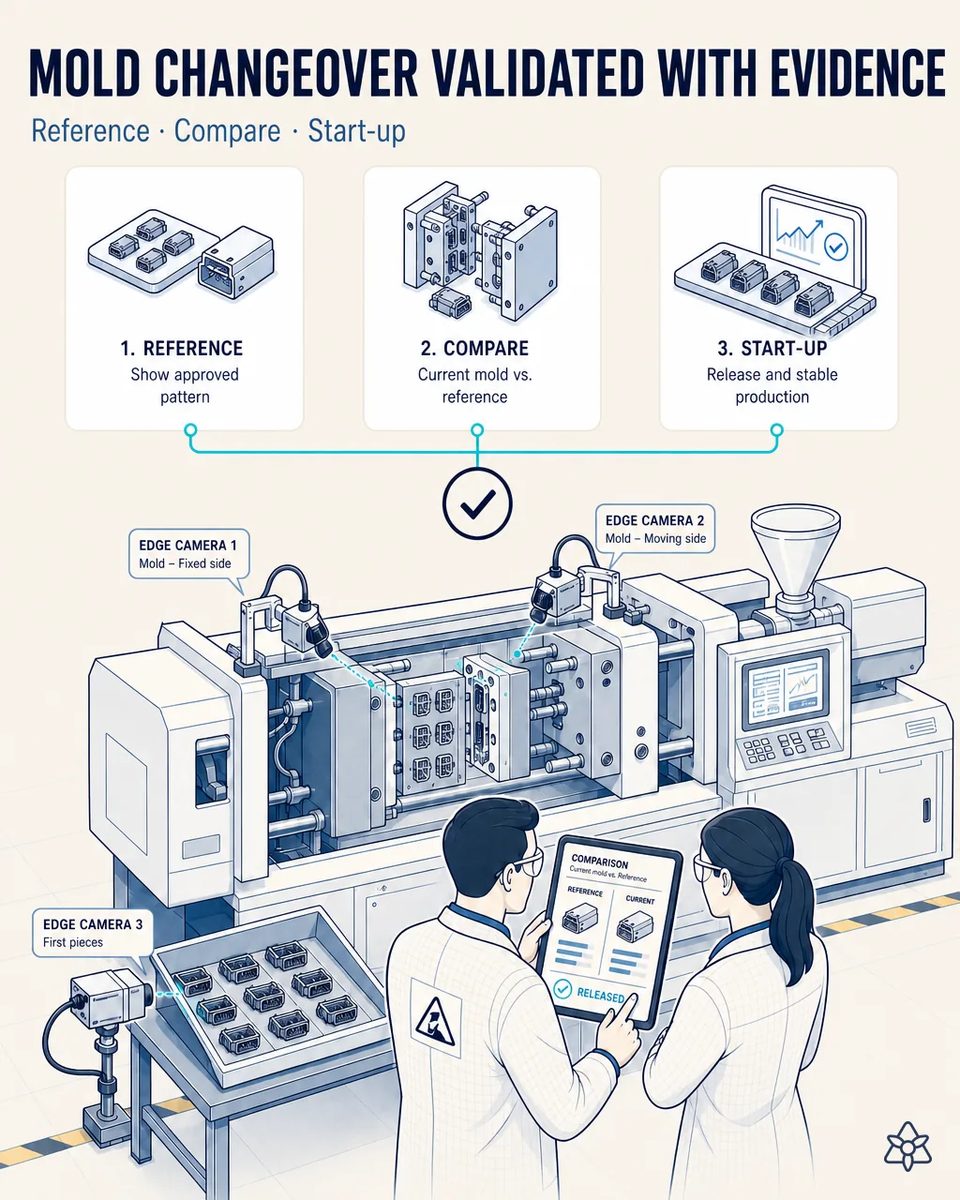
iLEAN Edge compares the first parts from each cavity with the part number's golden sample, and the mold's state with its ready-to-run reference. JIDOKA AI does not release production until the cameras say OK and quality signs off. Every changeover is measured: how long it took, which step delayed start-up, which cavity caused trouble. SMED AI suggests to the molding lead where to cut time on the next change. They decide.
The molding lead still decides; what changes is what they decide on. Per-cavity evidence against a golden sample replaces a signature on memory, and every change leaves the timing needed to make the next one shorter. Quality signs on images, not on memory. And the first boxes of the new lot stop being born under suspicion.
Release on a signature versus release on per-cavity evidence
| Aspect | Today | With iLEAN Edge |
|---|---|---|
| First housings per cavity | One sample checked | Each cavity against the golden sample |
| Wrong insert or core pin | Found at terminal insertion | Caught before release |
| Incomplete resin purge | Looks fine, fails later | Held for review |
| Release decision | Signature on experience | Cameras OK plus quality sign-off |
| Duration of each mold change | Not measured | Timed step by step |
| The next mold change | Same as the last | SMED AI suggests where to cut |
Before: release by sign-off without objective evidence, start-ups with compromised parts, long unmeasured changeovers. After: release backed by per-cavity evidence, clean start-ups, measured and shorter changeovers.
Impact estimate — to be validated with your numbers.
The block below is an estimate to be validated against your plant's actual data. We put it forward so the committee has an order of magnitude; we refine it during the assessment.
- Estimated payback 4-10 months, depending on how many changes you run and your product mix.
- Failed start-ups after a changeover cut by 30% or more, with fewer compromised boxes at the start of each lot and less sorting afterwards.
- Shorter changeovers, because SMED AI shows which step delays start-up and which cavity causes trouble, change after change.
- And release backed by per-cavity evidence, ready for the PPAP or IATF 16949 file without extra paperwork, change after change.
Estimated payback of 4 to 10 months; failed start-ups after changeover cut by 30% or more and shorter changeover time. Estimate to be validated.
And the fair question from the production manager
“What if the cameras hold a good start-up and we lose press time?” — the check compares the mold and first housings with the reference state of that specific part number, an anchored comparison where the best models stay below 1.5% error [1]. When there is doubt it does not block silently: it escalates to the molding lead with the images, who decides on the evidence. It stops on a verifiable discrepancy, not on uncertainty, and every exception is signed by a named person with the images attached.
[1] OpenAI paper "Why Language Models Hallucinate", 2025 — on the reliability of AI in anchored tasks.
What people ask about camera-validated mold changes
What does the camera compare on the mold itself?
The inserts and core pins mounted, the state of each cavity and the cleanliness of the parting line, against the ready-to-run reference of that part number. The checkpoints are defined with your tooling team during commissioning, mold by mold.
How are first housings checked cavity by cavity?
Each cavity's first shots are imaged and compared with the golden sample for that cavity, so a single blocked or short cavity is not hidden by the others. The cavity number travels with each image, so a trend per cavity builds up over time.
Can quality sign off without walking to the press?
Yes, with the images on the tablet; the sign-off is stored together with the evidence that was on screen when it was given. That saves the walk from the lab and the wait that comes with it.
Where does SMED AI get its timings?
From the changeover itself: each step is time-stamped by the cameras and the tablet, so delays are measured rather than estimated. The molding lead decides which suggestions to apply, and the next change shows whether they worked.
Can the hold be overridden when the molding cell is late?
An exception can be signed by an authorized person and it is recorded as such, with the images, so nobody starts up without a trace. Exceptions are reviewed weekly, which usually shows where the reference needs refining.
More cases from this series
- IATF 16949 evidence pack, always readyiLEAN Agents organizes each lot's evidence by standard and customer: IATF 16949 and PPAP audits prepared…
- Zero escapes to the automotive customerFour coordinated rings (order, test, vision and evidence) catch on the line what reaches the customer…
- Photograph the traveler at lot start-upOne photo of the traveler and the lot exists in the system from start-up: terminal-resin-assembly…
- The electrical tester, stitched into the MES and ERPiLEAN stitches the harness electrical tester into the MES and ERP: every result linked to serial and…
- The shift supervisor speaks, iLEAN recordsThe supervisor speaks while walking; iLEAN structures the incident by cell, lot and shift and replies…
- Nothing enters the ERP without a human sign-offEverything iLEAN captures goes through a tablet in the cell: the lead validates in two taps before the…
Tell us how many housing mold changes you run per week and how each one is released.
We work on your plant's real data, not ours. Assessment with no commitment.
Request estimated ROI within 48h ‹ See all cases of electronic connectors See electronics