Zero escapes to the automotive customer
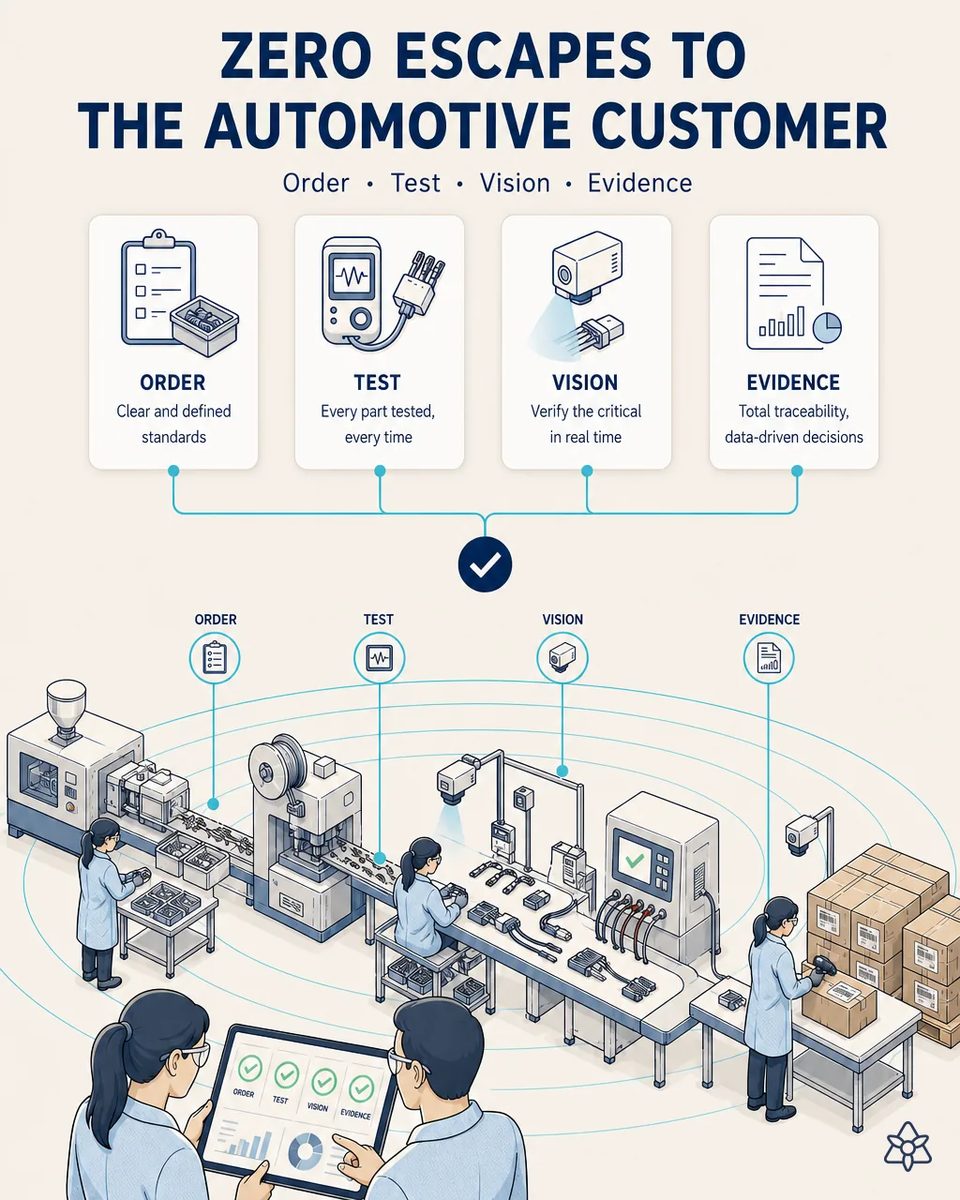
The core pain of a connector plant serving automotive is an escape to the customer. iLEAN coordinates four rings: the captured work order, the integrated electrical tester, Edge vision inline and at packing, and Agents with the evidence for every shipment. If something does not match, the station stops before the box leaves.
One escape costs more than a year of prevention.
In connectors and cable assemblies for automotive, the core pain is one: a defective part or a part-number mix reaching the customer's line. An escape means containment, sorting, chargebacks, a formal complaint and lost points on the supplier scorecard.
- In connectors for automotive, the core pain is one: a defective part or a part-number mix reaching the customer's line. A wrong connector fits nowhere, and a missing one stops everything.
- An escape means containment at the customer, third-party sorting, chargebacks, a formal complaint and lost points on the supplier scorecard. The cost of one event can exceed a year of prevention.
- Each control in the plant — the traveler, the electrical tester, the visual check, the packing label — catches its own failure, but none of them checks the others, so a combination slips through.
- The escape that hurts is usually a combination: a terminal lot booked wrong, a label left over from the previous order and a sample that missed the bent pin. Each one alone looked acceptable.
Agents coordinates four rings — order, test, vision and evidence.
iLEAN tackles it with four coordinated rings. Ring one: the work order defines part number, lots and control plan, captured from the traveler and from receiving. Ring two: the integrated electrical tester records every part against its serial and lot. Ring three: Edge inspects pins and terminals inline and, at packing, reads label and part and checks them against the active order. If something does not match, JIDOKA AI stops the station before the box is closed. Ring four: Agents cross-checks the three previous rings, opens containment with the exact lots affected and keeps the evidence pack for every shipment. Quality decides the action; the system delivers in minutes what takes days to gather today.
None of the rings is new on its own; what is new is that they cross-check. When the order, the tester, the camera and the label stop agreeing, the station stops before the box is closed, and quality decides with the full picture. What took days to gather arrives in minutes. And when a containment is needed, it is limited to the exact lots, not a month of production.
The four rings and what each one stops
| Ring | Which cases feed it | What it stops |
|---|---|---|
| 1 · Work order | Traveler (1) + receiving (7) | Wrong lots or part number at the start |
| 2 · Electrical test | Tester link (8) + metrology (6) | A failed part shipped without its record |
| 3 · Vision | Pins and terminals (9) + mold change (10) | Bent pins, unseated terminals, label mix-ups |
| 4 · Shipment evidence | Cell sign-off (5) + IATF dossier (11) | A shipment without its evidence pack |
| When rings disagree | JIDOKA AI at packing | The box closing on a discrepancy |
| Containment scope | Agents across all four | Sorting more lots than needed |
Before: escapes found at the customer's plant, costly containments, complaints and a damaged scorecard. After: discrepancies caught inline, containment limited to exact lots, evidence per shipment.
Impact estimate — to be validated with your numbers.
The block below is an estimate to be validated against your plant's actual data. We put it forward so the committee has an order of magnitude; we refine it during the assessment.
- Estimated payback 6-12 months against the first containment avoided, as an estimate to validate with quality and management.
- Customer PPM down by an order of magnitude, with discrepancies caught on the line instead of at the customer's plant.
- Containment limited to the exact lots affected, with the evidence pack for each shipment ready when the customer asks, instead of being gathered over days.
- A protected supplier scorecard, which conditions the award of future programs and the volume you are trusted with on the next platform.
Estimated payback of 6 to 12 months against the first containment avoided; customer PPM down by an order of magnitude and a protected supplier scorecard. Estimate to be validated with quality and management.
And the fair question from the production manager
“Do we need all twelve cases running before this works?” — no. The rings are built in layers and each case pays on its own; with the traveler and the tester link you already have most of rings 1 and 2. And JIDOKA AI stops on a verifiable discrepancy between sources — anchored checks where the best models stay below 1.5% error [1] — never on a model's guess. When the doubt is the model's, a person decides, and that decision is logged with the evidence of all four rings.
[1] OpenAI paper "Why Language Models Hallucinate", 2025 — on the reliability of AI in anchored tasks.
What people ask about zero escapes in connector plants
Which ring should a connector plant build first?
Usually ring 1, starting with the traveler, because it has the fewest dependencies and gives the other rings a reliable work order to check against. Each layer pays on its own, so the order can follow where your escapes come from.
In a connector plant, what does the cross-check catch that each control misses?
Combinations: a terminal lot booked against the wrong order that still passes the tester, or a correct part packed with the previous order's label. Each control alone would pass them, which is why they reach the customer today.
What happens when the packing station stops?
The cell lead sees which rings disagree and why, with the images and records; quality decides whether to correct, hold or release. The decision is logged with the evidence and becomes part of that shipment's pack, so a later customer question is answered with what was actually seen at packing.
Do we need a new MES for the four rings?
No. The rings cross-check the systems you already have against each other and against what the cameras and the tester see. Your MES remains the source of the work order and your quality system keeps its role.
How do we know customer PPM is really falling?
Customer PPM and internal catches by ring are tracked from the first layer, so the shift from escapes at the customer to catches on the line shows month by month, ring by ring.
More cases from this series
- IATF 16949 evidence pack, always readyiLEAN Agents organizes each lot's evidence by standard and customer: IATF 16949 and PPAP audits prepared…
- Photograph the traveler at lot start-upOne photo of the traveler and the lot exists in the system from start-up: terminal-resin-assembly…
- The electrical tester, stitched into the MES and ERPiLEAN stitches the harness electrical tester into the MES and ERP: every result linked to serial and…
- The shift supervisor speaks, iLEAN recordsThe supervisor speaks while walking; iLEAN structures the incident by cell, lot and shift and replies…
- Nothing enters the ERP without a human sign-offEverything iLEAN captures goes through a tablet in the cell: the lead validates in two taps before the…
- The metrology spreadsheet reaches the ERP on its owniLEAN reads the metrology spreadsheet on save, validates it with quality and posts it to the ERP. Up to…
Tell us what your last containment at an automotive customer cost you.
We work on your plant's real data, not ours. Assessment with no commitment.
Request estimated ROI within 48h ‹ See all cases of electronic connectors See electronics