Photograph the traveler at lot start-up
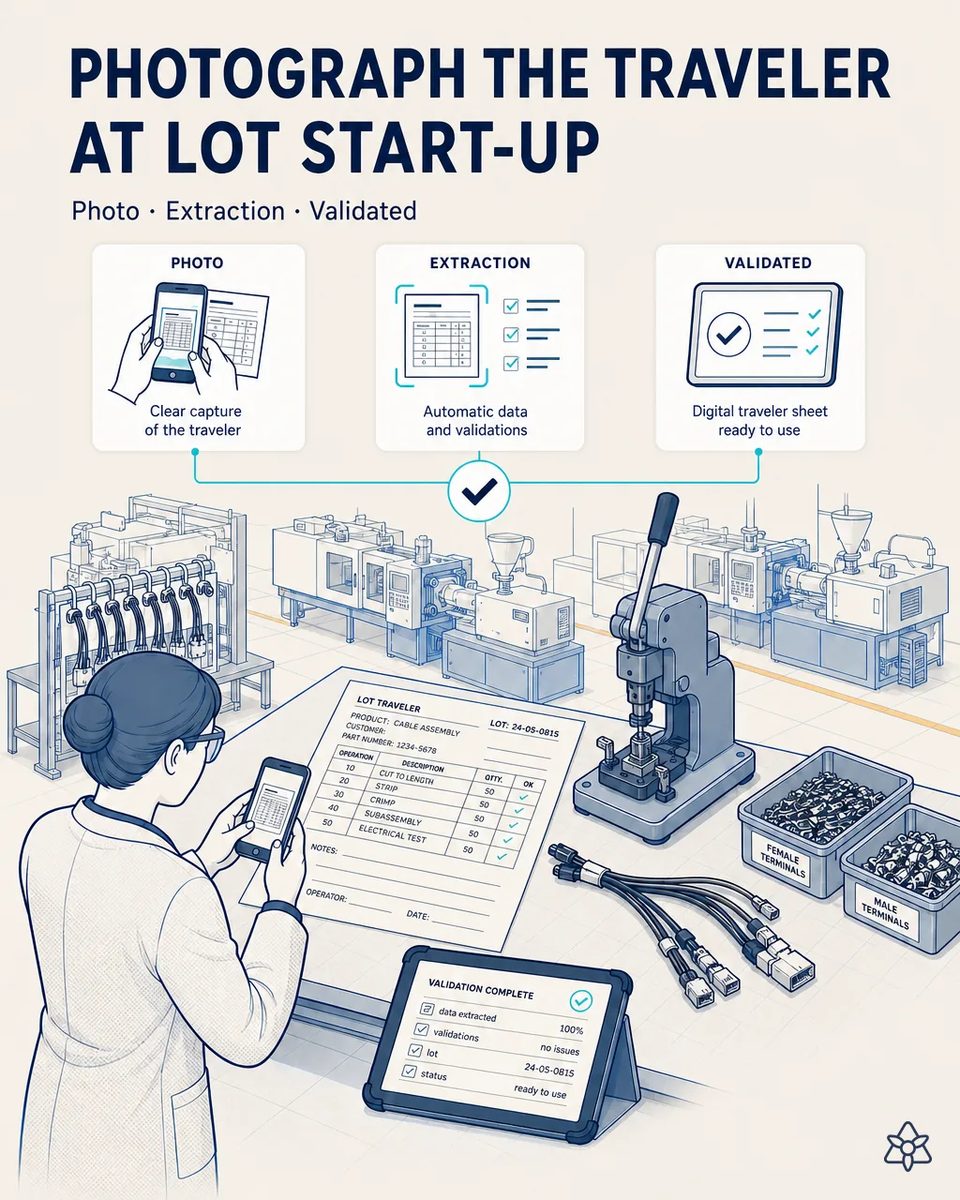
In a connector and cable assembly plant, the paper traveler defines the lot but takes hours to reach the system. With iLEAN Connect the operator photographs it at start-up, the AI extracts the fields and the cell lead validates in two taps: the lot exists in the system from second zero, with full genealogy.
The traveler knows which strip went into which connector. The system finds out tomorrow.
In a plant that makes connectors and cable assemblies, every lot starts with a paper traveler: part number, terminal lot, resin lot, crimp applicator and first-piece sign-off. That sheet follows the lot through molding, stamping and assembly, and reaches the office after the shift is over. Meanwhile the central system has no idea which terminal lot went into which assembly. Someone retypes it at the end of the day, late and with errors, and when the customer asks for traceability it has to be rebuilt by hand from a box of paper.
- Every lot starts with a traveler: part number, terminal strip lot, housing resin lot, plating batch and the first-piece sign-off. It is the only document that ties all of them together, and it is written by hand at the press.
- It travels with the lot from the stamping press to housing molding, terminal insertion and the electrical tester, collecting handwritten notes on the way, and reaches the office after the shift ends, sometimes the next morning.
- Someone retypes it hours later. That is four to eight hours in which the lot exists physically and in no queryable system, and longer over a weekend.
- When an automotive customer asks which strip coil fed a suspect lot, the genealogy is rebuilt by hand from a box of travelers, with the PPM clock running and the customer waiting for a containment scope.
Connect in photo mode — the traveler stays, the retyping goes.
With iLEAN Connect, the operator takes a photo of the traveler when the lot starts. The AI recognizes the layout, extracts part number, lots and sign-offs, and stores them in central memory. Nobody changes the form or the habit. Before anything reaches the ERP, the cell lead sees the summary on the tablet and confirms with two taps. Humans in command: the AI captures, the person decides.
The traveler is already the most complete traceability record in the plant; it is just trapped on paper. One photo at start-up releases it, and the cell lead's two taps give every field an owner before it reaches the ERP. Nothing about the form or the floor routine has to change for that to happen, which is why this is usually the first case approved.
The traveler in a folder versus the traveler in memory
| Aspect | Today, on paper | With iLEAN Connect |
|---|---|---|
| Strip lot to connector lot link | Rebuilt from paper | Recorded at start-up |
| Plating batch on the lot | Handwritten, rarely typed | Extracted with the rest |
| First-piece sign-off | A signature in a box | Time-stamped and searchable |
| Delay to a queryable lot | 4-8 h after start-up | Seconds after the photo |
| Customer genealogy request | An afternoon with a box | One query by lot |
| Form and routine on the floor | — | Unchanged: one photo added |
Before: 4-8 h latency, manual retyping at shift end, traceability rebuilt by hand. After: lot recorded in seconds, validated by a person, genealogy available instantly.
Impact estimate — to be validated with your numbers.
The block below is an estimate to be validated against your plant's actual data. We put it forward so the committee has an order of magnitude; we refine it during the assessment.
- Estimated payback 4-9 months, depending on how many lots you start per day and how many stages each traveler crosses.
- Transcription time recovered by production and quality, every shift, instead of an end-of-day retyping session.
- From 4-8 hours of latency to a lot recorded seconds after start-up and validated by a person, with its genealogy complete from the first stroke.
- Strip-to-connector genealogy available instantly, which is the first thing an automotive customer asks for in any complaint.
Estimated payback of 4 to 9 months depending on daily lot volume, plus the transcription time recovered in production and quality. Estimate to be validated.
And the fair question from the production manager
“What if it misreads a terminal lot number?” — reading fields from a traveler with a known layout is an anchored task, where the best models stay below 1.5% error [1]. And there is a second net: the lot summary goes to the cell tablet, the cell lead confirms or corrects it, and a lot number that does not exist in receiving is flagged before anything crosses into the ERP.
[1] OpenAI paper "Why Language Models Hallucinate", 2025 — on the reliability of AI in anchored tasks.
What people ask about photographing the connector lot traveler
Does the traveler need a new layout for this?
No. The model learns the layout you already print, including the boxes filled in by hand at the stamping press and at the molding cell. A new revision of the form is learned from a few examples.
Can it link the strip coil to the finished connector lot?
Yes, that is the main point: the terminal strip lot and the housing resin lot written on the traveler become the genealogy of the lot from the moment it starts. The plating batch is captured the same way when it is written down.
What about handwritten notes added at terminal insertion?
They are extracted as fields with a confidence score. Anything below the threshold is highlighted on the tablet for the cell lead to confirm or correct. Every correction is stored, so recurring weak fields become visible.
Does it cover lots that move between stamping, plating and molding?
Yes. Each stage can add a photo of the same traveler, so the lot accumulates its history along the route instead of waiting for the paper to reach the office. Each photo is tied to the stage and the time it was taken.
Will an IATF 16949 auditor accept a photographed traveler?
The original paper stays as it is. The photo, the extracted fields and the name of the person who validated them are added, time-stamped evidence, which auditors tend to welcome. Nothing is removed from the paper trail you already have, and the photo is kept with the lot for as long as the record must be retained.
More cases from this series
- IATF 16949 evidence pack, always readyiLEAN Agents organizes each lot's evidence by standard and customer: IATF 16949 and PPAP audits prepared…
- Zero escapes to the automotive customerFour coordinated rings (order, test, vision and evidence) catch on the line what reaches the customer…
- The electrical tester, stitched into the MES and ERPiLEAN stitches the harness electrical tester into the MES and ERP: every result linked to serial and…
- The shift supervisor speaks, iLEAN recordsThe supervisor speaks while walking; iLEAN structures the incident by cell, lot and shift and replies…
- Nothing enters the ERP without a human sign-offEverything iLEAN captures goes through a tablet in the cell: the lead validates in two taps before the…
- The metrology spreadsheet reaches the ERP on its owniLEAN reads the metrology spreadsheet on save, validates it with quality and posts it to the ERP. Up to…
Tell us how many lots a day start on a paper traveler in your plant.
We work on your plant's real data, not ours. Assessment with no commitment.
Request estimated ROI within 48h ‹ See all cases of electronic connectors See electronics