The metrology spreadsheet reaches the ERP on its own
In a connector plant, crimp, pull-test and plating data live in a lab spreadsheet that someone retypes into the ERP. iLEAN Connect reads the folder, picks up every change, routes it through human validation and posts it to the ERP via API. Less retyping and fewer quality-module licenses.
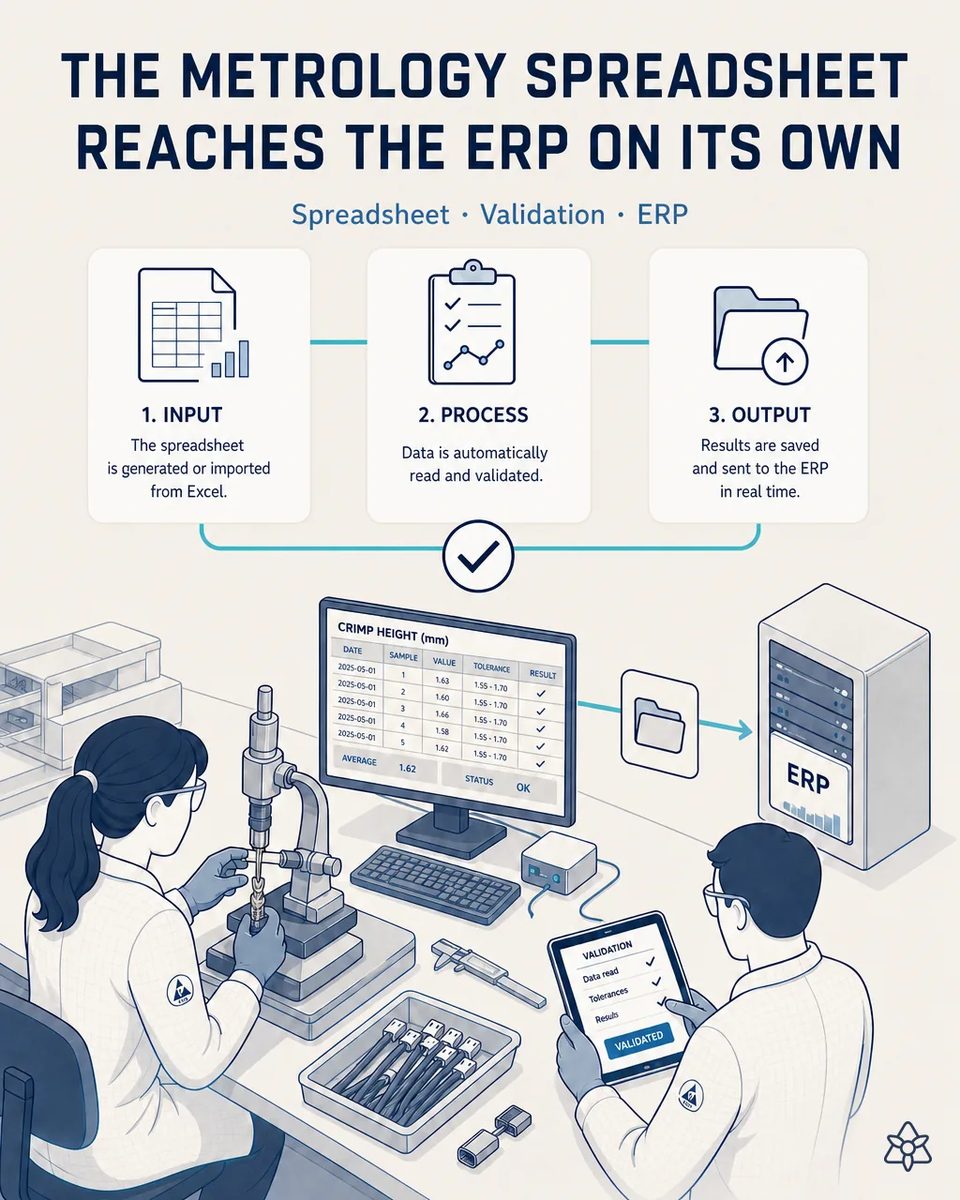
The lab measures every shift; the ERP hears about it once a month.
In the metrology lab, an Excel file in a shared folder is filled in every shift: crimp height and width, pull test, plating thickness, insertion and retention force, housing dimensions. That is where the real data lives. The ERP quality module needs someone to retype it. Half a day a month of copy and paste, typing errors, and a gap between real and official data that complicates any process capability analysis.
- Every shift the metrology lab fills in a shared spreadsheet: plating thickness, pin insertion and retention force, terminal dimensions off the progressive die, housing dimensions, crimp height and pull test on cable assemblies. Each characteristic has its own tab, its own units and its own habits, built up over years by different technicians.
- That spreadsheet holds the real data. The ERP quality module only holds what someone found time to retype, usually in a batch at month end.
- Half a day a month of copy and paste, typing errors, and a gap between real and official data that undermines any capability study the customer asks for in PPAP or at an annual review.
- Several people hold ERP licenses only to enter results, and the license bill grows with the lab, year after year.
Connect in inward listening mode — it reads the lab folder, not the technicians.
With iLEAN Connect, the system reads the shared folder, not the people. When the file is saved it reads what is new, interprets it with a model anchored to your template and stores it in central memory. The quality lead validates the summary in two taps and iLEAN posts it to the ERP through the API. The lab keeps working in the spreadsheet it always used.
The lab keeps the spreadsheet it trusts, and the ERP stops lagging behind it. The capability index for a plating or retention characteristic becomes a query instead of an afternoon of copy and paste. And the technicians do not learn a new screen. When a customer asks for the capability of a characteristic at a review, the answer is already in the system, current to the last saved shift.
The lab spreadsheet alone versus the spreadsheet read by iLEAN
| Aspect | Today | With iLEAN Connect |
|---|---|---|
| Plating thickness in the ERP | Weeks late | After a two-tap validation |
| Retention force capability | Recalculated by hand | Up to date per characteristic |
| Licenses used only for typing | Several | One, the validator |
| Retyping errors | Found during PPAP preparation | Removed at the source |
| Template changes in the lab | Break any macro | Absorbed by the model |
| The lab's working tool | — | The same spreadsheet |
Before: monthly manual retyping, a gap between real and official data, several licenses just for data entry. After: data in the ERP after validation in seconds, one license for the validator.
Impact estimate — to be validated against your actual invoice.
The block below is an estimate to be validated against your plant's actual data. We put it forward so the committee has an order of magnitude; we refine it during the assessment.
- Estimated payback 4-9 months, from the retyping removed in the lab and in quality, half a day a month at the very least.
- License angle: typical reduction of 50-80% in quality/lab module licenses, depending on your vendor's pricing — recurring every year.
- Real and official data aligned, so capability studies for PPAP stop being rebuilt by hand before every submission.
- Fewer transcription errors in the very figures an automotive customer audits, such as plating thickness and retention force.
Estimated payback of 4 to 9 months plus recurring ERP license savings: typical reduction of 50-80% in the quality/lab module depending on vendor pricing. Estimate to be validated.
And the fair question from the production manager
“That template has been edited by several technicians over the years — will it hold?” — that is the expected case: interpretation does not rely on fixed cells, it reads columns, units and notes as they are. It is an anchored task tied to your template, where the best models stay below 1.5% error [1], and the quality lead validates every batch of results before it is posted. A value outside the physical range of the gauge is flagged, never posted, so a typo in the lab cannot reach a PPAP figure.
[1] OpenAI paper "Why Language Models Hallucinate", 2025 — on the reliability of AI in anchored tasks.
What people ask about posting connector metrology to the ERP
Does the lab have to move to a new template in a connector plant?
No. iLEAN reads the spreadsheet the lab uses today, merged cells and margin notes included, and adapts when columns move. The lab keeps full ownership of its file; iLEAN only reads it when it is saved and never edits it.
Which characteristics are worth posting first?
Usually the ones on the control plan that a customer reviews: plating thickness, retention force and terminal dimensions. The rest can follow once the first characteristics run cleanly for a few weeks, typically housing dimensions and pull test results, which follow exactly the same path.
How does a row get linked to a lot and part number?
From the lot and part number columns already in the sheet, cross-checked against open work orders; a row that matches nothing is flagged for the quality lead instead of being posted to a guess. The lead either assigns it or sends it back to the lab.
Is the license reduction guaranteed?
No: it depends on your ERP vendor's pricing, which is why we give a typical 50-80% range to be checked against your own invoice. The logic is simple: whoever logs in only to type stops needing a seat, while the people who analyze data keep theirs.
Does it post through the ERP's API or by mimicking screens?
Through the API wherever one exists, which is the normal case with current quality modules. Screen automation is only a fallback for older modules without an interface, and it is agreed with your IT team beforehand.
More cases from this series
- IATF 16949 evidence pack, always readyiLEAN Agents organizes each lot's evidence by standard and customer: IATF 16949 and PPAP audits prepared…
- Zero escapes to the automotive customerFour coordinated rings (order, test, vision and evidence) catch on the line what reaches the customer…
- Photograph the traveler at lot start-upOne photo of the traveler and the lot exists in the system from start-up: terminal-resin-assembly…
- The electrical tester, stitched into the MES and ERPiLEAN stitches the harness electrical tester into the MES and ERP: every result linked to serial and…
- The shift supervisor speaks, iLEAN recordsThe supervisor speaks while walking; iLEAN structures the incident by cell, lot and shift and replies…
- Nothing enters the ERP without a human sign-offEverything iLEAN captures goes through a tablet in the cell: the lead validates in two taps before the…
Tell us how many ERP licenses your lab uses just to enter measurements.
We work on your plant's real data, not ours. Assessment with no commitment.
Request estimated ROI within 48h ‹ See all cases of electronic connectors See electronics