The veteran stamping press now talks
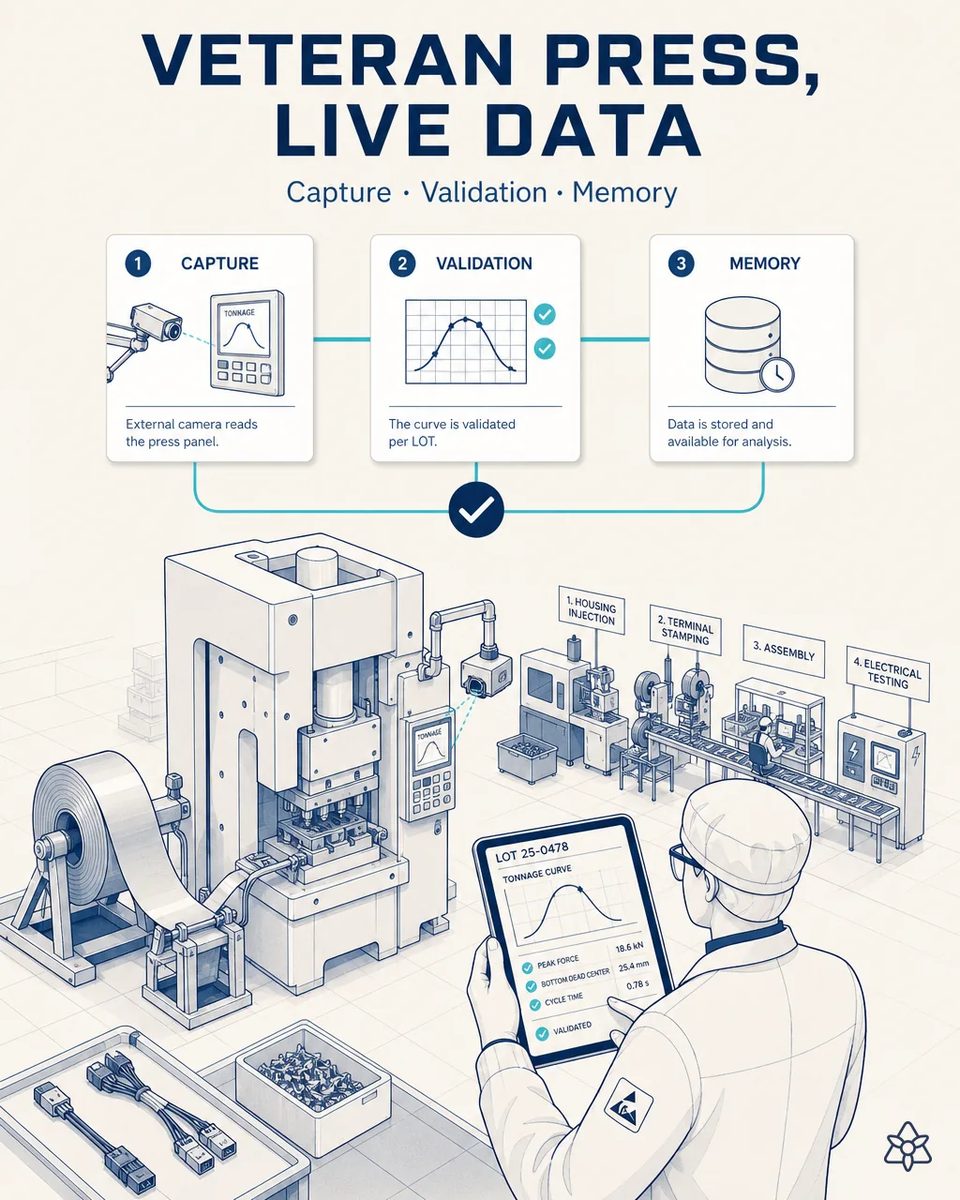
The progressive stamping presses that make terminals are often veterans, isolated from the network. Their panel shows tonnage, strokes per minute and alarms, but the data is lost. With iLEAN Connect an external camera reads the panel and links it to each lot: maintenance and quality gain evidence without touching the press.
The press shows the die wearing out, and the screen forgets it a second later.
Terminals and contacts come off high-speed progressive stamping presses. Many have been on the floor for fifteen or twenty years, with a proprietary panel and a tonnage monitor connected to nothing. Replacing the control means a serious investment and weeks of downtime. That screen shows what quality would need: strokes per minute, tonnage signature, die counter, feed alarms. But the data vanishes when the screen changes, and nobody correlates die wear with out-of-tolerance terminals.
- Terminals and contacts come off high-speed progressive dies running hundreds of strokes per minute. Many stamping presses have been on the floor for fifteen or twenty years, with a proprietary panel and a tonnage monitor wired to nothing. They still stamp good terminals at full speed, which is exactly why nobody wants to touch them or stop them for a retrofit.
- That panel shows what quality needs: tonnage signature, strokes per minute, die counter, strip feed and misfeed alarms. The value changes, and it is gone; at best someone notes a figure on the shift report.
- Nobody correlates the drift in the tonnage signature with the out-of-tolerance terminals that show up later at pin retention or on the metrology bench, so die sharpening is decided by counter or by complaint.
- Replacing the control means serious CAPEX and weeks of downtime on the machine that feeds the whole plant with terminals, and requalifying every die afterwards.
Connect in photo mode on the press panel — read from outside, control untouched.
With iLEAN Connect, one external camera pointed at the panel is enough. The AI reads the screen every few seconds, structures the values and links them to the lot and part number running. Without touching the press or its control. Now the maintenance lead sees how the tonnage signature evolves per die and per lot, and can schedule die sharpening before an out-of-tolerance terminal shows up. The decision stays with them; iLEAN provides the evidence.
The die tells you it is wearing before the terminal goes out of tolerance; the signal is on the screen, it was just never kept. Keeping it per die and per lot is what turns sharpening from a reaction into a plan. And it is done without opening a single port on the press.
The silent press versus the press being read
| Aspect | Today | With iLEAN Connect |
|---|---|---|
| Tonnage signature per stroke | Seen, never stored | Digitized and tied to the lot |
| Die counter between sharpenings | Noted on a card | History per die |
| Misfeed and strip alarms | Cleared and forgotten | Logged with time and lot |
| Die wear vs. out-of-tolerance terminals | No correlation | Visible as a trend |
| Die sharpening | When terminals fail | Scheduled on evidence |
| Control retrofit | In next year's budget | Can wait |
Before: ephemeral press data, no correlation between die wear and out-of-tolerance terminals. After: tonnage signature per die and lot, planned sharpening, retrofit can wait.
Impact estimate — to be validated with your numbers.
The block below is an estimate to be validated against your plant's actual data. We put it forward so the committee has an order of magnitude; we refine it during the assessment.
- Estimated payback 5-10 months, from lower strip scrap and fewer unplanned stops on the presses.
- Less strip scrap: a worn die caught by its tonnage trend stops producing out-of-tolerance terminals by the reel, and every reel of stamped terminals carries the press history of its lot.
- Fewer unplanned stops on the progressive die, because sharpening is scheduled before it fails rather than after, in a window planning can see coming, not in the middle of a customer order.
- And the control-retrofit CAPEX can be deferred while the press keeps producing what it already produces well.
Estimated payback of 5 to 10 months from lower strip scrap and fewer unplanned stops, plus the deferred control-retrofit CAPEX. Estimate to be validated.
And the fair question from the production manager
“Can a camera on a panel be trusted with tonnage values?” — this is an anchored task: a fixed screen, values in known positions and physically bounded ranges, where the best models stay below 1.5% error [1]. Any reading outside the press's possible range is discarded instead of stored, so a reflection on the glass never becomes a false tonnage peak in the die history. And the maintenance lead still decides when a die comes out.
[1] OpenAI paper "Why Language Models Hallucinate", 2025 — on the reliability of AI in anchored tasks.
What people ask about reading a veteran stamping press
Does the press control or tonnage monitor have to be opened?
No. The camera sits outside on its own bracket, reads the screen and opens no ports, so the press and its monitor stay exactly as the maker left them. Installation is done during a normal stop, with no requalification of the press or its dies.
Does it keep up with a press running hundreds of strokes per minute?
It does not read every stroke; it samples the panel every few seconds, which is enough to see the tonnage signature and the die counter evolve per lot. Alarms are captured as soon as they appear on screen.
Can it tell which die and which terminal part number were running?
Yes, by crossing each reading with the active work order and the traveler of the lot, so every value is tied to a die and a part number. Die swaps are detected from the panel and the work order together.
Does it help plan die sharpening?
That is the core use: the maintenance lead sees the tonnage trend per die and decides when to pull it, before terminals start drifting at pin retention. Over time, each die builds its own wear curve between sharpenings, which makes the next sharpening date a forecast instead of a guess.
What if the panel cycles through several screens in a connector plant?
The model recognizes each page and keeps the fields of each one. It is set up once per press model during commissioning, so a fleet of identical presses shares the same setup.
More cases from this series
- IATF 16949 evidence pack, always readyiLEAN Agents organizes each lot's evidence by standard and customer: IATF 16949 and PPAP audits prepared…
- Zero escapes to the automotive customerFour coordinated rings (order, test, vision and evidence) catch on the line what reaches the customer…
- Photograph the traveler at lot start-upOne photo of the traveler and the lot exists in the system from start-up: terminal-resin-assembly…
- The electrical tester, stitched into the MES and ERPiLEAN stitches the harness electrical tester into the MES and ERP: every result linked to serial and…
- The shift supervisor speaks, iLEAN recordsThe supervisor speaks while walking; iLEAN structures the incident by cell, lot and shift and replies…
- Nothing enters the ERP without a human sign-offEverything iLEAN captures goes through a tablet in the cell: the lead validates in two taps before the…
Tell us how many stamping presses you run that send no data anywhere.
We work on your plant's real data, not ours. Assessment with no commitment.
Request estimated ROI within 48h ‹ See all cases of electronic connectors See electronics