The machine stays itself, but now it talks
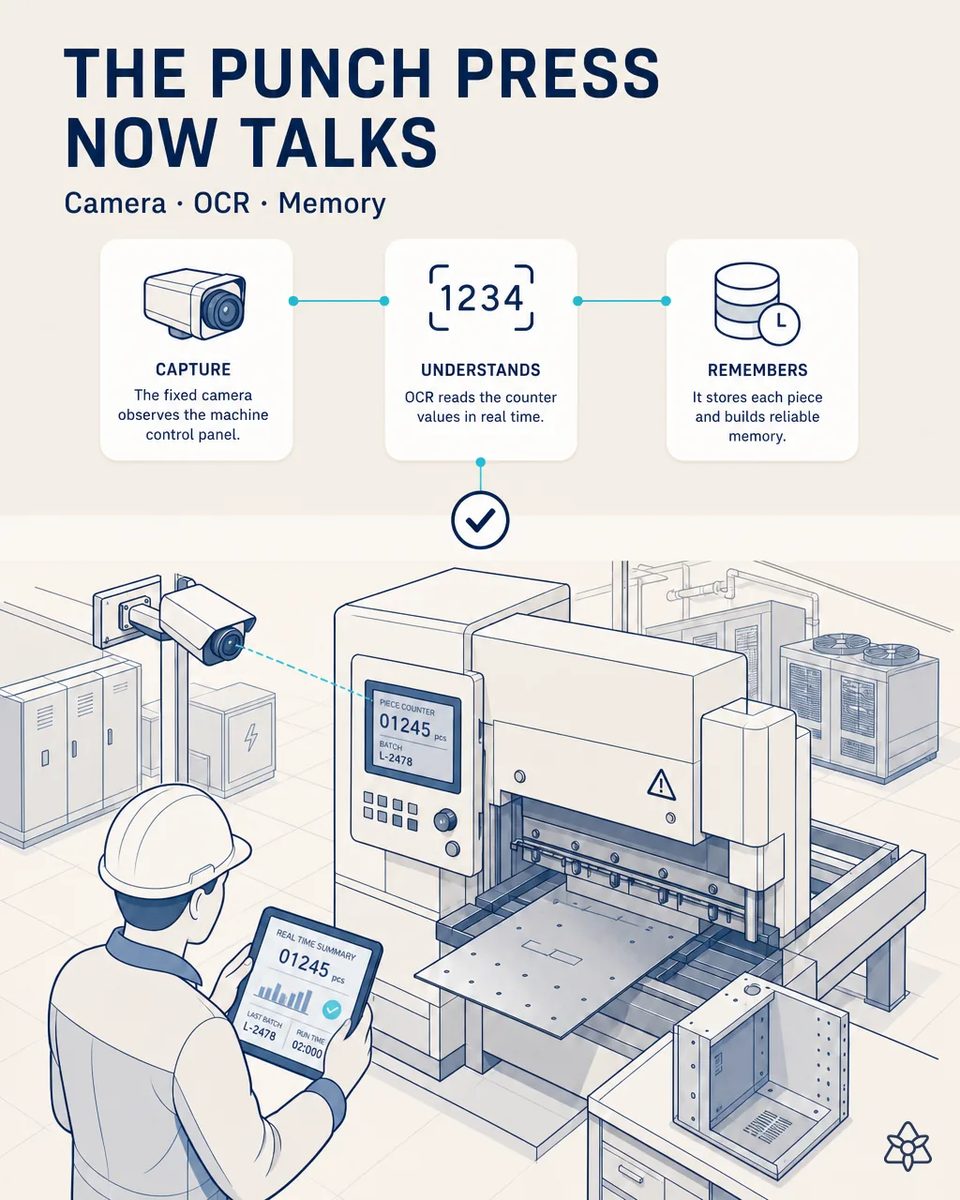
The sheet-metal cutting and bending line that forms the switchgear enclosures typically runs a 10-20 year-old proprietary panel, isolated from the network. Replacing it mid-expansion is unworkable. With iLEAN Connect, an external camera aimed at the panel is enough to digitize its performance without touching the original controller.
The machine that cuts every enclosure is the bottleneck nobody can measure.
The punch press is a critical capacity bottleneck right as the plant scales production. Its panel shows the active cutting program, piece counter and tool-change alarms, but today no one correlates it because the information dies on screen every time the display rotates.
- The sheet-metal line that punches and bends the switchgear and UPS enclosures typically runs a 10-20 year-old proprietary panel, isolated from the network by the builder's design and never meant to share data.
- Its screen shows the active cutting program, the piece counter and the tool-change alarms. The moment the display rotates to the next page, that information is gone for good.
- Replacing the controller mid-expansion is unworkable: it stops the very machine that limits how many enclosures reach assembly each week, and the retrofit lead time alone eats a quarter.
- So the plant plans capacity at its bottleneck on estimates, and when enclosures run late nobody can say whether it was tool changes, a slow program, a jammed sheet or simply waiting for material.
Connect in photo mode on the press panel — read from outside, the controller untouched.
Connect photo mode on the panel, with a fixed industrial camera. OCR plus a grounded language model reads every frame and structures pieces-per-hour and stop causes, cross-referenced with the ERP for which order was running — without touching the original PLC or panel.
Nothing is installed on the press, no port is opened and the builder's warranty is not at stake. A camera reads what the operator already sees, and that is enough to turn an opaque bottleneck into stop causes by part number. In an expansion, knowing where the press loses its hours is worth more than a new press ordered on intuition.
The silent enclosure press versus the enclosure press being read
| Aspect | Today | With iLEAN Connect |
|---|---|---|
| Enclosure panels per hour | Estimated at the end of the shift | Counted frame by frame |
| Which cutting program ran | Remembered by the operator | Read from the panel and tied to the order |
| Tool-change alarms | Cleared and forgotten | Logged with time and duration |
| Stop causes by enclosure part number | Unknown | Analyzed in minutes |
| The original PLC and panel | — | Untouched, no software installed |
| Capacity planning at the bottleneck | Rule of thumb | Based on measured rates |
Zero OEE visibility on this machine → root-cause analysis of stops by part number in minutes.
Punch press visibility: estimated impact, to validate with your cutting plan.
The block below is an estimate to be validated against your plant's actual data. We put it forward so the committee has an order of magnitude; we refine it during the assessment.
- Estimated payback 5-10 months, mostly from capacity recovered at the machine that sets the pace of the whole enclosure flow, without the capex and downtime of a retrofit.
- Better cutting-capacity planning right at the bottleneck of the expansion ramp, which decides how many cabinets assembly can start each week.
- Stop analysis by enclosure part number in minutes instead of zero OEE visibility on this machine.
- And a replacement decision made on measured data, not on the feeling that the old press is slowing everything down. Sometimes the data shows the press is fine and the loss is upstream, in sheet supply.
Estimated payback 5-10 months, better cutting-capacity planning right at the bottleneck of the expansion ramp. *Estimate to validate.*
And the fair question from the production manager
“Can a camera on a fifteen-year-old screen give numbers we can plan with?” — reading a fixed panel with fields in known positions is an anchored task, where the best models drop below 1.5% error [1]. On top of that, a counter that jumps backwards or a rate outside what the press can physically punch is discarded, not stored, so a bad frame never turns into a planning figure.
[1] OpenAI paper "Why Language Models Hallucinate", 2025 — on the reliability of AI in anchored tasks.
What people ask about reading the punch press panel
Does the press builder have to be involved?
No. Nothing is connected to the controller or the PLC, so there is no software change to approve and no warranty question. The camera sits outside the machine guard, on its own bracket, and can be removed in minutes without leaving a trace on the press.
How does it know which enclosure order was being punched?
It reads the active program on the panel and crosses it with the ERP order released to the press at that time, so every counted panel lands on the right work order. Programs and orders that do not match are flagged rather than guessed.
Does it capture tool changes and alarm stops?
Yes. Alarm screens and tool-change prompts are read like any other frame, and each stop gets a start time, a duration and the program that was running. That is what turns a vague complaint about the press into a Pareto of causes by enclosure family, which is what maintenance and planning can actually act on.
What if the screen rotates between pages?
That is the normal case. The camera captures every page as it appears and rebuilds the full state of the press from the sequence of frames, so a counter shown for three seconds every minute is still counted continuously.
Can the same approach cover the press brake as well?
Yes, the pattern is the same for any isolated panel on the sheet-metal line, including the shear and the brake that bend the enclosure panels. You start with whichever machine limits enclosure output today, then extend camera by camera.
More cases from this series
- The assembly traveler no longer gets lost in paperHow a switchgear factory digitizes its paper assembly traveler with a photo, no habit change.…
- The truck no longer waits while someone typesOne photo of the delivery note and the critical-component certificate is enough to clear the truck and…
- The supplier alert no longer waits hours in an inboxILEAN reads a critical-component supplier's email at zero latency and replans the line before material…
- Nothing enters the central system without a human validating itNothing enters the ERP without a technician validating it with two taps. That's how iLEAN avoids…
- The supervisor's knowledge no longer dies at end of shiftWith an earpiece and Connect, the line supervisor logs incidents while walking between stations — no…
- The lab spreadsheet no longer lives cut off from the ERPILEAN absorbs the lab's test-result spreadsheet in real time and pushes it into the ERP. Up to 80% fewer…
Tell us which legacy machine on your enclosure line is the real bottleneck.
We work on your plant's real data, not ours. Assessment with no commitment.
Request estimated ROI within 48h ‹ See all cases of critical datacenter infrastructure See electronics