The supplier alert no longer waits hours in an inbox
An email from a breaker or busbar supplier warning of a delay lands in a single inbox and is read hours later, once assembly orders are already scheduled against that component. With iLEAN Connect, the system reads the alert at zero latency, cross-references active ERP orders, and returns the concrete action to take.
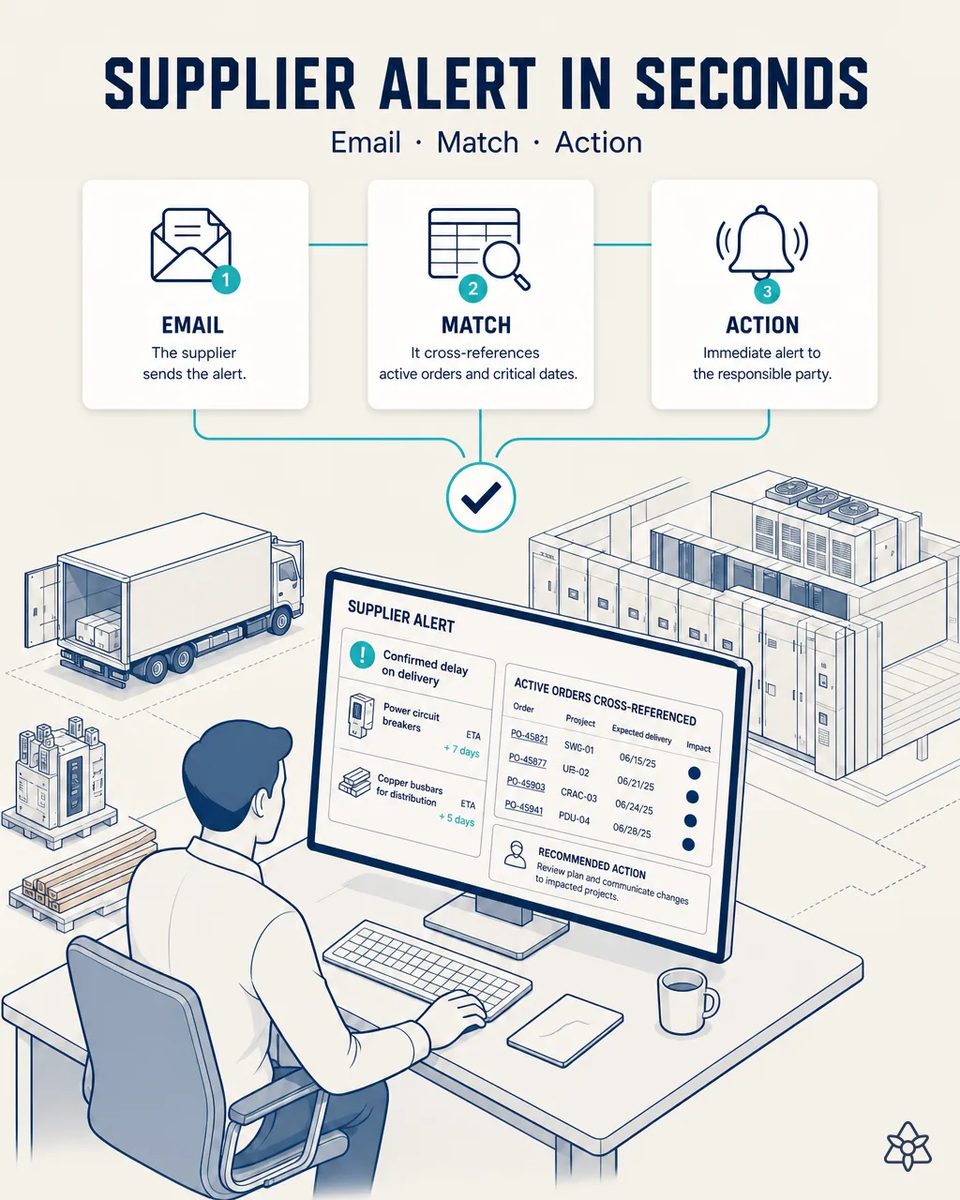
The notice that breaks the assembly plan arrives in one person's inbox.
Critical supplier alerts reach specific people who can't watch their inbox in real time. By the time they're read, assembly planning already in motion breaks, and the line either runs short on material or starts with an unapproved substitute.
- A breaker or busbar supplier warns of a delay, a partial shipment or a lot hold. The email lands in a single buyer's inbox, among a hundred others about prices, confirmations and invoices.
- It is read hours later, once the assembly orders that depend on that component are already scheduled, kitted and sometimes started on the floor, with copper already cut for them.
- By then the line either runs short and a half-built lineup waits on the floor taking up a bay, or someone starts it with a substitute breaker nobody has approved for that rating.
- Nobody failed: the people who receive these notices cannot read their inbox in real time while they are also expediting, negotiating lead times and receiving trucks at the dock.
Connect in chaotic-sources mode — a mailbox in silent copy, read around the clock.
Connect's chaotic-sources mode — a mailbox on silent copy 24/7. A language model extracts intent, supplier, component, lot and date, instantly cross-referencing it against active ERP orders. The planning lead gets the concrete action, not just a notice that an email arrived.
Finding out sooner is only half of it. What changes the day is knowing which open orders consume that breaker and which ones can move up in its place, and that is what reaches the planning lead. A late notice read in seconds is a resequenced week; read at four in the afternoon, it is a stopped bay.
The supplier email today versus the email that is cross-checked
| Aspect | Today | With iLEAN Connect |
|---|---|---|
| Breaker or busbar delay notice | Read when the buyer gets to it | Read in seconds |
| Orders consuming the late component | Worked out by hand | Listed from active ERP orders |
| Lineup started without its breakers | Parked half-built | Resequenced before kitting |
| Unapproved substitute for a rating | A temptation under pressure | Flagged, never proposed |
| Who gets the action | Whoever the email was sent to | The planning lead |
| What the assembly replan is based on | What was read hours ago | Stock and orders right now |
Hours of human latency → seconds. Replanning based on real-time stock, not on what was read hours later.
Supplier alert reading: estimated impact, to validate with your incident history.
The block below is an estimate to be validated against your plant's actual data. We put it forward so the committee has an order of magnitude; we refine it during the assessment.
- Estimated payback 3-7 months, depending on how often supply incidents hit critical components such as breakers, busbars and contactors.
- Fewer line stoppages from critical-component shortages discovered after the orders were already released to the floor, and fewer half-built lineups occupying bays while they wait for their breakers.
- Human latency on a critical notice goes from hours to seconds, at night and over the weekend as well, when a notice from a supplier in another time zone usually sits unread until Monday.
- And replanning is done on real-time stock and open orders, not on what somebody read before lunch. The planning lead moves another rating forward while the late breakers are on their way.
Estimated payback 3-7 months depending on how often supply incidents occur, avoiding line stoppages from critical-component shortages. *Estimate to validate.*
And the fair question from the production manager
“Are you going to read my buyers' email?” — no. iLEAN sits in copy on a dedicated supplier mailbox and only sees what is sent there. Pulling supplier, component, lot and new date out of a delay notice is an anchored task, where the best models drop below 1.5% error [1], and the replanning decision stays with the planning lead, who sees the original email next to the proposed action.
[1] OpenAI paper "Why Language Models Hallucinate", 2025 — on the reliability of AI in anchored tasks.
What people ask about reading critical-component supplier alerts
Can it tell a real breaker delay from a routine order confirmation?
Yes. It extracts the intent of each message, so a confirmed delay or a lot hold is prioritized while an acknowledgment or a price update interrupts nobody. A partial shipment is treated as a delay for the missing quantity, not as good news.
How does it know which switchgear orders are hit?
It crosses the component and lot in the notice with the bill of materials of active ERP orders, and returns the list of orders and their planned start dates. Orders already kitted are shown first, because those are the ones that stop a bay.
Will it suggest an alternative breaker on its own?
No. For a rated component it never proposes a substitute; it flags the gap and leaves the approved-alternative decision to engineering and planning. In this industry that line is not negotiable.
Does it cover alerts sent by messaging apps as well?
Yes, if they reach the dedicated company number. Many urgent supply notices arrive that way, often as a photo of a shipping notice or a short voice message, and the extraction works the same for all of them.
Do our suppliers need to change how they write to us?
No. They keep writing as they do today, in their own format and language. The mailbox simply receives a silent copy, and the supplier never knows it is there. That matters with breaker and busbar vendors whose formats you do not control.
More cases from this series
- The assembly traveler no longer gets lost in paperHow a switchgear factory digitizes its paper assembly traveler with a photo, no habit change.…
- The truck no longer waits while someone typesOne photo of the delivery note and the critical-component certificate is enough to clear the truck and…
- Nothing enters the central system without a human validating itNothing enters the ERP without a technician validating it with two taps. That's how iLEAN avoids…
- The supervisor's knowledge no longer dies at end of shiftWith an earpiece and Connect, the line supervisor logs incidents while walking between stations — no…
- The lab spreadsheet no longer lives cut off from the ERPILEAN absorbs the lab's test-result spreadsheet in real time and pushes it into the ERP. Up to 80% fewer…
- The nameplate engraves itself, with no manual typingConnect your laser nameplate engraver to the ERP via API: serial numbers flow automatically, no manual…
Connect your critical-supplier mailbox during the demo and watch the first alert land.
We work on your plant's real data, not ours. Assessment with no commitment.
Request estimated ROI within 48h ‹ See all cases of critical datacenter infrastructure See electronics