The assembly traveler no longer gets lost in paper
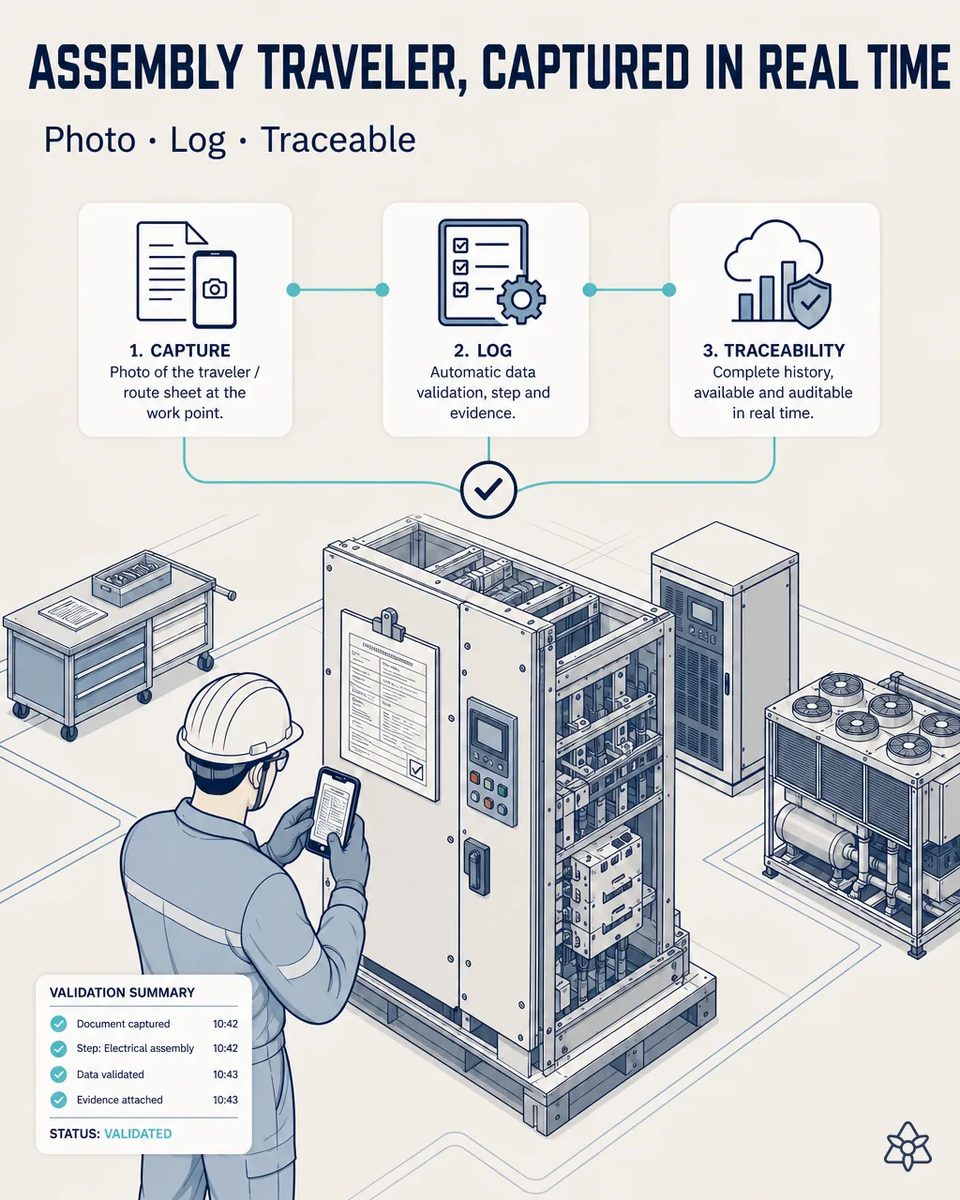
Every switchgear and UPS cabinet starts assembly with a paper traveler signed off station by station — torque, component, inspection. With iLEAN Connect, the technician photographs that same paper when closing out each station, and the unit's traceability exists in the central system at zero latency, with no change to their routine.
The only record of which breaker sits in which cabinet is a sheet of paper clipped to the door.
The traveler is the only document that ties "which specific component is on this specific unit." Until it's digitized, any traceability query — a customer complaint, a supplier alert about a breaker lot — means digging through filed paper. On a plant hiring new staff every week, that paper trail gets less reliable by the day.
- Every switchgear lineup and UPS cabinet starts assembly with a traveler: busbar torque, breaker serial, CT ratio, wiring check and the sign-off of each station, all filled in by hand as the unit moves down the line.
- It is the only document that ties a specific component to a specific unit. While it hangs on the cabinet door or sits in a binder in the quality office, it exists for nobody outside that bay.
- When a breaker supplier issues a lot alert or a customer asks about a unit already energized at their site, the answer means digging through filed paper — hours per query, sometimes days, and always someone senior doing it.
- On a plant onboarding new technicians every week, the handwriting, the blank torque fields and the late sign-offs get less reliable by the day, exactly as volume climbs and the binders multiply.
Connect in photo mode — the technician keeps signing the same traveler and adds one photo.
Connect photo mode. The technician keeps doing exactly what they already did: photographing the traveler with their phone or the shop-floor tablet at the close of each station. A grounded language model extracts serial number, station, component, torque and sign-off, and stores it in iLEAN's central memory the instant the photo is taken. Early human verification (see case 5) ensures nothing enters the ERP without a human validating it first.
Nobody is asked to fill in a tablet form instead of the traveler. The technician closes the station exactly as before and photographs the sheet; iLEAN reads serial, station, component, torque and sign-off, and the unit's history exists the instant the photo is taken. That absence of friction on the floor is usually why this is the first case quality approves.
The traveler in a binder versus the traveler being read
| Aspect | Today, on paper | With iLEAN Connect |
|---|---|---|
| Breaker serial per cabinet | Handwritten on the door sheet | Linked to the unit serial at photo time |
| Busbar torque values | Visible only to whoever opens the binder | Stored per joint and station |
| Supplier lot alert on a breaker | Hours digging through filed travelers | One lookup lists the affected cabinets |
| Station sign-off on the traveler | Initials on paper | Name, station and time on record |
| Blank or illegible field | Found at FAT, if at all | Flagged at the station that left it |
| Traveler technician's routine per station | Fill and sign the sheet | Fill, sign and take one photo |
Traceability rebuilt by hand in hours → instant web lookup by serial number.
Traveler capture: estimated impact, to validate with your unit volume.
The block below is an estimate to be validated against your plant's actual data. We put it forward so the committee has an order of magnitude; we refine it during the assessment.
- Estimated payback 4-9 months, depending on daily unit volume through final assembly and on how many traceability questions you answer each month.
- The quality lead stops spending hours filing travelers and searching for them every time a supplier, an auditor or a customer asks a question.
- Traceability queries go from hours rebuilding by hand to an instant web lookup by serial number, including for units already shipped.
- And the FAT starts from a complete traveler instead of discovering, in front of the customer's witness, that a torque field was never filled in.
Estimated payback 4-9 months depending on daily unit volume, recovering the time the quality lead spent filing and searching for paper. *Estimate to validate.*
And the fair question from the production manager
“What if it misreads a torque value or a breaker serial?” — reading fields from a traveler whose layout is known is an anchored task, where the best models drop below 1.5% error [1]. And there is a second net: every capture goes to the line tablet as a short summary, and the technician confirms or corrects it before anything enters the ERP (case 5). A misread value never reaches the unit's record unseen.
[1] OpenAI paper "Why Language Models Hallucinate", 2025 — on the reliability of AI in anchored tasks.
What people ask about capturing the switchgear traveler
Do we have to redesign our assembly traveler for this?
No. iLEAN learns the traveler you already use, including the columns added over the years, and reads it as it is. The sheet only changes if quality decides to change it for its own reasons.
Does it read handwritten torque values and initials?
Yes. Handwritten values are extracted like printed ones, and any value read with low confidence or outside the torque window defined for that joint is flagged for the technician to confirm. That check happens at the station, while the wrench is still at hand.
Can we find every cabinet that carries a given breaker lot?
That is the main use: with each traveler tied to a unit serial, a lookup by breaker or busbar lot returns the affected cabinets, including those already shipped to a data center. What took a morning in the archive takes seconds.
Does it work across switchgear, UPS and PDU lines with different travelers?
Yes. Each product family keeps its own traveler layout and iLEAN recognizes which one it is reading, so a mixed plant does not need a single common format.
Do we need ERP integration before the first traveler is captured?
No. Captures land in iLEAN's central memory from the first day, and the push to the ERP is connected once quality has seen the data is reliable. Most plants prefer it in that order.
More cases from this series
- The truck no longer waits while someone typesOne photo of the delivery note and the critical-component certificate is enough to clear the truck and…
- The supplier alert no longer waits hours in an inboxILEAN reads a critical-component supplier's email at zero latency and replans the line before material…
- Nothing enters the central system without a human validating itNothing enters the ERP without a technician validating it with two taps. That's how iLEAN avoids…
- The supervisor's knowledge no longer dies at end of shiftWith an earpiece and Connect, the line supervisor logs incidents while walking between stations — no…
- The lab spreadsheet no longer lives cut off from the ERPILEAN absorbs the lab's test-result spreadsheet in real time and pushes it into the ERP. Up to 80% fewer…
- The nameplate engraves itself, with no manual typingConnect your laser nameplate engraver to the ERP via API: serial numbers flow automatically, no manual…
Send us one of your switchgear travelers and see it read in the demo.
We work on your plant's real data, not ours. Assessment with no commitment.
Request estimated ROI within 48h ‹ See all cases of critical datacenter infrastructure See electronics