From the supplier lot to the exact unit, in minutes
Payback 6-12 months against the first avoided event · supplier-component traceability in minutes, not weeks
A defective supplier lot is a question nobody can answer in time.
When a supplier lot — compressor, control board, foam, sheet metal — turns out defective or gets a safety alert, you need to narrow down in minutes, not weeks, which finished-unit serial numbers carry it and which countries they're in. That reconstruction today depends on manually cross-referencing receiving slips, build sheets and final-test records from different sources — risking hundreds or thousands of units already shipped to dozens of countries with no clear traceability.
- When a supplier lot — compressor, control board, foam, sheet metal — turns out defective or gets a safety alert, the question is immediate: which finished coolers carry it, and in which countries are they?
- Today the answer depends on cross-referencing receiving slips, build sheets and final-test records by hand, from different sources. Each source was built by a different department and none of them shares a key with the others.
- That takes weeks, and meanwhile hundreds or thousands of units are already shipped to dozens of countries.
- Without clear traceability, the only safe scope is a wide one: far more units recalled or inspected than actually carry the suspect lot. And the bottler or retail customer, who has the coolers in their stores, wants an answer before the plant can give one.
Four coordinated traceability rings — the previous cases, working as one system.
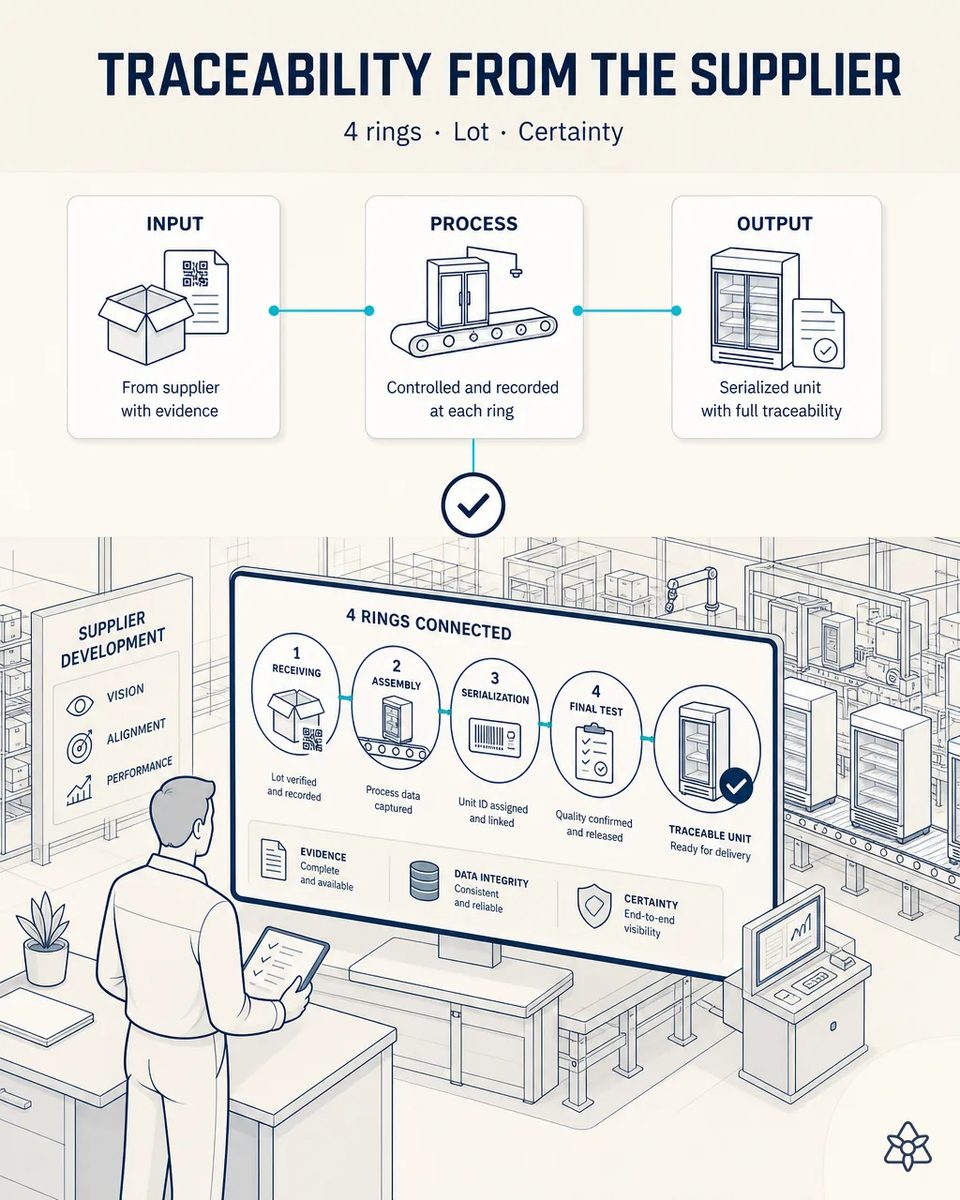
The iLEAN flagship system coordinates 4 rings: the supplier lot captured at receiving, the lot consumed by the assembly production order, the serial number engraved by the serializer, and the final test result with its auditable dossier. If the 4 rings don't match for a unit, JIDOKA AI flags it before it leaves the plant; SMED AI speeds up export configuration changeovers so the coordination doesn't cost productivity.
No single ring answers the question; each already exists in some form and the answer still takes weeks. The value is in linking them: the supplier lot at receiving, the order that consumed it, the serial number engraved and the test that cleared the unit. When the four agree, a unit's history is complete; when they disagree, it is caught before the unit leaves the plant.
The four rings, and what each one guarantees
| Ring | Which cases it draws on | What it guarantees |
|---|---|---|
| 1 · Receiving | Incoming slip (7) + supplier alert (3) | The supplier lot enters correctly |
| 2 · Assembly | Line startup (1) + foam panel (2) + headset (4) | Which order consumed which lot |
| 3 · Serialization | Serializer (8) + export voltage (10) | One serial number per cooler, same in plant and ERP |
| 4 · Final test | Test tablet (5) + lab (6) + dossier (11) | The test that cleared the unit |
| Cross-check in commercial refrigeration | JIDOKA AI | A unit whose rings disagree does not leave |
| Line time | SMED AI | Export changeovers stay fast |
Weeks of manual rebuilding after a supplier alert → a minutes-long lookup by lot or serial number.
Impact estimate — to be validated with your numbers.
The block below is an estimate to be validated against your plant's actual data. We put it forward so the committee has an order of magnitude; we refine it during the assessment.
- Estimated payback 6-12 months against the first avoided mass-traceability event, to validate with Quality, Supplier Development and General Management.
- Weeks of manual rebuilding after a supplier alert become a minutes-long lookup by lot or by serial number. The answer to a supplier alert stops depending on who is available to search paper that week.
- The scope of any field action narrows from everything built in a period to the exact coolers that carry the suspect lot.
- And the plant can answer a bottler or retail customer with serial numbers and countries, not estimates. Supplier development can also hold the component supplier to account with exact figures.
Estimated payback of 6-12 months against the first avoided mass-traceability event. Estimate to validate with Quality, Supplier Development and General Management.
And the fair question from the production manager
“Do we need all twelve cases before this works?” — no, and framing it that way would mean never starting. The rings are built layer by layer, each case pays on its own, and receiving plus serialization already give the first lookups. Linking records across rings is an anchored task, where the best models drop below 1.5% error [1]; when two rings disagree, JIDOKA AI holds the unit and a person decides.
[1] OpenAI paper "Why Language Models Hallucinate", 2025 — on the reliability of AI in anchored tasks.
What people ask about supplier traceability in commercial refrigeration
Which case should we deploy first to build the rings?
Usually receiving and the serializer, because they are the two ends of the chain: the supplier lot coming in and the serial number going out. From there, each new case adds a ring or strengthens one, and each pays on its own.
Can we look up by supplier lot and by serial number?
Both. From a compressor lot you get the list of coolers and destination countries; from a serial number you get every component lot it carries. The lookup works in both directions because every ring shares the same keys: lot, order and serial number.
What does JIDOKA AI do when the rings disagree?
It holds the unit before it leaves the plant and shows which ring does not match, so a person can resolve it on evidence. Every hold and its resolution are recorded, which becomes part of the unit's evidence.
Why is SMED AI part of a traceability system?
Because the coordination adds checks at export configuration changeovers. SMED AI keeps those changeovers fast so traceability does not cost line time. Without it, the extra verification would be paid in line time on every destination change.
Does it replace our ERP or our quality system?
No. It links the records those systems already hold with what happens at the dock, on the line and at the test bench. Each system keeps its role; iLEAN supplies the links that today are rebuilt by hand.
More cases from this series
- The certification dossier, ready without manual rebuildEvery final test generates an auditable dossier organized by certifier (UL, NSF, ENERGY STAR), ready for…
- The compressor supplier alert, turned into action in secondsiLEAN reads a critical supplier alert at zero latency, cross-checks it against active production orders…
- Final test, confirmed by a human in 2 tapsIndustrial tablet at the final test bench: the technician confirms the leak and power-draw reading…
- The foam machine panel, digitized without touching the machineAn external camera reads the polyurethane foam machine's panel and traces the foam cycle lot by lot,…
- The critical-material packing slip, validated in one tapPhoto the packing slip and lot certificate of a critical component; after one tap, everything flows to…
- The lab spreadsheet, absorbed in real timeiLEAN reads the lab's test spreadsheet and pushes it to the ERP after human validation, freeing up…
Tell us how long your last supplier lot lookup took, from the alert to the list of units.
We work on your plant's real data, not ours. Assessment with no commitment.
Request estimated ROI within 48h ‹ See all cases of commercial refrigeration See electronics