The certification dossier, ready without manual rebuild
Payback 6-12 months · certification dossier ready without manual rebuild
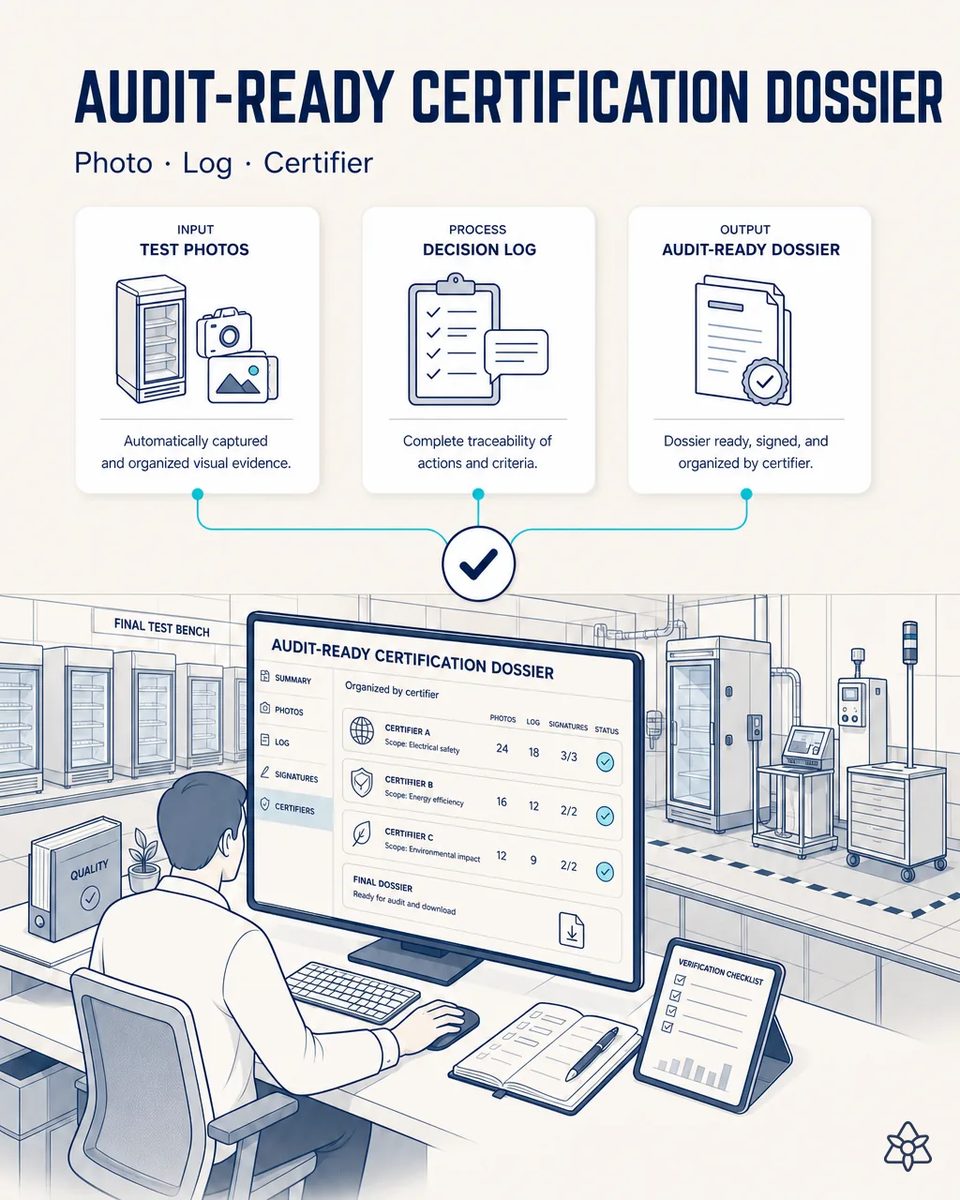
The evidence exists the day the cooler is tested. It is rebuilt the week before the audit.
The day the product certification auditor shows up, someone today spends weeks reconstructing which units from which lot passed which test with what result. The auditor asks for evidence, the plant shows scattered records, and a documentation gap can cost the certification of an entire model line.
- The day the product certification auditor arrives, someone has spent weeks reconstructing which units from which lot passed which test, with what result. It is usually the quality engineer, pulled away from the line for days to search folders and spreadsheets.
- The evidence is scattered: test sheets, lab spreadsheets, photos on phones, records in the ERP. Each source was built for a different purpose, and none of them was built for an auditor.
- The auditor asks for evidence and the plant shows scattered records. A documentation gap can cost the certification of an entire model line.
- And with UL, NSF and ENERGY STAR each asking for their own view of the same tests, the rebuilding happens once per certifier. The evidence is the same; the indexing is different, and so the work is repeated.
Edge captures each final test; Agents files it by certifier, model and period.
Edge plus Agents: every final test automatically generates an auditable dossier — a photo of the measurement result, a timestamped decision log, the technician's signature — that Agents organizes by certification standard and by period/model, with no human work after the fact.
The dossier is not built for the audit; it is closed at the moment each cooler is tested. What Agents does is present the same evidence in the shape each certifier asks for, without anyone rebuilding it. Every gap is found the day it happens, when it can still be completed, instead of the day the auditor asks for it.
Pre-audit rebuilding versus the dossier that keeps itself
| Aspect | Today | With iLEAN Agents |
|---|---|---|
| Preparing for a UL or NSF audit | Weeks of rebuilding records | Zero rebuilding, a review |
| Evidence per final test | Scattered across sheets and files | Photo, decision log and signature |
| UL, NSF, ENERGY STAR views | Rebuilt for each certifier | Same evidence, filtered by standard |
| Missing test record | Found by the auditor on site | Detected when the test happens |
| Model line certification | At risk from a missing record | Backed by every unit tested |
| Who assembles the dossier | Quality, by hand | Agents |
Weeks of pre-audit record rebuilding → zero. Documentation non-conformity risk → eliminated.
Impact estimate — to be validated with your numbers.
The block below is an estimate to be validated against your plant's actual data. We put it forward so the committee has an order of magnitude; we refine it during the assessment.
- Estimated payback 6-12 months, depending on audit frequency. The more certifications and model lines the plant carries, the larger the saving.
- Weeks of pre-audit record rebuilding go to zero.
- The risk of a documentation nonconformity is removed, because a missing record is detected the day the test happens. A model line's certification no longer depends on whether one sheet was filed correctly.
- And the quality team stops preparing the same evidence three times for three certifiers. Quality engineers return to improving the product instead of reconstructing its history.
Estimated payback of 6-12 months depending on audit frequency. Estimate to validate.
And the fair question from the production manager
“Isn't this just a document management system with a new name?” — no: a document system stores what someone uploads afterwards, with the same gaps. Here the evidence is captured at the test itself. Filing each record under the right certifier, model and period is an anchored task, where the best models drop below 1.5% error [1], and the quality manager reviews the dossier before it goes to the auditor. Nothing is sent to a certifier without that human review, and every record keeps a link to the original test photo.
[1] OpenAI paper "Why Language Models Hallucinate", 2025 — on the reliability of AI in anchored tasks.
What people ask about the certification dossier
Which certifications can it organize evidence for?
Any product certification that asks for test evidence by unit or lot. UL, NSF and ENERGY STAR are the usual ones for commercial coolers and merchandisers. New standards can be added by defining what evidence each one requires.
What does each final test contribute to the dossier?
A photo of the measurement result, a timestamped decision log and the technician's signature, tied to the unit's serial number. Those are the same records produced by the final test tablet case, now organized for the auditor.
Does the certifier's auditor log into our systems?
No. They receive a view or a download limited to the period, models and scope of their audit. Their view can be revoked once the audit is closed.
Does it warn us before the audit if something is missing?
Yes. A test without its photo, log or signature is flagged the day it happens, while it can still be completed, not on audit day. That turns audit preparation into a short review rather than a reconstruction.
What about units tested before we deployed it?
They stay in their current records. The dossier builds from the first day onward; importing history is optional. Most plants start with the models that face the next audit.
More cases from this series
- The compressor supplier alert, turned into action in secondsiLEAN reads a critical supplier alert at zero latency, cross-checks it against active production orders…
- Final test, confirmed by a human in 2 tapsIndustrial tablet at the final test bench: the technician confirms the leak and power-draw reading…
- The foam machine panel, digitized without touching the machineAn external camera reads the polyurethane foam machine's panel and traces the foam cycle lot by lot,…
- The critical-material packing slip, validated in one tapPhoto the packing slip and lot certificate of a critical component; after one tap, everything flows to…
- The lab spreadsheet, absorbed in real timeiLEAN reads the lab's test spreadsheet and pushes it to the ERP after human validation, freeing up…
- Photo the production order: the lot exists from minute oneHow a commercial refrigeration factory digitizes the production order and build sheet with a photo, with…
Tell us how many weeks your team spends preparing each certification audit.
We work on your plant's real data, not ours. Assessment with no commitment.
Request estimated ROI within 48h ‹ See all cases of commercial refrigeration See electronics