Photo the production order: the lot exists from minute one
Payback 4-9 months · from end-of-shift transcription to a lot visible from startup
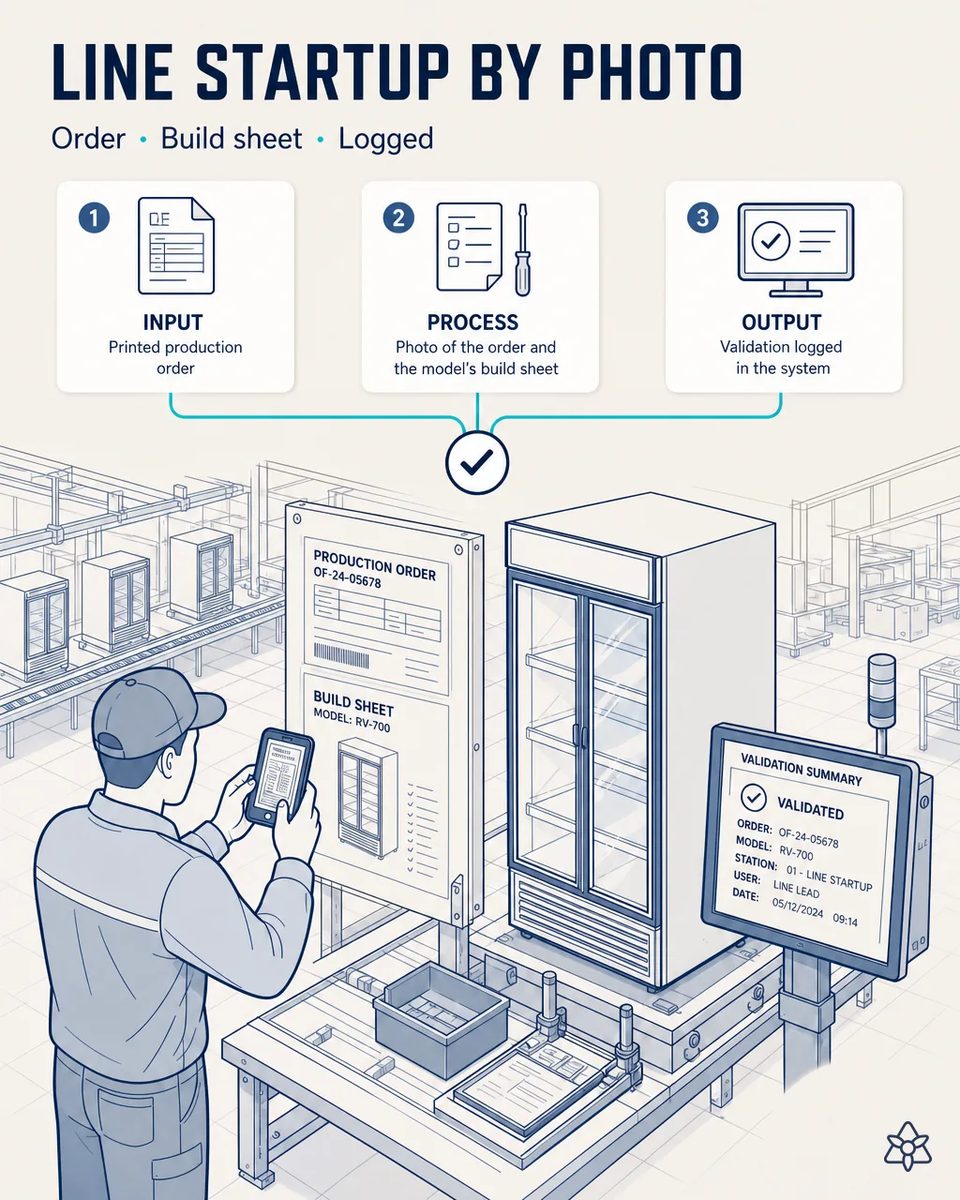
The order that sets voltage and variant waits in a folder until shift end.
In a commercial refrigerator and merchandiser factory, every line startup begins with a printed production order that sets the model, destination voltage and lot size, plus a model-specific build sheet with its variants. Today both sheets sit in the line lead's folder until someone transcribes them at shift end. A transcription error in voltage or variant only surfaces at final test, once the cabinet is already fully built and rework gets expensive — exactly the kind of friction an export operation serving dozens of countries with different electrical codes can't afford.
- Every startup on a cooler or merchandiser line begins with a printed production order: model, destination voltage, lot size. Next to it sits the build sheet for that model, with its door, shelving, lighting and controller variants.
- Both sheets stay in the line lead's folder for the whole shift. Someone types them in at the end, from handwriting and memory, when the lot has already been built. The handwriting is the line lead's, but the typing is often done by someone who was not at the line when the lot started.
- A wrong voltage or a wrong variant typed at the end of the shift only surfaces at final test, with the cabinet foamed, the refrigeration circuit charged and the doors hung — the most expensive point to rework.
- For a plant exporting to dozens of countries with different electrical codes, a lot that does not exist in any system during its own build is a lot nobody can check against the order while it is still cheap to fix. Coolers for one bottler program can share a cabinet with coolers for another, with only the voltage and the controller setting telling them apart.
Connect in photo mode — the line lead adds one photo to the startup they already do.
Connect photo mode: the line lead photographs the production order and the build sheet at startup, with a phone or an industrial tablet. A grounded language model extracts model, voltage, variant, quantity, line and shift, and stores it in iLEAN's central memory. Zero change to the line lead's routine.
It is the case with the least friction of the twelve because it asks the line for nothing new: the order and the build sheet stay on paper, exactly as they are. What changes is that the lot exists from the first cabinet, and every later check has something to compare against. On most plants it is also the first case approved, precisely because nobody on the floor has to be convinced.
A cooler line startup on paper versus a captured startup
| Aspect | Today, in the folder | With iLEAN Connect |
|---|---|---|
| When the lot exists in a system | End of shift, typed by hand | From startup |
| Destination voltage | Read again at final test | Extracted from the order at minute one |
| Door, shelf and controller variant | Checked when the unit is complete | Compared from the first cabinet |
| Wrong-variant rework | Cabinet already foamed and charged | Caught before assembly advances |
| Lot by model and line | Rebuilt from paper | One query |
| Line lead's startup routine | Order and build sheet on paper | Unchanged: one extra photo |
End-of-shift transcription → lot visible from startup. Variant mismatch caught at final test → caught against the order from the first cabinet.
Impact estimate — to be validated with your numbers.
The block below is an estimate to be validated against your plant's actual data. We put it forward so the committee has an order of magnitude; we refine it during the assessment.
- Estimated payback 4-9 months, depending on the number of line startups per day.
- Less rework from mismatched variants: the mismatch is caught against the order from the first cabinet, not at final test. A cooler that would have been built to the wrong spec is corrected before it gets its foam and refrigerant charge.
- End-of-shift transcription disappears; the lot is visible to production, quality and planning from startup.
- And every later case in this matrix — final test, serialization, traceability — starts from a lot that already exists in the central memory. That is why it is usually deployed first.
Estimated payback of 4-9 months depending on daily startup volume, with less rework from mismatched variants. Estimate to validate.
And the fair question from the production manager
“What if it reads 115 V where the order says 220 V?” — extracting fields from a production order with a known layout is an anchored task, where the best models drop below 1.5% error [1]. And voltage is a closed list per destination: a value that does not match the order's country is flagged for the line lead to confirm before anything is stored.
[1] OpenAI paper "Why Language Models Hallucinate", 2025 — on the reliability of AI in anchored tasks.
What people ask about capturing the cooler line startup
Do we have to redesign the production order or the build sheet?
No. They are read exactly as they print today, including handwritten notes in the margin, which are often where a last-minute variant change is written. The build sheet keeps its role as the reference document at the station.
Does it understand the build sheet variants for each cooler model?
Yes. Door type, shelving, lighting kit and controller are extracted as separate fields and tied to the model, so a mismatch with the order shows up immediately. Variant codes specific to a bottler or retail program are learned from your own build sheets during commissioning.
What happens when the line changes model mid-shift?
The new order and build sheet are photographed at that changeover, and the system opens a new lot. Each cabinet is attributed to the order that was active when it was built. That keeps the lot count clean even on lines that switch between a single-door cooler and a merchandiser twice a shift.
Is a phone enough or do we need an industrial tablet?
Either works. The choice usually depends on gloves, dust and where the line lead keeps the folder, not on the reading quality. What matters is that the photo is taken at startup, before the first cabinet moves.
Do we need the ERP connected before starting?
No. The case works from the first startup against iLEAN's central memory, and the push to the ERP is connected once the value is proven on the line. Many plants run the first weeks this way to measure how many variant mismatches the photo catches.
More cases from this series
- The certification dossier, ready without manual rebuildEvery final test generates an auditable dossier organized by certifier (UL, NSF, ENERGY STAR), ready for…
- The compressor supplier alert, turned into action in secondsiLEAN reads a critical supplier alert at zero latency, cross-checks it against active production orders…
- Final test, confirmed by a human in 2 tapsIndustrial tablet at the final test bench: the technician confirms the leak and power-draw reading…
- The foam machine panel, digitized without touching the machineAn external camera reads the polyurethane foam machine's panel and traces the foam cycle lot by lot,…
- The critical-material packing slip, validated in one tapPhoto the packing slip and lot certificate of a critical component; after one tap, everything flows to…
- The lab spreadsheet, absorbed in real timeiLEAN reads the lab's test spreadsheet and pushes it to the ERP after human validation, freeing up…
Tell us how many line startups and voltage variants your cooler lines run per day.
We work on your plant's real data, not ours. Assessment with no commitment.
Request estimated ROI within 48h ‹ See all cases of commercial refrigeration See electronics