Final test, confirmed by a human in 2 taps
Payback 3-6 months · final test result traced to serial number from the first tap
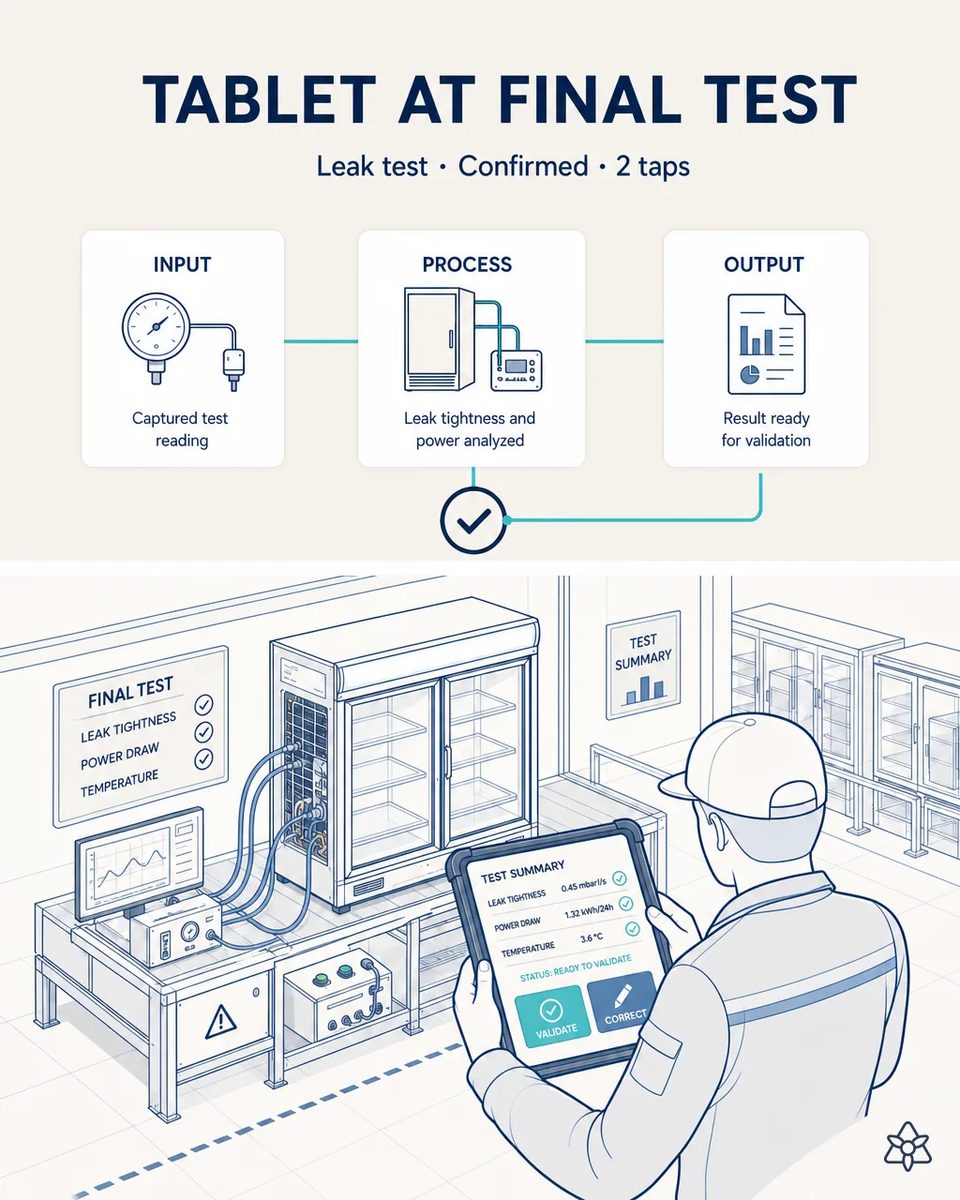
The last checkpoint before shipping is still transcribed by hand.
Final test certifies that the unit meets leak-tightness, power draw and temperature specs before moving to packing and shipping to any of more than 50 destination countries — it's the last checkpoint before the unit leaves the plant. Automating its logging without a human looking at it first would risk product certifications.
- Final test certifies that each cooler meets leak tightness, power draw and temperature pull-down before it moves to packing and ships to any of more than 50 destination countries.
- It is the last checkpoint before the unit leaves the plant, and the result is still written on a sheet and typed in at shift end. Leak rate, watts and temperature are copied by hand from the instrument display, often by the same technician who already has the next unit connected.
- Automating that record without a human looking at it first would put product certifications at risk. That is why most plants keep it manual, even knowing it is slow.
- Meanwhile the unit has already been packed and sometimes shipped, with its test result living only on paper. When a question comes back from the field, finding that sheet again takes longer than the test itself.
Connect with early human verification — the technician confirms in two taps.
An industrial tablet at the test bench shows a visual summary of what iLEAN just captured from the test — a photo of the measurement device's display, OCR reading. The technician confirms with two taps (confirm / correct). Only then does the data cross over to the central system and the unit's record.
The point is not to remove the technician from the decision; it is to put them at the start of the data instead of the end. The reading is captured, the technician confirms it at the bench, and only then does it reach the unit's record. It is a deliberate choice: data reaches the system faster precisely because a human has seen it first.
The final test result on paper versus confirmed at the bench
| Aspect | Today | With iLEAN Connect |
|---|---|---|
| Leak tightness reading | Written on a sheet | Captured from the instrument display |
| Power draw and pull-down temperature | Typed in at shift end | Confirmed at the bench |
| Who validates the data | Nobody, until the transcription | The technician, in two taps |
| Link to the serial number | Rebuilt afterwards | From the first tap |
| A correction | Crossed out on paper | Recorded with its author |
| Data reaching the record unseen | — | Never |
Manual transcription of the result at shift end → data validated and traced to the unit in seconds.
Impact estimate — to be validated with your numbers.
The block below is an estimate to be validated against your plant's actual data. We put it forward so the committee has an order of magnitude; we refine it during the assessment.
- Estimated payback 3-6 months, from full final-test traceability by serial number.
- Manual transcription at shift end becomes data validated and traced to the unit in seconds. No more hunting for test sheets when a field question arrives about a specific serial number.
- The test result exists before the unit is packed, not after it has shipped. Units with a doubtful test can be held before packing instead of recalled from the dock.
- And certifications gain a record with a human confirmation behind every value, which is exactly what an auditor wants to see.
Estimated payback of 3-6 months from full final-test traceability by serial number. Estimate to validate.
And the fair question from the production manager
“And if the OCR misreads the leak rate and the technician taps confirm without looking?” — reading a measurement instrument's display is an anchored task, where the best models drop below 1.5% error [1]. On top of that, each value is checked against the test's pass range: an out-of-range reading cannot be confirmed with one tap, it forces the technician to look and correct.
[1] OpenAI paper "Why Language Models Hallucinate", 2025 — on the reliability of AI in anchored tasks.
What people ask about confirming final test at the bench
How long does the confirmation take the technician?
Two taps: confirm or correct. It replaces writing the result on a sheet, so in practice it does not add time to the test cycle. The technician sees the values side by side with the photo of the instrument display.
Which readings are captured?
Leak tightness of the refrigeration circuit, power draw and cabinet temperature, taken from the display of each measuring instrument at the bench. Each reading keeps the photo it came from, which is what an auditor or a customer will want to see.
What is stored when the technician corrects a value?
Both the captured value and the corrected one, with the technician's name and time. The correction is part of the evidence, not something erased. Over time, the corrections also show which instrument or which bench needs attention.
Can a unit move to packing without a confirmed test?
That depends on the rule you set. Most plants block packing until the result is confirmed, because it is the last checkpoint before shipping. The rule can also differ by destination or by model if your quality system requires it.
Does this help with UL, NSF or ENERGY STAR audits?
Yes. Each result is tied to the serial number and carries a human confirmation, which is the base the certification dossier case builds on. It is usually the second case deployed, because it creates the trust the rest of the matrix relies on.
More cases from this series
- The certification dossier, ready without manual rebuildEvery final test generates an auditable dossier organized by certifier (UL, NSF, ENERGY STAR), ready for…
- The compressor supplier alert, turned into action in secondsiLEAN reads a critical supplier alert at zero latency, cross-checks it against active production orders…
- The foam machine panel, digitized without touching the machineAn external camera reads the polyurethane foam machine's panel and traces the foam cycle lot by lot,…
- The critical-material packing slip, validated in one tapPhoto the packing slip and lot certificate of a critical component; after one tap, everything flows to…
- The lab spreadsheet, absorbed in real timeiLEAN reads the lab's test spreadsheet and pushes it to the ERP after human validation, freeing up…
- Photo the production order: the lot exists from minute oneHow a commercial refrigeration factory digitizes the production order and build sheet with a photo, with…
Tell us how many coolers pass your final test benches per shift and where the result is written.
We work on your plant's real data, not ours. Assessment with no commitment.
Request estimated ROI within 48h ‹ See all cases of commercial refrigeration See electronics