The critical-material packing slip, validated in one tap
Payback 4-9 months · -50 to -70% ERP seats in receiving + supplier lot traced from the photo
The supplier lot is lost at the dock, under pressure from the truck.
A truck arrives with a lot of compressors or a coil of sheet steel. The receiving lead has the packing slip and the lot's quality certificate, lot number on the label, and on top of signing has to enter the ERP line by line. Either the driver waits racking up demurrage, or receiving rushes it and the critical component's lot ends up poorly traced — that shows up weeks later, when a component from that lot fails in the field.
- A truck arrives with a lot of compressors or a coil of sheet steel. The receiving lead has the packing slip, the lot quality certificate and the lot number on the label. Compressors usually arrive palletized with one slip for several lots, and sheet steel with a mill certificate that has its own heat number.
- On top of signing, they have to enter it in the ERP line by line, while the driver waits.
- Either the truck racks up demurrage, or receiving rushes it and the component lot ends up poorly traced.
- That gap does not show at the dock. It shows weeks later, when a compressor from that lot fails in the field and nobody can say which coolers carry it. At that point the only safe answer is a wide one, which means inspecting far more units than necessary.
Connect in photo-of-the-analog mode — slip, certificate and label in one capture.
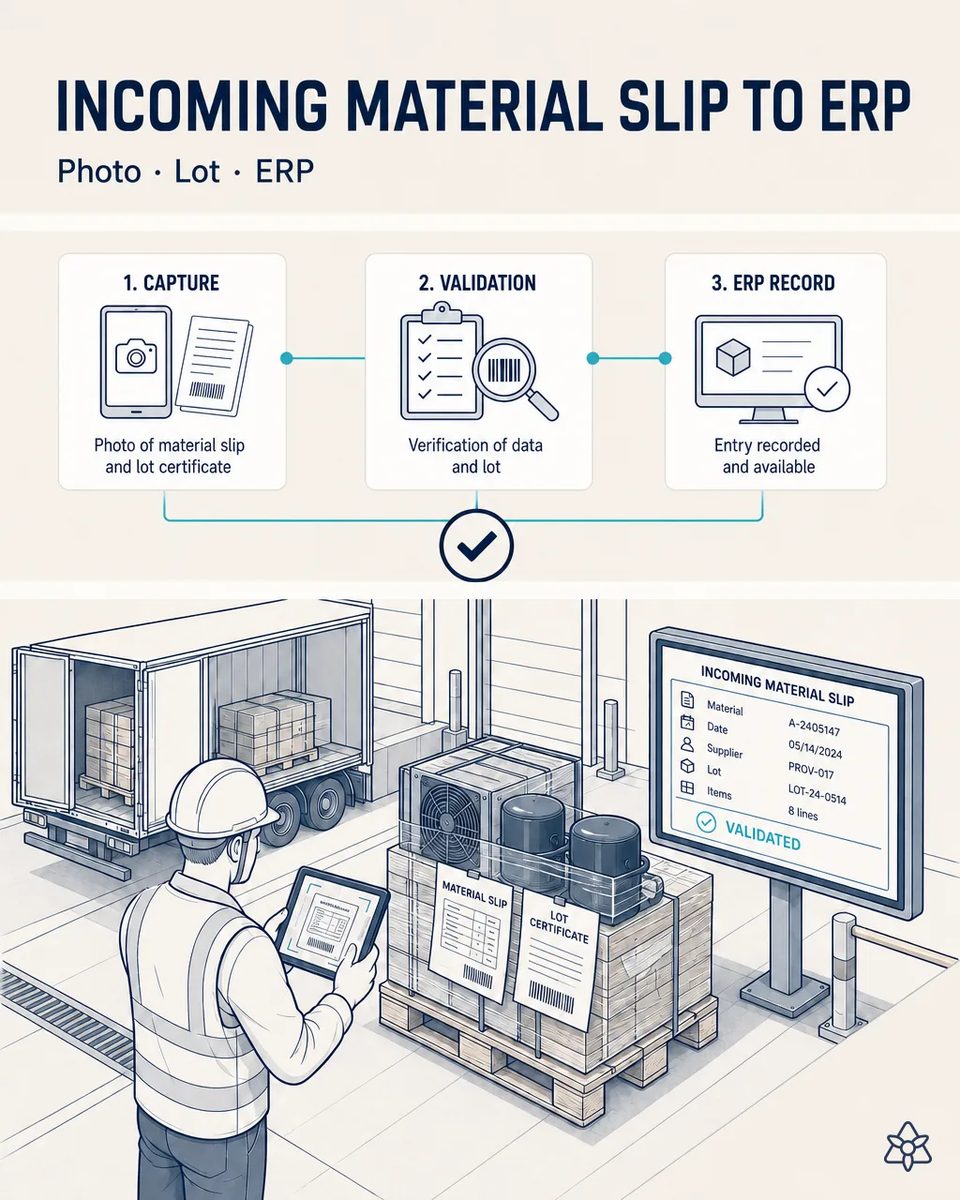
Connect photo of the packing slip and lot certificate (reading barcode, QR, plain OCR): extracts everything and summarizes it on screen. The receiving lead confirms with one tap and Connect pushes it to the ERP via API, linking the supplier lot to the production orders that will consume it.
Receiving is the first ring of all traceability: if the supplier lot does not enter correctly here, nothing downstream can fix it. One photo and one tap make it enter correctly every time, even with the truck waiting. It is also the case that shortens the most visible queue in the plant: the one at the dock.
Receiving compressors by hand versus receiving them by photo
| Aspect | Today, at the dock | With iLEAN Connect |
|---|---|---|
| Booking in a compressor delivery | Line by line in the ERP | One photo and one tap |
| Supplier lot number | Typed, sometimes skipped | Read from label, barcode or QR |
| Lot quality certificate | Filed on paper | Linked to the lot |
| Driver waiting time | Demurrage | Seconds |
| Lot → production order | Unknown until it fails | Linked from receiving |
| Receiving-module seats | Several active | -50 to -70% |
Transcription under carrier time pressure → receiving traced in seconds with no demurrage.
Impact estimate — to be validated with your numbers.
The block below is an estimate to be validated against your plant's actual data. We put it forward so the committee has an order of magnitude; we refine it during the assessment.
- 💰 CFO angle: fewer people need the ERP just to book in deliveries. Estimated reduction of -50 to -70% in receiving-module seats.
- Estimated payback 4-9 months. The carrier leaves sooner, and the dock is free for the next delivery.
- Transcription under carrier time pressure becomes receiving traced in seconds, with no demurrage.
- And the supplier lot of every compressor, coil and control board is linked to the orders that consume it from the moment it arrives. Which is the starting point of the flagship traceability case.
CFO angle: -50 to -70% in receiving-module ERP seats. Estimated payback of 4-9 months. Estimate to validate.
And the fair question from the production manager
“What if the slip says one lot and the label on the compressor box says another?” — reading a packing slip, a certificate and a label with known fields is an anchored task, where the best models drop below 1.5% error [1]. And the cross-check between the three documents is exactly the point: a mismatch is shown on screen before the receiving lead confirms, not after.
[1] OpenAI paper "Why Language Models Hallucinate", 2025 — on the reliability of AI in anchored tasks.
What people ask about booking in compressors and sheet steel
Does it read the lot certificate as well as the packing slip?
Yes. Both are captured in the same photo session and the certificate is stored linked to the supplier lot, ready for any later quality query. The heat number on a steel certificate is captured too, because it is what the steel mill will ask for in a claim.
What codes does it read on the boxes and labels?
Barcodes, QR codes and plain printed text. Many compressor and steel suppliers mix all three on the same delivery. The receiving lead does not need any extra device beyond the phone or tablet already used at the dock.
Does the receiving lead still sign?
Yes, the confirmation tap is the receiving lead's signature. Nothing reaches the ERP without it. If they want to correct a field, they do it on the same screen before confirming.
What happens with a partial delivery?
The quantities read are compared with the purchase order and the shortfall is shown on screen, so the partial receipt is recorded as partial. The missing part stays open against the purchase order until the next delivery arrives.
Does it work for refrigerant, foam chemicals and control boards too?
Yes, any critical material with a slip and a lot. Compressors and sheet steel usually go first because they weigh most in field failures. Each new material reuses the same pattern, with its own fields defined at commissioning.
More cases from this series
- The certification dossier, ready without manual rebuildEvery final test generates an auditable dossier organized by certifier (UL, NSF, ENERGY STAR), ready for…
- The compressor supplier alert, turned into action in secondsiLEAN reads a critical supplier alert at zero latency, cross-checks it against active production orders…
- Final test, confirmed by a human in 2 tapsIndustrial tablet at the final test bench: the technician confirms the leak and power-draw reading…
- The foam machine panel, digitized without touching the machineAn external camera reads the polyurethane foam machine's panel and traces the foam cycle lot by lot,…
- The lab spreadsheet, absorbed in real timeiLEAN reads the lab's test spreadsheet and pushes it to the ERP after human validation, freeing up…
- Photo the production order: the lot exists from minute oneHow a commercial refrigeration factory digitizes the production order and build sheet with a photo, with…
Tell us how long it takes to book in a compressor delivery at your dock today.
We work on your plant's real data, not ours. Assessment with no commitment.
Request estimated ROI within 48h ‹ See all cases of commercial refrigeration See electronics