The compressor supplier alert, turned into action in seconds
Payback 3-7 months · from hours of alert latency to replanning in seconds
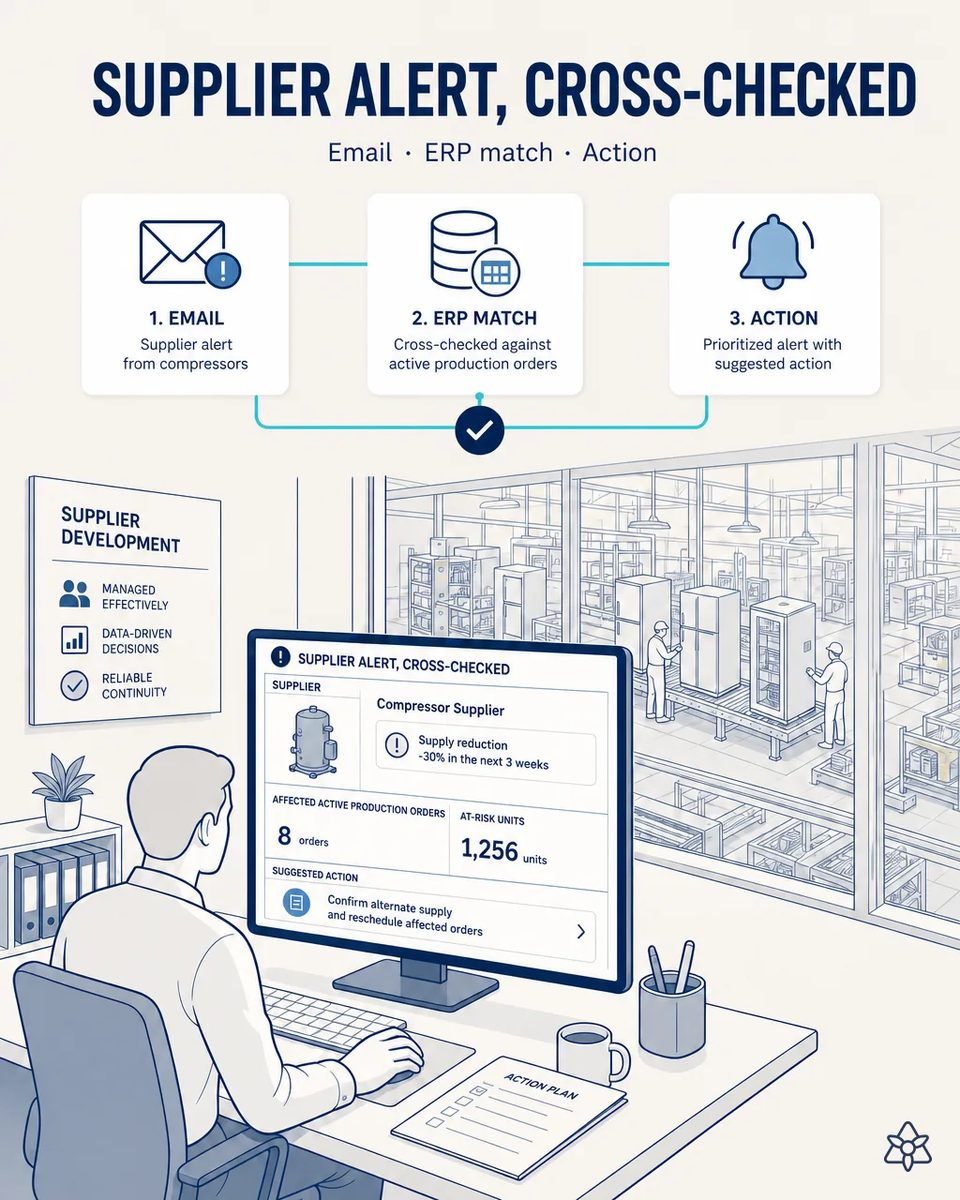
The compressor alert arrives on time and gets read too late.
Mid-morning, an email comes in from the compressor supplier flagging a spec change or a 48-hour delay on the lot due that week. It lands in an inbox nobody is watching in real time. By the time the alert is read, a production order is already planned around that compressor: the line stops waiting on a decision, or the wrong compressor makes it to the line.
- Mid-morning, the compressor supplier emails a spec change or a 48-hour delay on the lot due that week. It is written in free text, in a thread with quotes and shipping notes. Sometimes it is a phone message to a buyer instead of an email, which is even harder to find later.
- It lands in an inbox that nobody reads in real time, competing with dozens of other messages.
- By the time it is read, a production order is already planned around that compressor. Either the line stops waiting for a decision, or a compressor that no longer matches the spec reaches the line. In both cases, the information existed hours earlier in someone's inbox.
- The compressor is the heart of the cooler and the refrigerant charge (R290 or R600a) depends on it: a wrong compressor is not a cosmetic issue, it is a unit that has to come back apart.
Connect in chaotic-sources mode — the supplier email becomes a replanning decision.
Connect chaotic-sources mode: the system reads the email at zero latency, extracts intent, supplier, component and dates, and cross-checks it against active production orders in the ERP. It returns to supplier development and production the concrete action: reschedule the order or confirm the replacement lot's approval before release.
Reading the alert sooner is only half of it. The other half is the cross-check: which active orders depend on that compressor lot, and what to do with them. That is what reaches supplier development and production, already worked out. Supplier development keeps the relationship with the compressor maker; production keeps the decision on the line. iLEAN only removes the hours in between.
The compressor alert in the inbox versus the alert matched to the ERP
| Aspect | Today, in the inbox | With iLEAN Connect |
|---|---|---|
| Time to read a compressor alert | Hours, depending on who is in | Seconds |
| Orders that depend on that lot | Searched by hand in the ERP | Listed automatically |
| Spec change on the compressor | Discovered at the line | Flagged before release |
| Replacement lot | Approved in a hurry or not at all | Approval requested before release |
| Line waiting on a decision | Common | Decision ready when the line needs it |
| Who acts | Whoever read it first | Supplier development and production |
Hours of human latency → seconds. Replanning decisions based on the real alert, not on what got read late.
Impact estimate — to be validated with your numbers.
The block below is an estimate to be validated against your plant's actual data. We put it forward so the committee has an order of magnitude; we refine it during the assessment.
- Estimated payback 3-7 months, depending on how often critical supplier alerts occur.
- From hours of human latency to seconds between the supplier's email and the replanning decision. The faster the decision, the more options remain: a resequenced order instead of a stopped line.
- Fewer line stops waiting on a compressor decision, and fewer compressors reaching the line against an outdated spec. Each wrong compressor that does not reach the line is a cooler that does not have to be opened, recovered and recharged.
- And replanning is based on the real alert, not on whatever got read late in the afternoon.
Estimated payback of 3-7 months depending on how often critical supplier alerts occur. Estimate to validate.
And the fair question from the production manager
“Can it really tell a delay notice from a routine shipping confirmation?” — classifying the intent of a supplier email and pulling out component, lot and dates is an anchored task, where the best models drop below 1.5% error [1]. And it never reschedules anything on its own: the suggested action goes to a person in supplier development or production, who decides.
[1] OpenAI paper "Why Language Models Hallucinate", 2025 — on the reliability of AI in anchored tasks.
What people ask about compressor supplier alerts
Which mailbox does it read for compressor alerts?
A dedicated operational address that the supplier writes to or that is copied on supplier threads. It does not read personal inboxes. Supplier threads that today go to one buyer's personal address can be copied to it without changing the supplier's habits.
Does it understand a spec change, not just a delay?
Yes. A change in displacement, refrigerant or electrical rating on the compressor is classified separately from a date change, because the action it triggers is different. A change in the compressor's specification usually needs a quality approval, while a date change needs a planning decision.
Does it suggest the action or execute it?
It suggests it: reschedule the order or confirm the replacement lot's approval before release. A person in supplier development or production executes it. The action and who executed it are recorded with the alert, which is useful for the supplier review.
Does it cover other critical suppliers, like control boards or sheet steel?
Yes, the pattern is the same. Compressors usually go first because they are the component with the highest impact on the finished cooler. Each supplier is configured with its components, so the cross-check knows which orders depend on which part.
What if the compressor supplier writes in another language?
It is extracted the same way. Many compressor suppliers write from other countries, and the structured result comes back in the plant's language. Dates are normalized to the plant's time zone, which avoids misreading a delivery day from another continent.
More cases from this series
- The certification dossier, ready without manual rebuildEvery final test generates an auditable dossier organized by certifier (UL, NSF, ENERGY STAR), ready for…
- Final test, confirmed by a human in 2 tapsIndustrial tablet at the final test bench: the technician confirms the leak and power-draw reading…
- The foam machine panel, digitized without touching the machineAn external camera reads the polyurethane foam machine's panel and traces the foam cycle lot by lot,…
- The critical-material packing slip, validated in one tapPhoto the packing slip and lot certificate of a critical component; after one tap, everything flows to…
- The lab spreadsheet, absorbed in real timeiLEAN reads the lab's test spreadsheet and pushes it to the ERP after human validation, freeing up…
- Photo the production order: the lot exists from minute oneHow a commercial refrigeration factory digitizes the production order and build sheet with a photo, with…
Tell us how many hours your last compressor supplier alert took to reach production.
We work on your plant's real data, not ours. Assessment with no commitment.
Request estimated ROI within 48h ‹ See all cases of commercial refrigeration See electronics