The cabinet defect, caught before it reaches the customer
Payback 5-10 months · cabinet defect rejected before packing, not at the point of sale
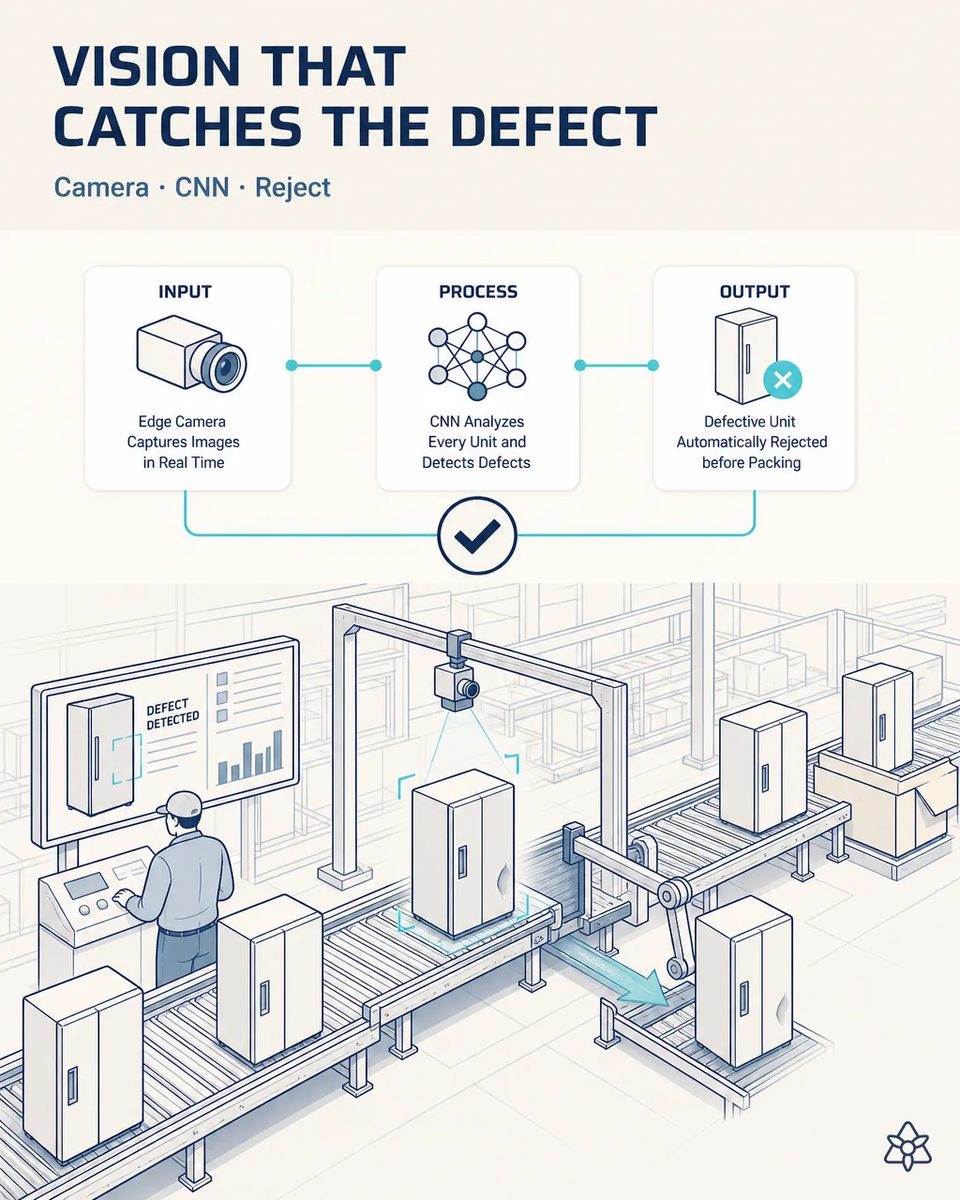
The cabinet is the part the bottler sees, and the least inspected.
At line cadence, the human eye gets tired and lets through sheet-metal dents, paint defects, or a glass door seal that doesn't close tight. The defect reaches the end customer's point of sale — visible, brand-facing, expensive to fix in the field.
- At line cadence, the inspector's eye gets tired. Sheet-metal dents, paint runs and a glass door gasket that does not seal flush slip through. The inspector is usually alone at the end of the line, looking at every cabinet at the same pace for the whole shift.
- The cooler is a brand-facing object: it ends up at the bottler's or the retailer's point of sale, in front of their shoppers.
- A defect there is visible, embarrassing for the customer and expensive to fix in the field, often with a technician traveling to the store. The bottler or retailer judges the plant by what its shoppers see in the store, not by the yield report.
- Door seal problems are worse than cosmetic: a gasket that does not close tight raises power draw and makes the cooler fail the customer's own checks.
Edge — a camera over the line and a model trained on that cooler model's cabinets.
An Edge camera over the line with a neural network trained on good and bad cabinets of that specific model catches the defect in milliseconds and pulls the unit before packing.
The camera does not get tired at the end of the shift and inspects the hundredth cabinet like the first. The unit with the defect is pulled before it is boxed, which is the last point where fixing it is cheap. It also gives Quality something it does not have today: a count of each defect type per model, per shift and per station.
Cabinet inspection by eye versus Edge vision
| Aspect | Visual inspection | With iLEAN Edge |
|---|---|---|
| Coverage at line speed | Depends on fatigue | Every cabinet, every shift |
| Sheet-metal dent | Seen if the light is right | Detected in milliseconds |
| Paint run or scratch | Inconsistent | Classified per unit |
| Door gasket not seating | Rarely checked | Checked on every door |
| Where the defect is found | At the point of sale | Before packing |
| Field repair at the store | Recurring cost | Avoided |
Human visual inspection at line speed → consistent Edge inspection shift after shift.
Impact estimate — to be validated with your numbers.
The block below is an estimate to be validated against your plant's actual data. We put it forward so the committee has an order of magnitude; we refine it during the assessment.
- Estimated payback 5-10 months, depending on line speed and the current reject rate.
- Cabinet defects rejected before packing, not discovered at the bottler's or retailer's point of sale. Every defect stopped at the plant is a field visit avoided at the customer's store.
- Human visual inspection at line speed becomes consistent Edge inspection shift after shift. The defect statistics per model show which upstream station is producing them.
- And the inspector moves from looking at every cabinet to deciding on the borderline ones the model escalates.
Estimated payback of 5-10 months depending on line speed and current reject rate. Estimate to validate.
And the fair question from the production manager
“A paint shade or a reflection on the glass door will make it reject good coolers.” — that is the real risk, which is why the model is trained on good and bad cabinets of your specific models, under your line's lighting. Classifying a known defect type on a fixed product is an anchored task, where the best models drop below 1.5% error [1]; the borderline cases go to a person, and each decision improves the model.
[1] OpenAI paper "Why Language Models Hallucinate", 2025 — on the reliability of AI in anchored tasks.
What people ask about cabinet vision inspection
Which defects does it catch on a cooler cabinet?
Sheet-metal dents, paint runs and scratches, and a glass door gasket that does not seal flush. The catalog is defined with your quality team at commissioning. New defect types can be added later as they appear in claims.
Does it handle several cooler models on the same line?
Yes. The model in use switches with the active production order, so a single-door cooler and a two-door merchandiser are each checked against their own reference. Product changes on the line do not require recalibrating the camera, only selecting the right model.
Does it slow down the conveyor?
No. Inference runs locally next to the camera in milliseconds per cabinet and does not depend on the plant network. That is what allows it to work at the cadence of a cooler line without becoming a bottleneck.
How many cabinets do you need to train it?
Fewer than expected, because the defect catalog of a cabinet is short and repetitive. What matters is that the images come from your models and your line. The first model is usually trained in a few weeks with real cabinets from the line.
Do images of our customers' branded coolers leave the plant?
No. Images are processed at the edge, next to the line, and stay in the plant unless you decide otherwise. That matters when the coolers carry your bottler customers' artwork and logos.
More cases from this series
- The certification dossier, ready without manual rebuildEvery final test generates an auditable dossier organized by certifier (UL, NSF, ENERGY STAR), ready for…
- The compressor supplier alert, turned into action in secondsiLEAN reads a critical supplier alert at zero latency, cross-checks it against active production orders…
- Final test, confirmed by a human in 2 tapsIndustrial tablet at the final test bench: the technician confirms the leak and power-draw reading…
- The foam machine panel, digitized without touching the machineAn external camera reads the polyurethane foam machine's panel and traces the foam cycle lot by lot,…
- The critical-material packing slip, validated in one tapPhoto the packing slip and lot certificate of a critical component; after one tap, everything flows to…
- The lab spreadsheet, absorbed in real timeiLEAN reads the lab's test spreadsheet and pushes it to the ERP after human validation, freeing up…
Tell us how many cabinet defect claims your bottler and retail customers sent last year.
We work on your plant's real data, not ours. Assessment with no commitment.
Request estimated ROI within 48h ‹ See all cases of commercial refrigeration See electronics