The serializer and the ERP, finally in sync
Payback 3-6 months · removes double entry between serializer and ERP
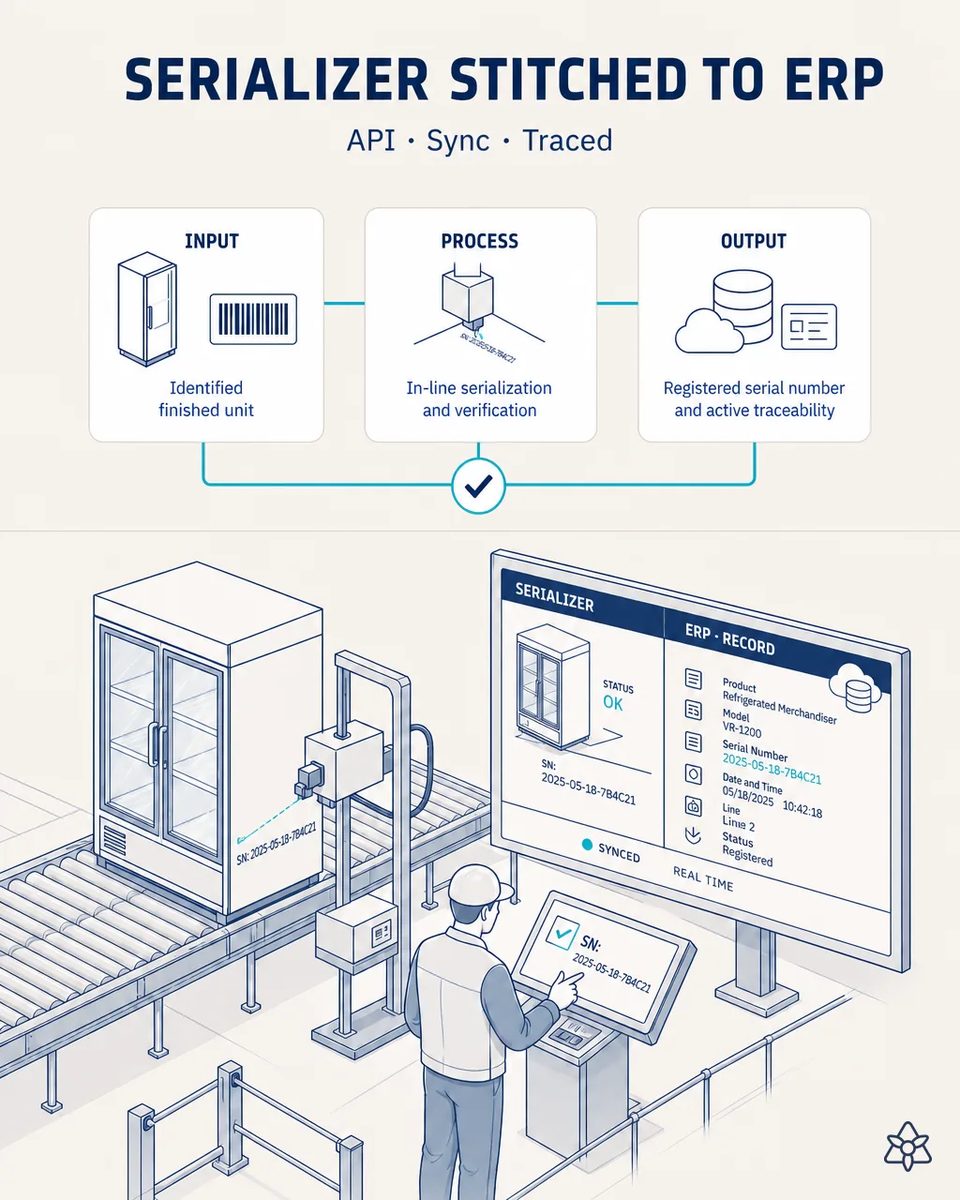
The key to the whole cooler's traceability is typed twice.
The serial number the serializer engraves on each finished unit is the key linking that unit to every component lot it contains. The serializer usually already has an API or protocol of its own, but there's never time to integrate it well with the ERP. Someone types the same serial number into both systems, risking a mismatch exactly where it matters most.
- The serial number engraved on each finished cooler is the key that links the unit to every component lot inside it: compressor, control board, foam, sheet metal.
- The serializer usually already has an API or a protocol of its own. There is just never time to integrate it properly with the ERP. IT has other priorities, and the serializer vendor quotes an integration project that never gets budget.
- So someone types the same serial number into both systems, by hand, at line speed.
- A single mismatch breaks the chain exactly where it matters most: the unit exists physically with one number and in the ERP with another. And the mismatch is usually discovered when it hurts: during a field claim or a supplier lot lookup.
Connect stitches serializer and ERP — what is engraved is what is recorded.
iLEAN Connect stitches the serializer and the ERP together via API: what the serializer physically engraves on the unit is reflected in the ERP record at the same instant, without replacing either system.
Neither system is replaced and neither vendor has to change anything. Connect sits between the two and makes sure that the number physically marked on the cabinet appears in the ERP at the same instant. It is the smallest case in scope and one of the most important in effect, because every other link in the chain hangs from this number.
The serial number typed twice versus the serial number synced
| Aspect | Today | With iLEAN Connect |
|---|---|---|
| Serial number entry | Typed in two systems | Once, by the serializer |
| Mismatch risk | On every unit | Removed |
| Unit ↔ component lots | Broken by a typo | Kept intact |
| When the ERP knows the unit | Whenever someone types it | The moment it is engraved |
| Serializer software | — | Untouched |
| ERP | — | Untouched |
Double entry with mismatch risk → automatic sync with no manual work.
Impact estimate — to be validated with your numbers.
The block below is an estimate to be validated against your plant's actual data. We put it forward so the committee has an order of magnitude; we refine it during the assessment.
- Estimated payback 3-6 months, by removing the costliest break point in traceability.
- Double entry with mismatch risk becomes automatic sync with no manual work. Duplicate or missing serial numbers in the ERP stop appearing at shipping.
- The person who typed serial numbers twice moves to work that adds value on the line. Nobody has to reconcile two lists of serial numbers at month end.
- And every later traceability query — by compressor lot, by destination country — rests on a serial number that is guaranteed to be the same in the plant and in the ERP.
Estimated payback of 3-6 months by removing the costliest break point in traceability. Estimate to validate.
And the fair question from the production manager
“If the serializer already has an API, why not just integrate it ourselves?” — you can, and many plants plan to; the issue is that it never gets prioritized. Connect does it without a project on either side. And matching serializer events to ERP records is an anchored task, where the best models drop below 1.5% error [1]; anything that does not match one-to-one is held for a person to resolve, not pushed.
[1] OpenAI paper "Why Language Models Hallucinate", 2025 — on the reliability of AI in anchored tasks.
What people ask about stitching the serializer to the ERP
Do we have to replace the serializer or the ERP?
No. Connect uses the interfaces both already have. The serializer keeps marking, the ERP keeps recording, and the manual step in between disappears. Neither vendor has to modify its product, and neither maintenance contract is affected.
What if the serializer has no modern API?
Then Connect uses whatever protocol or export it does have, or reads its screen as in the panel cases. There is always a way in that does not require replacing it. In practice, almost every serializer installed in the last two decades has some usable output.
What happens if a mark fails on the cabinet?
The failed event is recorded as such and the serial number is not created in the ERP until the mark is redone, so no ghost units appear. The operator sees the failed mark on the screen next to the serializer and can repeat it.
Does it link the serial number to the compressor and board lots?
Yes, through the production order and the receiving records. That link is what makes a lookup by supplier lot possible. Without it, a lookup by compressor lot ends at the production order and cannot reach the exact unit.
Is it worth it if we ship few units a day?
The value is not the typing time but the broken traceability chain. One mismatch on a unit shipped abroad costs more than the integration. And the integration is reused by every later traceability case, so its value grows with the matrix.
More cases from this series
- The certification dossier, ready without manual rebuildEvery final test generates an auditable dossier organized by certifier (UL, NSF, ENERGY STAR), ready for…
- The compressor supplier alert, turned into action in secondsiLEAN reads a critical supplier alert at zero latency, cross-checks it against active production orders…
- Final test, confirmed by a human in 2 tapsIndustrial tablet at the final test bench: the technician confirms the leak and power-draw reading…
- The foam machine panel, digitized without touching the machineAn external camera reads the polyurethane foam machine's panel and traces the foam cycle lot by lot,…
- The critical-material packing slip, validated in one tapPhoto the packing slip and lot certificate of a critical component; after one tap, everything flows to…
- The lab spreadsheet, absorbed in real timeiLEAN reads the lab's test spreadsheet and pushes it to the ERP after human validation, freeing up…
Tell us how serial numbers move from your serializer to your ERP today.
We work on your plant's real data, not ours. Assessment with no commitment.
Request estimated ROI within 48h ‹ See all cases of commercial refrigeration See electronics