The weighbridge, stitched to the ERP with no manual keying
(3-5 lines of prose): The weighbridge that weighs every inbound and outbound truck has its own software with an API, but lives isolated from the ERP. With iLEAN Connect, the weighbridge software is stitched to the ERP: when a weighing is recorded, it automatically publishes weight, plate and client/handler.
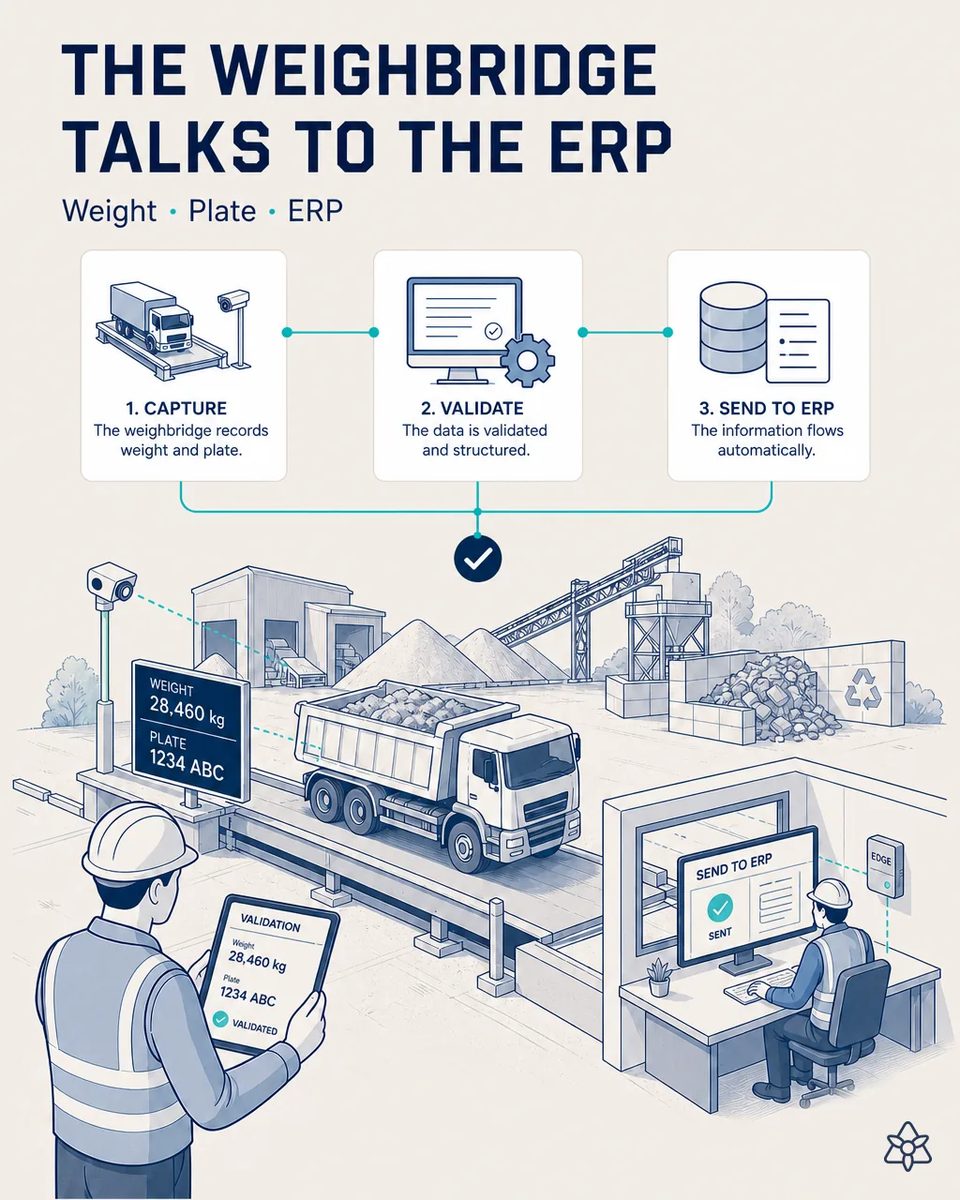
Two modern systems, a few meters apart, joined by a person typing all day.
When a truck crosses, someone manually copies the weight and plate into the billing system. A mistyped figure becomes a delivery note or waste document with the wrong weight. This creates billing discrepancies and traceability gaps that surface late.
- Every inbound and outbound truck crosses the weighbridge, and its software records the weighing perfectly well. It is modern, it has a documented interface, and it is simply not connected to anything else.
- So somebody reads the weight and the plate off the display and copies them into the billing system, truck after truck, all day, with a queue forming behind the scale while they do it.
- One mistyped digit becomes a delivery note or a waste document carrying the wrong weight — and both of those are documents a customer, a handler or an inspector will later rely on as fact.
- The discrepancy surfaces at month end, reconciling billed tonnage against what the destination handler says it received, and by then nobody can say which truck on which day it came from.
Connect stitches the two systems together through their APIs, replacing neither of them.
Connect stitches two modern systems together via API: without replacing the existing weighbridge software, every weighing automatically publishes weight, plate and client/handler into the ERP.
This is the classic case of a modern system left isolated because the integration project never reached the top of anyone's list. The stitching asks for no replacement, no downtime and no new software on the gatehouse machine, so it does not have to win a place in that queue in order to happen this quarter.
The isolated weighbridge versus the weighbridge stitched to the ERP
| Aspect | Today | With iLEAN Connect |
|---|---|---|
| Typing the weight | Once per truck, by hand | Never |
| Plate and destination handler | Copied by hand from the display | Published with every weighing |
| A mistyped digit | A delivery note with the wrong weight | Not possible by construction |
| Month-end reconciliation | Discrepancies with no traceable origin | Every weighing matched one to one |
| Time at the gate | A queue building behind the scale | The truck weighs and moves on |
| Either software | — | Neither is replaced |
Before: monthly weight/plate keying errors with associated billing discrepancies. After: zero human-origin error in weighing.
Impact estimate — to be validated with your numbers.
The block below is an estimate to be validated against your plant's actual data. We put it forward so the committee has an order of magnitude; we refine it during the assessment.
- Estimated payback 3-6 months, counting only the billing and traceability discrepancies that stop appearing at month end.
- Zero human-origin error in weighing, which is the real cost: a wrong weight travels into a delivery note and into a waste document.
- Gate time recovered on every truck, inbound and outbound, on a site where a queue at the scale backs straight up into the loader's run.
- And month-end reconciliation stops being an argument about which truck, on which day, the missing tonnage came from.
Estimated payback of 3-6 months from fewer billing and traceability discrepancies. Estimate to validate.
And the fair question from the production manager
"Isn't a proper integration project cleaner?" — it is, on the day it finally reaches the top of the list, and that day is exactly the problem: the weighbridge has had a documented interface for years and is still being keyed in by hand every morning. This stitching replaces neither system, needs no shutdown window and competes for nobody's project slot. Where a value has to be read from a display rather than pulled from the interface, the task is anchored and the best models drop below 1.5% error [1], with the weighing itself as the physical sanity check.
[1] OpenAI paper "Why Language Models Hallucinate", 2025 — on the reliability of AI in anchored tasks.
What people ask about connecting the weighbridge to the ERP
Do we have to change the weighbridge software?
No. Connect uses the documented interface it already has. The scale keeps its legal certification, the gatehouse operator keeps the same screen and nothing is installed on that machine.
Does it work with a rented weighbridge on a temporary site?
Yes, provided its software exposes an interface. On a site where the scale is hired for the duration of the job, that is exactly the situation where manual keying is at its worst and least supervised.
Does it capture the plate as well as the weight?
Yes, and the plate is what lets a weighing be matched to its waste manifest and to its licensed carrier automatically, without anybody sitting down to reconcile two lists by hand.
What happens if the link drops?
Weighings queue and publish when it comes back. Nothing is lost and, just as important, nothing is counted twice — the duplicate is the failure that would actually hurt at month end.
Does it help with inbound material too?
Yes. Inbound tonnage is what feeds the crushing plant's material balance, and today it is the half of the traceability nobody reconciles because it does not get invoiced to anyone.
More cases from this series
- Asbestos enclosure verified before work startsEdge cameras verify enclosure sealing and PPE before an asbestos removal starts; JIDOKA AI blocks the…
- The aggregate crushing plant, digitized without touching itAn external camera reads the aggregate crushing plant's proprietary panel and structures output,…
- Auditable evidence for every demolition, ready without rebuilding itiLEAN Edge + Agents automatically builds a dossier with pre/post photos, decision logs and sign-offs for…
- Zero exclusion-zone intrusion incidentsConnect, Edge and Agents coordinated: the work permit, the voice alert, the Edge camera and the evidence…
- Hands-free on site: the foreman dictates, iLEAN logs itThe demolition foreman dictates issues via earpiece while walking between work zones; iLEAN structures…
- The aggregate quality spreadsheet, connected to the ERPiLEAN watches the recycled-aggregate quality spreadsheet and, after validation, pushes it automatically…
Tell us what last month's weighing discrepancies cost you, and how many trucks cross your scale a day.
We work on your plant's real data, not ours. Assessment with no commitment.
Request estimated ROI within 48h ‹ See all cases of industrial demolition See construction