The waste transport manifest travels itself into the ERP
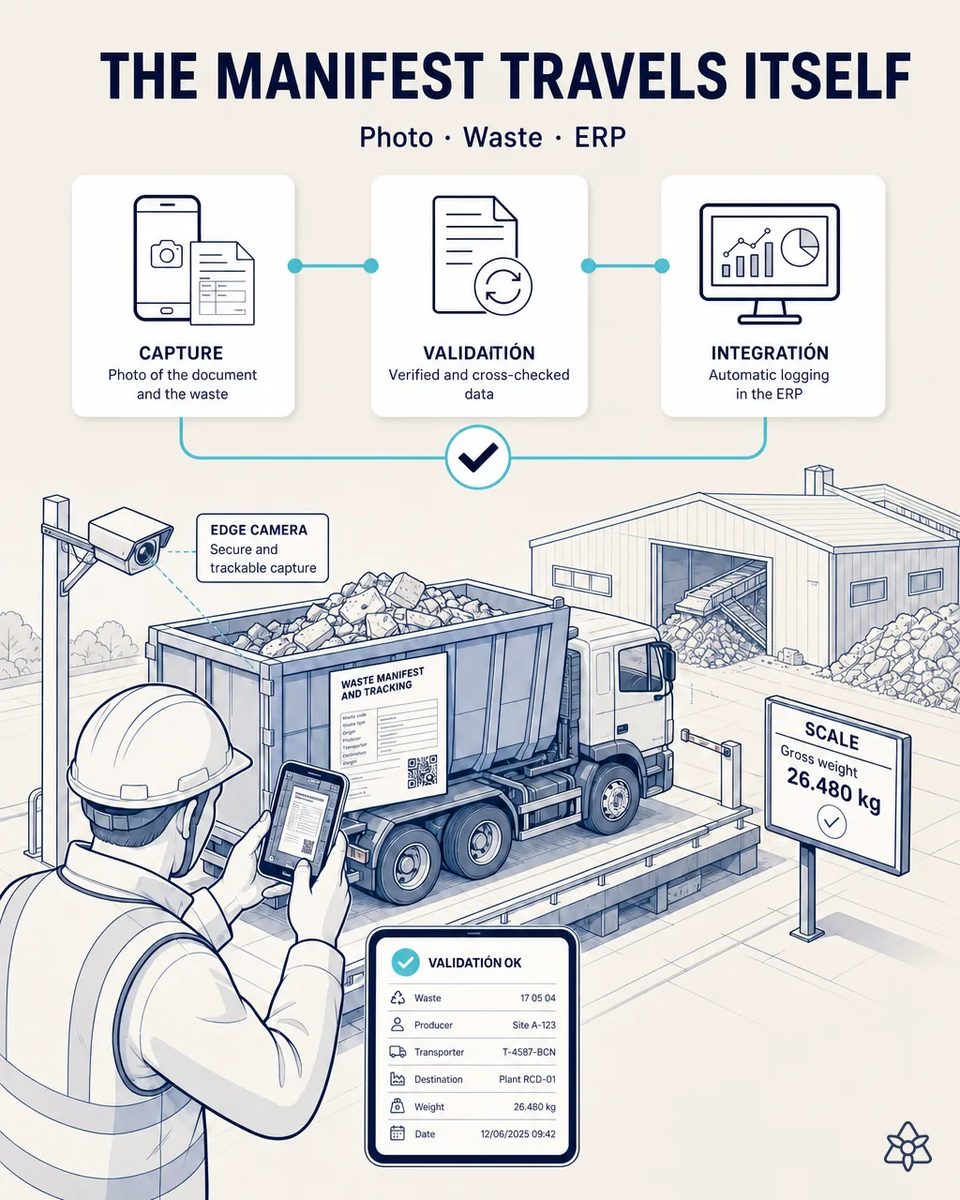
(3-5 lines of prose): Every waste shipment — including hazardous waste — leaves with a paper transport manifest proving its legal traceability. With iLEAN Connect, the manager photographs it with their phone, computer vision extracts origin, quantity, carrier and destination handler, and after one validation tap it all enters the ERP.
The document that proves legal traceability depends on somebody finding a free hour that never comes.
The transport manifest proves to the authorities that hazardous waste reached its legal destination. Transcribing it into the ERP line by line depends on someone finding the time. Done late or wrong, traceability breaks and shows up weeks later as a documentary gap during an inspection.
- Every shipment leaves the site with a paper transport manifest: waste code, producer, licensed carrier, destination handler and quantity. For hazardous waste it is the proof that the material reached where it legally had to reach.
- Typing it into the ERP line by line is nobody's priority with a truck waiting at the gate, two work zones open behind them and the loader queuing to fill the next container.
- Done late or done wrong, traceability breaks silently — nothing fails that day — and it surfaces weeks later as a documentary gap in an inspection or in a handover to the developer.
- The paper copy, meanwhile, travels in a folder from site to site in somebody's van, which is not where a legal record proving the fate of hazardous waste should be living.
Connect in photo mode — the manifest is read as issued, no format changes asked of anyone.
Connect's photo mode: computer vision recognizes the document's format without asking the authorities to change it, and extracts its tabular structure. One validation tap on a tablet inserts it directly into the ERP.
No one is asked to change the manifest: not the authorities that define it, not the licensed carrier that signs it, not the handler that stamps it on arrival. Computer vision reads the document exactly as it exists, which is the only way a case like this can survive at a site gate with a loaded truck running and a queue behind it.
Today's manifest versus the captured manifest
| Aspect | Today | With iLEAN Connect |
|---|---|---|
| When it enters the ERP | Days later, if at all | Minutes, at the gate |
| Waste code and handler | Retyped by hand | Extracted from the document |
| Hazardous waste shipment | Traced on paper first | Traced in the system from the start |
| A documentary gap | Found in the inspection | Flagged the same day |
| The paper original | Travels between sites | Photographed and linked |
| Waste module licenses | Two or three | One, the manager who validates |
Before: delayed, error-prone transcription. After: photo and validation in minutes, complete legal traceability.
Impact estimate — to be validated against your actual invoice.
The block below is an estimate to be validated against your plant's actual data. We put it forward so the committee has an order of magnitude; we refine it during the assessment.
- 💰 CFO angle: a 50-70 % reduction in ERP licenses for the waste and logistics module, because only the person who validates at the gate still needs a named seat.
- Estimated payback 3-8 months, counting only the transcription and the license line.
- From delayed, error-prone transcription to a photo and a validation tap in minutes, shipment by shipment, without holding the truck.
- And complete legal traceability for hazardous waste, which is the part an inspection actually opens the file to check.
CFO angle: a typical 50-70% reduction in ERP licenses for the waste/logistics module. Estimated payback 3-8 months. Estimate to validate.
And the fair question from the production manager
"Every handler's manifest looks different, and none of them will change it for us." — nor do they need to. Reading a tabular document with a known field set — waste code, producer, licensed carrier, destination handler, quantity — is an anchored task, where the best models drop below 1.5% error [1], and no per-handler template has to be maintained. The summary is then confirmed on the tablet before it enters the ERP, so no waste code ever crosses over on a guess.
[1] OpenAI paper "Why Language Models Hallucinate", 2025 — on the reliability of AI in anchored tasks.
What people ask about digitizing the waste manifest
Does it replace the paper document?
No. The paper keeps its legal role and its signatures; what changes is that it stops being the only copy in existence and stops depending on somebody finding an hour to type it into the ERP days later.
Does it read the carrier's and handler's details?
Yes: licensed carrier, destination handler and their authorization identifiers. Those are the fields that have to match when the chain is checked from producer to final destination.
What if the quantity on the manifest and the weighbridge disagree?
The discrepancy is highlighted on the tablet before the manager validates. Today nobody performs that cross-check at all, because it would mean holding a loaded truck at the gate to do arithmetic.
Does it work for non-hazardous rubble too?
Yes, and it is worth doing from the start: inert rubble is the bulk of the shipments by weight, and it is where the tonnage that feeds the project's waste certification comes from.
Can we start with waste alone?
Yes, and it is a good entry point: the result is visible from the very first shipment, it touches one role only, and it does not depend on any other case in the matrix being deployed first.
More cases from this series
- Asbestos enclosure verified before work startsEdge cameras verify enclosure sealing and PPE before an asbestos removal starts; JIDOKA AI blocks the…
- The aggregate crushing plant, digitized without touching itAn external camera reads the aggregate crushing plant's proprietary panel and structures output,…
- Auditable evidence for every demolition, ready without rebuilding itiLEAN Edge + Agents automatically builds a dossier with pre/post photos, decision logs and sign-offs for…
- Zero exclusion-zone intrusion incidentsConnect, Edge and Agents coordinated: the work permit, the voice alert, the Edge camera and the evidence…
- Hands-free on site: the foreman dictates, iLEAN logs itThe demolition foreman dictates issues via earpiece while walking between work zones; iLEAN structures…
- The aggregate quality spreadsheet, connected to the ERPiLEAN watches the recycled-aggregate quality spreadsheet and, after validation, pushes it automatically…
Tell us how many waste shipments left your sites last month, and where their transport manifests are right now.
We work on your plant's real data, not ours. Assessment with no commitment.
Request estimated ROI within 48h ‹ See all cases of industrial demolition See construction