Nothing enters the system without human validation first
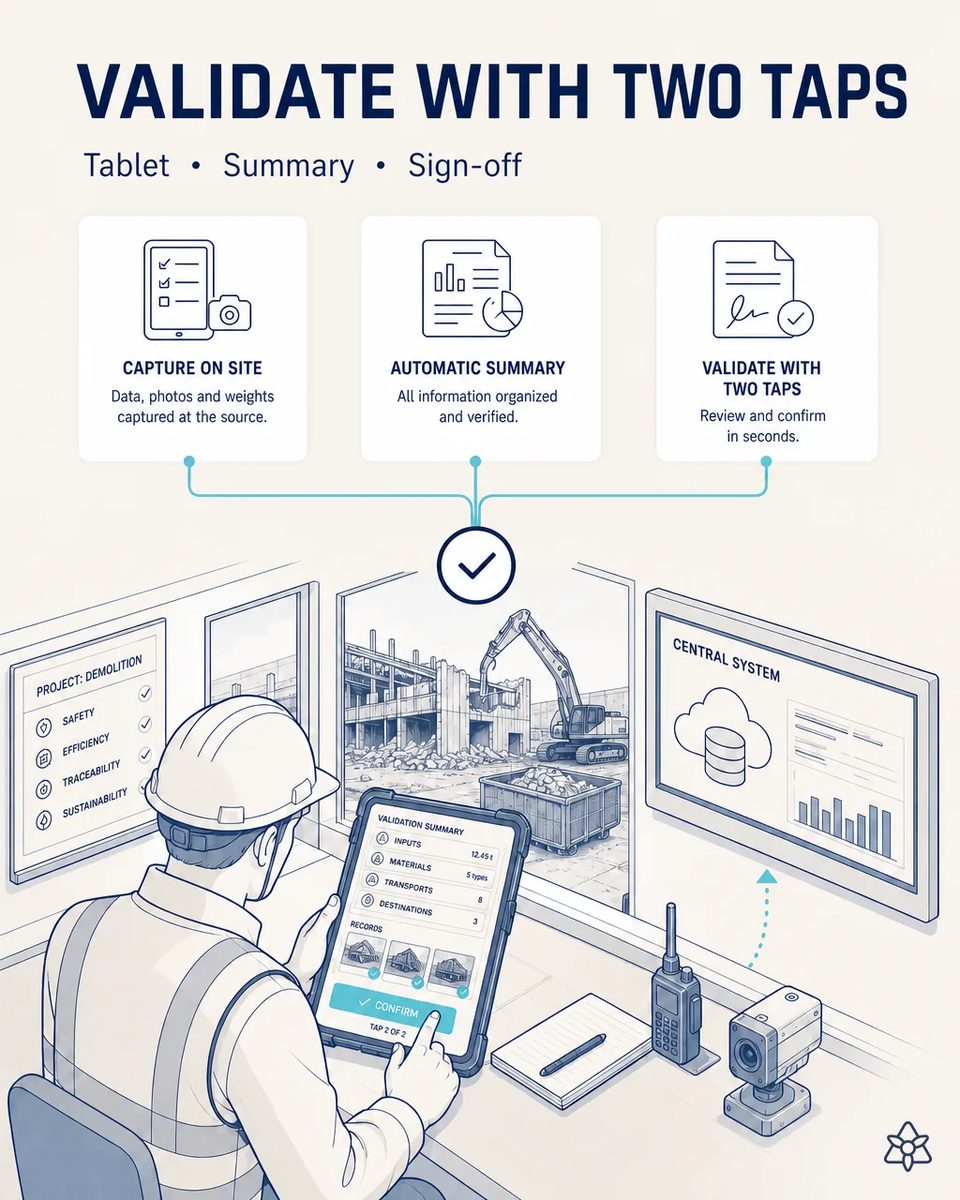
(3-5 lines of prose): The most common cultural blocker to digitizing a site is the fear that AI will enter unsigned data and contaminate the ERP. That's why nothing iLEAN captures crosses into the central system without a human seeing it first: on the site-office tablet, every capture appears as a 2-second visual summary confirmed with 2 taps.
The blocker is cultural, and it is entirely reasonable.
The fear that AI will "enter data on its own" is a real cultural blocker in an industry where every bad data point can end up as a contractual discrepancy with the developer or the authorities. At the same time, the site worker or manager doesn't want to manually type data either.
- The fear that AI will "enter data on its own" is real, and on a demolition site it is well founded: a wrong figure ends up as a contractual discrepancy with the developer or as a documentary gap in front of the authorities.
- At the same time, nobody on that site wants to type anything. Not the site manager with a truck waiting at the gate, not the foreman with gloves on and two zones open behind them.
- Both things have to be true at once: capture that costs no effort, and real human control over everything that gets written into the company's systems.
- Any tool that adds administrative work to the day is abandoned within weeks, and the site quietly goes back to the notebook and the parallel spreadsheet that nobody else can read.
Connect with early human verification — an interface designed to validate, not to capture.
Connect's early human-verification mode: every capture — a permit photo, a dictated issue, a supervisor alert — reaches a tablet with a visual summary designed to be read in 2 seconds. One tap on ✓ lets it through as-is; one tap on ✏️ corrects it before entry.
Validating takes two seconds and needs no training; capturing takes minutes and does. That difference is the whole case, and it is why this is the piece that makes the other eleven signable instead of a good idea in a slide deck. It is also the answer to the only question a management meeting really asks about any of this: who signed for the data, by name, and when.
Data entering the central system, before and after
| Aspect | Today | With iLEAN Connect |
|---|---|---|
| Who checks a critical figure | Whoever types it, if anyone | The manager, in two seconds |
| What is asked of the site | Capture: minutes and training | Validate: two taps |
| An AI-extracted value | Enters or does not enter | Enters only once confirmed |
| Confidence of the capture | Not visible | Shown with the summary |
| A correction | Corrected and forgotten | Stored, and it tunes the model |
| Trust on site | Fragile: the notebook returns | Holds: the signature is theirs |
Before: unvalidated data contaminating the ERP, or data not captured at all out of distrust. After: data captured and validated within seconds, master data stays clean.
Impact estimate — an enabling piece, and it is worth saying so.
The block below is an estimate to be validated against your plant's actual data. We put it forward so the committee has an order of magnitude; we refine it during the assessment.
- This case does not monetize directly and there is no payback of its own — the brief says so and so does this page.
- Its value is strategic and it is the largest of the set: without early human verification, the other eleven do not get signed off in a management meeting.
- It is what turns "iLEAN captured this" into a record with an author, a timestamp and a signature the developer can be shown.
- And it is what stops the parallel notebook from quietly coming back, which is where most site digitization projects actually die.
An enabling piece for the whole iLEAN matrix: without it, none of the other examples would get signed off in a leadership meeting. Strategic value, not directly monetizable.
And the fair question from the production manager
"If a person has to look at it anyway, what are we gaining?" — looking is not typing. The anchored extraction work is already done, with the best models below 1.5% error [1], and what reaches the tablet is a summary readable in two seconds with its confidence level. You go from transcribing to confirming, and the data lands in seconds instead of at week's close.
[1] OpenAI paper "Why Language Models Hallucinate", 2025 — on the reliability of AI in anchored tasks.
What people ask about early human verification
Does it slow the site down?
It is two taps on a summary designed to be read with gloves on, from an arm's length away. Those seconds are measured against what a wrong weight or a wrong waste code costs when it surfaces weeks later in an inspection.
Who should validate: the foreman or the site manager?
It depends on the data. Whatever the foreman already owns on the zone, the foreman confirms; anything going into legal traceability is better signed by the role that answers for it in front of the authorities today.
Can validation be skipped when there is pressure?
No, and that is the point of having it. What can be tuned is which fields require it: asking for a signature on absolutely everything ends with people signing out of habit, which is worse than not asking.
Does it work when the site office is a container with no coverage?
Yes. The queue holds on the tablet and the summaries are validated when there is signal; nothing is written into the central system in the meantime, so a bad link delays data but never corrupts it.
Is it mandatory before deploying the rest?
In practice yes. It is the piece that guarantees nothing unsigned reaches your system, and that is the condition on which every other case in this matrix gets approved at all.
More cases from this series
- Asbestos enclosure verified before work startsEdge cameras verify enclosure sealing and PPE before an asbestos removal starts; JIDOKA AI blocks the…
- The aggregate crushing plant, digitized without touching itAn external camera reads the aggregate crushing plant's proprietary panel and structures output,…
- Auditable evidence for every demolition, ready without rebuilding itiLEAN Edge + Agents automatically builds a dossier with pre/post photos, decision logs and sign-offs for…
- Zero exclusion-zone intrusion incidentsConnect, Edge and Agents coordinated: the work permit, the voice alert, the Edge camera and the evidence…
- Hands-free on site: the foreman dictates, iLEAN logs itThe demolition foreman dictates issues via earpiece while walking between work zones; iLEAN structures…
- The aggregate quality spreadsheet, connected to the ERPiLEAN watches the recycled-aggregate quality spreadsheet and, after validation, pushes it automatically…
Tell us who signs today for the data that reaches your central system.
We work on your plant's real data, not ours. Assessment with no commitment.
Request estimated ROI within 48h ‹ See all cases of industrial demolition See construction