Critical site-supervisor alerts, in seconds
(3-5 lines of prose): The site supervisor emails about an unexpected finding that forces a stop in a specific work zone. The email lands in an inbox nobody checks in real time from the field. With iLEAN Connect, the system reads the email instantly, cross-references it with the active demolition plan, and alerts the affected zone's foreman with the concrete action to take.
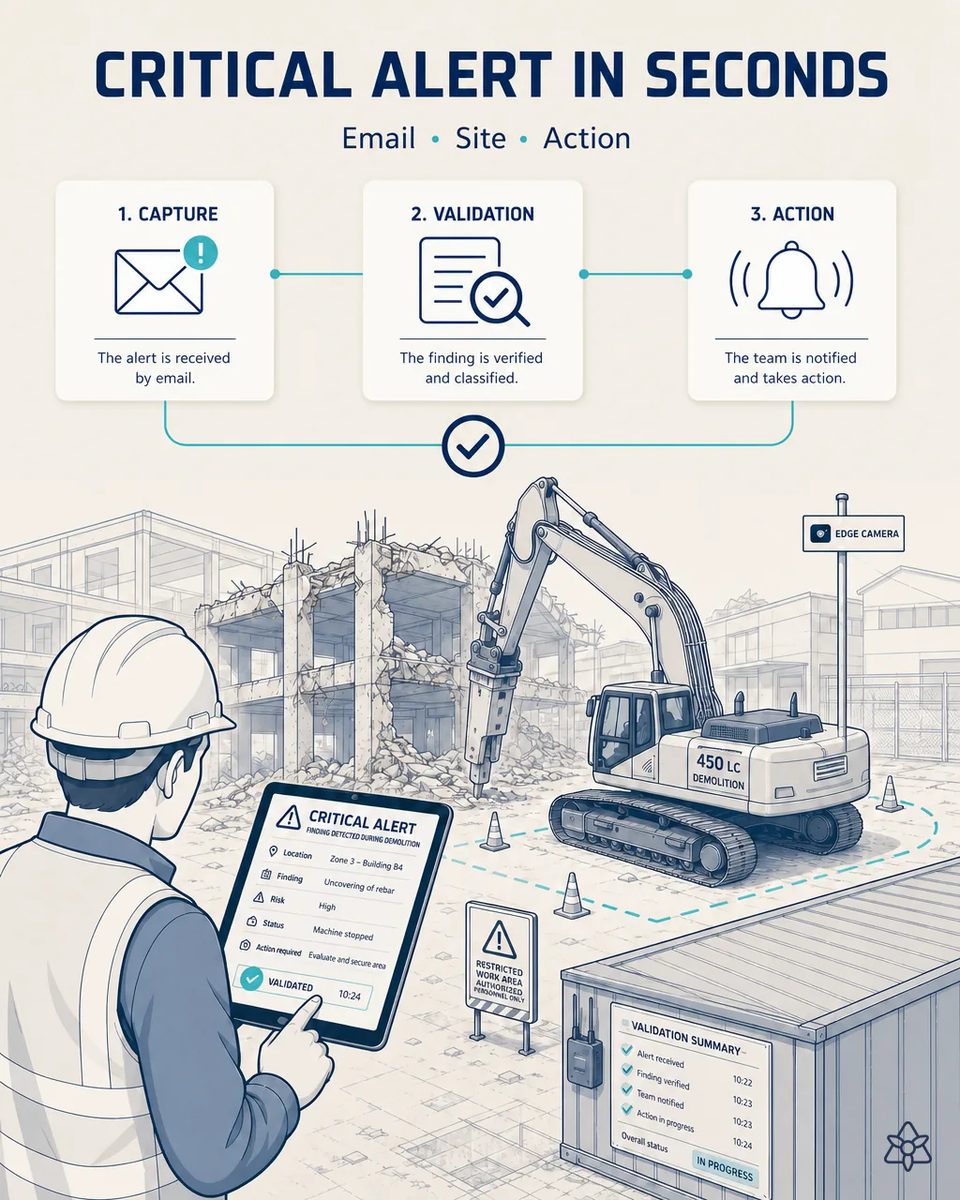
The channel that carries the most urgent news is the one nobody is watching.
Critical alerts from third parties — the site supervisor, the authorities, the developer — arrive by email or WhatsApp to someone who can't check their inbox in real time from the field. By the time it's finally read, the machine may have been working the affected zone for hours, with the environmental or safety risk that implies.
- A finding appears — an unmapped service, a structural element that was not in the survey, suspected asbestos-containing material — and the site supervisor writes an email ordering a stop in that zone.
- The developer, the authorities and the engineer of record all use that same channel, and the message lands in an inbox belonging to somebody who is out on a site, in a helmet, with no realistic way to read it in the next couple of hours.
- One to three hours of human latency is normal, and during those hours the machine keeps working the zone the order was meant to freeze.
- When it is finally read, the question is no longer what to do but what has already been demolished, and the answer has to be given to the supervisor in writing.
Connect in chaotic-sources mode — a dedicated mailbox, silent copy, around the clock.
Connect's chaotic-sources mode: a dedicated mailbox in silent copy 24/7. A grounded LLM extracts the alert's intent (finding, stop order, scope change) and entities (location, zone, deadline), automatically cross-referencing them with the active demolition plan and the machines working that zone, returning the concrete action to the affected foreman.
Finding out sooner is only half of it. What changes the outcome is the cross-check: the alert is matched against the active demolition plan and the machines working that zone, so what comes back is not a forwarded email but a concrete action, addressed to the person holding the radio. On a site, an instruction that names the machine and the zone is acted on; an email that has to be interpreted is not.
Today's alert versus the cross-checked alert
| Aspect | Today, in the inbox | With iLEAN Connect |
|---|---|---|
| When the field finds out | 1-3 hours later | Seconds |
| Who receives it | Whoever it was addressed to | The foreman of the affected zone |
| What arrives | An email to interpret | The action, the machine and the zone |
| Work in the frozen zone | Continues until someone reads it | Stops on the alert |
| Scope of the stop | Widened to be safe | Bounded to the zone named |
| Trace of the notice | Buried in a thread | Logged with its timestamp |
Before: 1-3 hours of human latency until the foreman finds out. After: seconds, with a directed instruction naming the specific machine and zone.
Impact estimate — this one is defended as exposure avoided, not as hours saved.
The block below is an estimate to be validated against your plant's actual data. We put it forward so the committee has an order of magnitude; we refine it during the assessment.
- The brief puts no payback range on this case and neither do we: the risk avoided does not reduce to a single figure.
- What it does change is measurable: from 1-3 hours of human latency down to seconds, with a directed instruction naming the machine and the zone.
- The exposure it protects is environmental and safety-related — the two kinds that stop a site, reach the developer and end up in a report.
- It is a case to size with your safety officer, against the last stop order that was read too late.
Risk avoided is hard to pin to a single figure, but critical in terms of environmental or safety exposure avoided. Estimate to validate with the safety officer.
And the fair question from the production manager
"Are you going to read our company email?" — no. iLEAN sits on silent copy of a dedicated mailbox used with the site supervisor, the developer and the authorities: it sees nothing else. On extraction, classifying the intent of a notice — finding, stop order, scope change — and pulling out zone and deadline is an anchored task, where the best models drop below 1.5% error [1], and the action is always executed by a person.
[1] OpenAI paper "Why Language Models Hallucinate", 2025 — on the reliability of AI in anchored tasks.
What people ask about routing critical site alerts
Does it tell a stop order from a routine notice?
Yes, and that is the whole value: a stop order on a work zone is escalated immediately, while a request for a document or a meeting date waits in the queue and interrupts nobody in the field. Getting that wrong in either direction is what kills this kind of tool.
Does it work with messages arriving by phone messaging?
Yes, on a company number used for the site. What is not read is anyone's personal messaging, and that boundary is worth settling with the crew on day one.
How does it know which machine is in that zone?
From the active Work Permit and the demolition plan. That cross-check is what turns an alert into an instruction with a name and a machine attached.
What if the email does not name the zone clearly?
Then it is escalated as ambiguous to the site manager instead of being resolved on a guess. Bounding the zone wrongly is the one failure that would cost more than the delay.
Does it leave a record for the supervisor?
Yes: the notice, the time it was read, who it reached and the action taken, all timestamped. That log is what you show when the supervisor asks what happened between the email being sent and the machine stopping.
More cases from this series
- Asbestos enclosure verified before work startsEdge cameras verify enclosure sealing and PPE before an asbestos removal starts; JIDOKA AI blocks the…
- The aggregate crushing plant, digitized without touching itAn external camera reads the aggregate crushing plant's proprietary panel and structures output,…
- Auditable evidence for every demolition, ready without rebuilding itiLEAN Edge + Agents automatically builds a dossier with pre/post photos, decision logs and sign-offs for…
- Zero exclusion-zone intrusion incidentsConnect, Edge and Agents coordinated: the work permit, the voice alert, the Edge camera and the evidence…
- Hands-free on site: the foreman dictates, iLEAN logs itThe demolition foreman dictates issues via earpiece while walking between work zones; iLEAN structures…
- The aggregate quality spreadsheet, connected to the ERPiLEAN watches the recycled-aggregate quality spreadsheet and, after validation, pushes it automatically…
Tell us how long your last stop order took to reach the machine.
We work on your plant's real data, not ours. Assessment with no commitment.
Request estimated ROI within 48h ‹ See all cases of industrial demolition See construction