The trim defect stays at home
Seat trimming is where quality gets decided by eye. Wrinkles in the cover, an open seam or a skipped stitch, a missing clip or hog ring, uneven leather shade between backrest and cushion, a mislaid label.
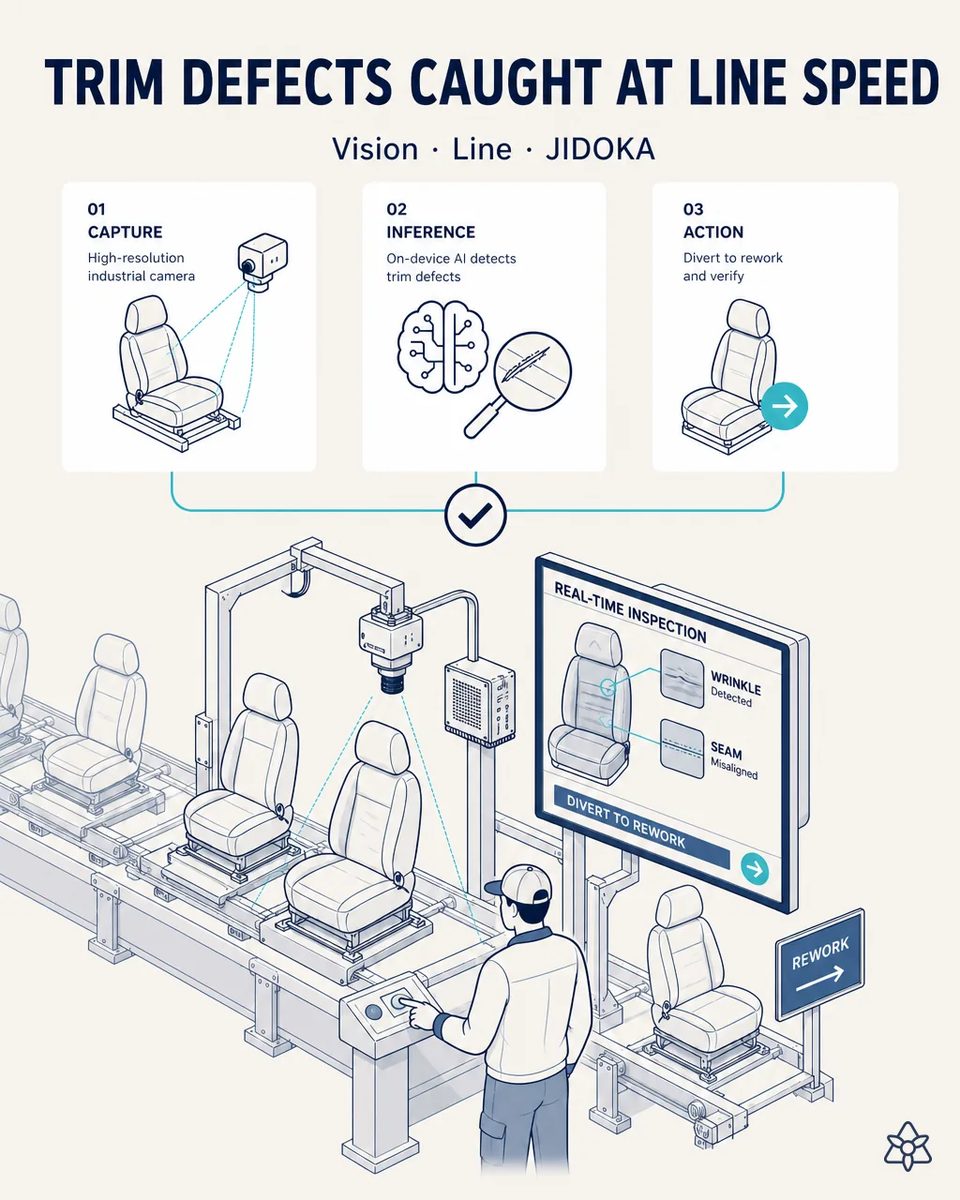
At cadence the human eye tires, and the criteria drift.
At line cadence, with variants changing every few units, the human eye tires and lets things through. One hundred percent visual inspection at real cadence is physically impossible, and sampling leaves gaps by definition. There is something worse than fatigue: the criteria. What counts as an acceptable wrinkle changes between fabric and leather, between colors, between operators, and it degrades across the shift. There is no objective standard, there are several people doing their best. And in a sequenced operation the defect does not stay home. It goes on the truck in the exact order, reaches the customer line and is found there, where it costs an order of magnitude more and where it turns into quality points and into your supplier rating.
- Wrinkles in the trim cover, an open seam or a skipped stitch, a missing clip or hog ring, uneven leather shade between backrest and cushion, a mislaid label: trim quality is decided by eye.
- One hundred percent visual inspection at real cadence, with variants changing every few units, is physically impossible, and sampling leaves gaps by definition.
- What counts as an acceptable wrinkle changes between fabric and leather, between colors, between operators, and degrades across the shift. There is no objective standard, there are several people doing their best.
- In a sequenced operation the defect does not stay home: it goes on the truck in the exact order and is found on the customer line, where it costs an order of magnitude more and turns into quality points and your supplier rating.
Edge — local inference in milliseconds, trained on your own variants, the image never leaves the plant.
Edge iLEAN puts a camera over the trimming station, with local inference in milliseconds. The model is trained on good and bad examples of your plant's real variants, not on a generic catalog. And inference runs locally, on the unit next to the camera. No cloud latency, no cost per image, no bandwidth. And above all: the image never leaves the plant. The flagged unit is diverted to rework before entering sequence, not after. From one or two percent sampling to one hundred percent inspection, with a single auditable criterion that does not depend on the time of the shift.
The flagged seat is diverted to rework before entering sequence, not after. From one or two percent sampling to one hundred percent inspection, with a single auditable criterion that does not depend on who is on shift or what hour it is. The wrinkle stays home, and so do the quality points it would have cost.
Today's trim inspection versus Edge vision
| Aspect | Visual inspection | With iLEAN Edge |
|---|---|---|
| Coverage | 1-2% sampling | 100% of seats |
| Acceptable wrinkle | Depends on operator, color and hour | One auditable criterion |
| Missing hog ring or clip | Found on the customer line | Found at the trimming station |
| Leather shade between backrest and cushion | Judged by eye | Compared against the variant's reference |
| Where the defect is caught | On the truck, in sequence | Before entering sequence |
| Image and inference | — | Local, no cloud, no cost per image |
Impact estimate — to be validated with your numbers.
The block below is an estimate to be validated against your plant's actual data. We put it forward so the committee has an order of magnitude; we refine it during the assessment.
- Estimated payback 5-12 months, depending on your rework ratio and the cost of quality points with the customer, to validate against your claims history.
- From 1-2% sampling to 100% inspection with one criterion that does not drift across the shift.
- Fewer trim defects reaching the customer line, which is where they cost an order of magnitude more and turn into quality points.
- And the return that never shows in the accounts: your position in the customer's quality ranking, which decides the award of the next program and is where the rework ratio is really measured.
Estimated payback 5-12 months · from 1-2% sampling to 100% inspection Estimated payback of five to twelve months depending on your current rework ratio and the cost of quality points with the customer, an estimate to validate against your claims history. The bigger return never shows up in the accounts: it is your position in the customer's quality ranking, which is what decides the award of the next program.
And the fair question from the production manager
“What if it sends good seats to rework?” — the false positive is the real risk of any vision system, which is why the model is trained on good and bad examples of your plant's real variants and lighting, not on a generic catalog. Judging a cover against its own variant reference is an anchored task where the best models drop below 1.5% error [1]. And borderline cases are not simply rejected: they are escalated for a person to decide, and every decision feeds training.
[1] OpenAI paper "Why Language Models Hallucinate", 2025 — on the reliability of AI in anchored tasks.
What people ask about trim defect vision
Does it handle fabric and leather with the same model?
It handles each variant against its own reference. A wrinkle acceptable on a fabric cover is not the same wrinkle on perforated leather, and the model is trained per variant, with the manufacturing system telling it which one is on the line.
Does it keep up with the line cadence?
Yes: inference is local, on the unit beside the camera, and resolves in milliseconds. It does not depend on the plant network or the cloud, so a variant changing every few units does not slow it down.
Does the image leave the plant?
No. Inference runs locally and the image stays on the plant unit. There is no cloud latency, no bandwidth and no cost per image, which matters when you inspect every seat instead of a sample.
How many defective seats are needed to train it?
Fewer than feared, because the trim defect catalog is short and repetitive: wrinkle, open seam, skipped stitch, missing hog ring, shade. What matters is that they are your parts, under your station's lighting.
Which defect should we start with?
The one that costs you the most quality points with the customer. That is the one that pays the fastest and the one your supplier rating notices first, and the model is trained on your own parts.
More cases from this series
- The audit stops being a two-week projectAgents organizes by standard and serial number the evidence Connect and Edge already capture: the audit…
- Four rings between the broadcast and the truckFour verification rings (sequence, preparation, build and loading) cross-checked: if they disagree, the…
- The foam carousel that finally talksAn external camera digitizes mold temperature, curing and alarms from an isolated foam carousel,…
- Shift knowledge stops dying at clock-outThe supervisor dictates while walking what dies at end of shift today; iLEAN structures it with line,…
- Nothing enters the master without a human sign-offNothing the AI captures enters the traceability master without a human validating it in two taps from a…
- The lab stops transcribing into the ERPiLEAN reads the test sheet the moment it is saved and, once validated, writes it to the ERP. Typical…
Tell us which trim defect cost you the most quality points last quarter.
We work on your plant's real data, not ours. Assessment with no commitment.
Request estimated ROI within 48h ‹ See all cases of automotive seating See automotive