Shift knowledge stops dying at clock-out
The area supervisor spends the whole shift walking between cutting, sewing, foaming, assembly and sequencing. Hands busy, head full.
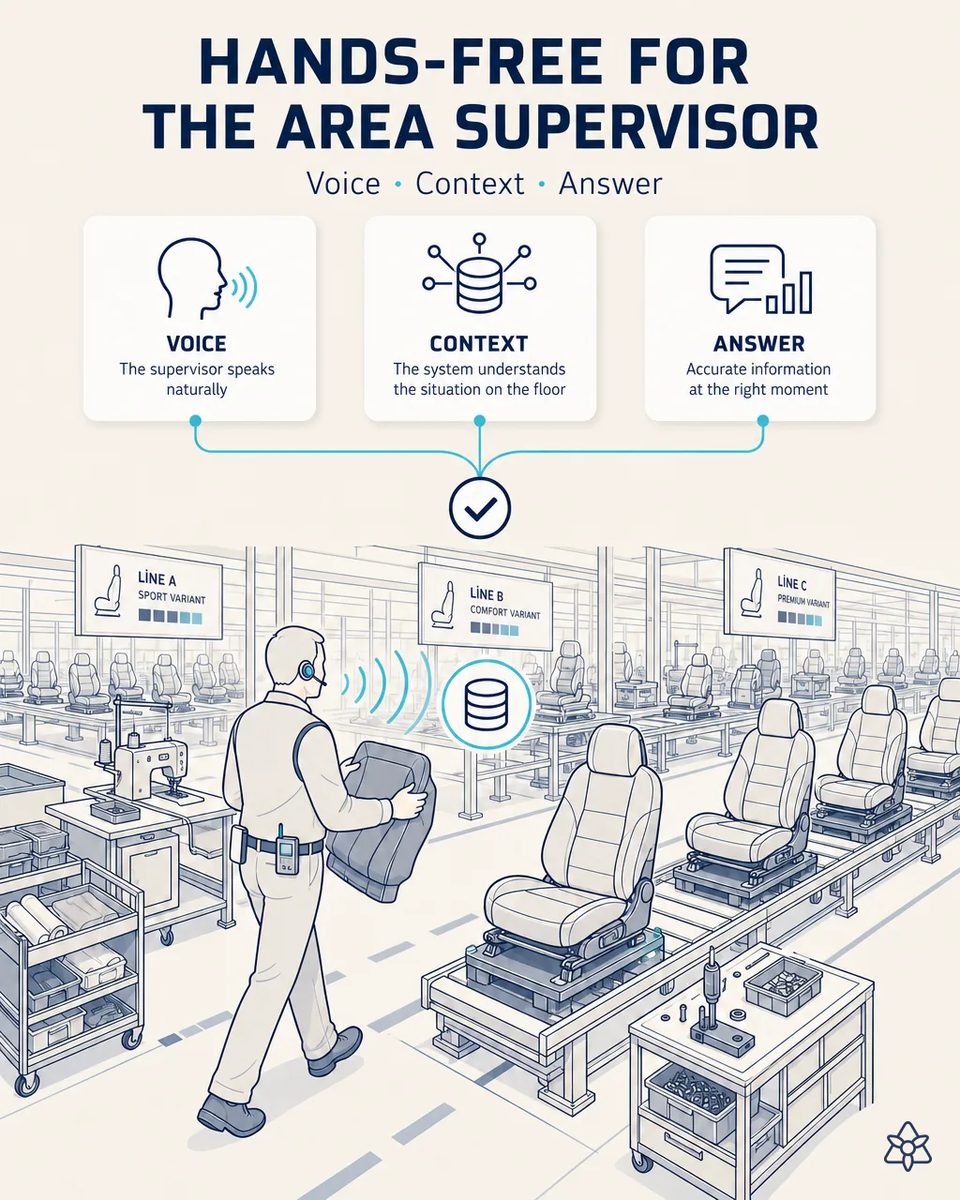
The most valuable information in the plant is never typed.
They know sewing station three has been generating more rework since the roll change. That the new operator on line two will need support on the leather variant. That the carousel has been demoulding worse since this morning. None of that is in any system. Nobody asks them anything because they cannot type, and all that information, the most valuable in the plant, dies when they clock out. It gets passed on verbally at shift handover, with losses. If that person rotates or is absent, the plant loses memory.
- The area supervisor walks the whole shift between cutting, sewing, foaming, assembly and sequencing. Hands busy, head full.
- They know sewing station three has generated more rework since the roll change, that the new operator on line two needs support on the leather variant, that the carousel has been demolding worse since this morning. None of that is in any system.
- Nobody asks them anything because they cannot type, and all of it dies when they clock out. What survives is a verbal handover at the door, with losses, and a page in a notebook at best.
- If that person rotates or is absent, the plant loses memory, and any continuous improvement plan starts again from what three people remember.
Connect in voice mode — a headset, and iLEAN listens to the supervisor, not to the operators.
Connect in voice mode, with a bluetooth earpiece. They dictate without stopping: note that line two has more sewing rework since the roll change, I want quality to look at it. iLEAN structures it as an issue tied to the line, the shift and the reference active at that moment. The human does not have to say where they are or what is running: the system already knows. And it answers within seconds: quality can meet at quarter past twelve, shall I confirm? And it works both ways. It is the natural channel to ask without breaking stride: how much light foam coverage is left, how many units of the variant starting after the break we have already built.
The supervisor does not say where they are or what is running: the system already knows the line, the shift and the variant active at that moment, and files the issue against them. And it answers back in seconds — quality can meet at quarter past twelve, shall I confirm? — which is what makes the channel natural instead of one more thing to remember at the end of the shift.
Today's shift versus the captured shift
| Aspect | Today | With iLEAN Connect |
|---|---|---|
| Sewing rework since the roll change | In one head | An issue tied to line, shift and variant |
| Shift handover | Verbal, with losses | History on screen |
| Light foam coverage left | Walk to a terminal | Ask without breaking stride |
| Meeting with quality | Arranged by phone, later | Proposed and confirmed in seconds |
| When the supervisor rotates | The plant loses memory | The memory stays |
| Ordinary floor conversation | — | Not recorded |
Impact estimate — to be validated with your numbers.
The block below is an estimate to be validated against your plant's actual data. We put it forward so the committee has an order of magnitude; we refine it during the assessment.
- No standalone payback — an enabling piece. We do not put a number on this one either.
- It is the flow that feeds the other eleven: without it, continuous improvement still depends on the memory of three people, and the root-cause analysis on the carousel or the sewing line starts without the observation that would have pointed at the cause.
- Issues and observations enter the system in real time, with context, and handover happens with the history on screen instead of from memory in a corridor.
- To validate with your continuous improvement lead, who is usually the one most excited about this case.
Strategic value · shift knowledge stops dying at clock-out This case is honestly hard to monetize on its own, and I am not going to sell you a number for it. But it is the piece that feeds all the others: without this flow, any continuous improvement plan still depends on the memory of three people. To validate with your continuous improvement lead, who is usually the one most excited about this one.
And the fair question from the production manager
“Is this for keeping tabs on my team?” — no: iLEAN listens to the supervisor, not to the operators, and only to what they choose to dictate. There is no continuous listening and no tracking of where anyone is. Turning a dictated note into an issue with line, shift and variant already known is an anchored task, where the best models drop below 1.5% error [1], and the supervisor sees and confirms what was filed.
[1] OpenAI paper "Why Language Models Hallucinate", 2025 — on the reliability of AI in anchored tasks.
What people ask about the supervisor headset
Does it work with the noise of the foaming area and the sewing room?
That is the design condition. The headset is compatible with hearing protection and recognition is prepared for industrial noise and for the trade vocabulary of trim and foam: hog ring, demolding, roll change, light foam, leather variant.
Does the supervisor have to say which line they are on?
No. iLEAN already knows the line, the shift and the variant running at that moment, and files the issue against them. A note dictated next to the carousel about demolding lands on the carousel, not in a generic list.
Can they ask questions, not just dictate?
Yes, and that is half the value: how much light foam coverage is left, how many units of the variant starting after the break are already built. The answer comes back in the earpiece without anyone walking to a terminal.
What happens to the note about sewing rework?
It becomes an issue tied to station three and the roll change, visible to quality within seconds. When the same symptom appears a third time, it is a pattern with a date, not an anecdote passed on at handover.
Why does it not carry a payback figure?
Because on its own it is honestly hard to monetize, and we would rather not sell you a number. Its value shows in the other cases, which stop depending on what three people remember, and in the shift handover that happens with the history on screen instead of in a corridor.
More cases from this series
- The audit stops being a two-week projectAgents organizes by standard and serial number the evidence Connect and Edge already capture: the audit…
- Four rings between the broadcast and the truckFour verification rings (sequence, preparation, build and loading) cross-checked: if they disagree, the…
- The foam carousel that finally talksAn external camera digitizes mold temperature, curing and alarms from an isolated foam carousel,…
- Nothing enters the master without a human sign-offNothing the AI captures enters the traceability master without a human validating it in two taps from a…
- The lab stops transcribing into the ERPiLEAN reads the test sheet the moment it is saved and, once validated, writes it to the ERP. Typical…
- Receiving stops blocking the dockOne photo of the delivery note and roll labels: batch, quantity and certificate enter the ERP after one…
Tell us how many issues from the last shift exist today only in your supervisor's head.
We work on your plant's real data, not ours. Assessment with no commitment.
Request estimated ROI within 48h ‹ See all cases of automotive seating See automotive