Receiving stops blocking the dock
The truck arrives with fabric rolls, leather, foam, structures or mechanisms. The receiving lead is holding a delivery note with fifteen or twenty lines, the labels on every unit with their batch, and the material quality certificates, which in automotive are not optional.
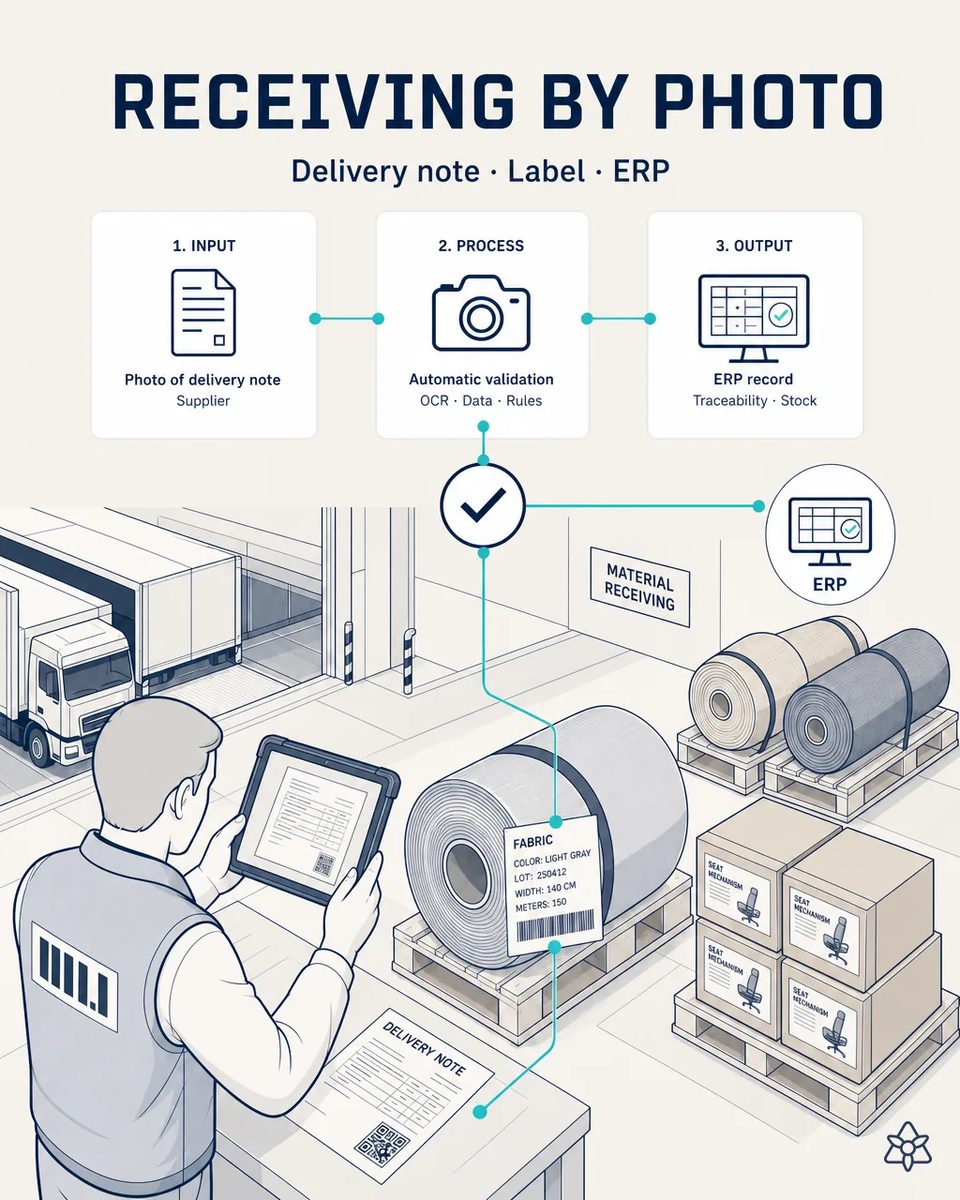
Either the truck waits, or the batch is badly traced.
And they have to sign and then log into the ERP to key it in line by line. There are only two possible endings: either the carrier waits and charges demurrage, or it gets keyed in fast. And what gets keyed in fast comes back weeks later, when somebody needs to trace which leather roll went into which seat of which vehicle, and it turns out you cannot. Backward traceability is as demandable as forward: when the customer opens an investigation, the chain has to reach the roll and its certificate.
- The truck arrives with fabric rolls, leather hides, foam, frames or mechanisms: a delivery note with fifteen or twenty lines, a label with a batch on every unit, and the material quality certificates that in automotive are not optional.
- The receiving lead signs and then keys it into the ERP line by line, with the driver standing there. There are two endings: the carrier waits and charges demurrage, or it gets keyed in fast and badly.
- What was keyed in fast comes back weeks later, when somebody needs to know which leather roll went into which seat of which vehicle, and cannot. The batch was typed loosely, or not at all.
- The certificate ends up in a folder nobody opens again, when it is exactly the document that closes the chain back to the roll and the one the customer's investigation asks for first.
Connect in photo mode — delivery note, labels and certificate, no supplier asked to change anything.
Connect in photo-of-the-analog mode. Vision recognizes each supplier's delivery note layout, without asking anybody to change theirs, and extracts the full tabular structure. For the units it reads barcodes, QR, data matrix codes or plain text by optical recognition. And the material quality certificate is captured as a document and stays tied to the batch that arrived, not filed separately in a folder nobody opens again. One-tap validation on the tablet and the write into the ERP through its programming interface. From forty-five or sixty minutes of truck at the dock to under ten. From loosely tied batches that surface during an investigation to complete photo-based traceability from day one. And again the financial angle: the receiving and warehouse module typically requires two or three active licenses, receiving lead, support and supervisor. With Connect only the lead validates with one tap, without logging into the ERP. Typical reduction of fifty to seventy percent in that module's licenses, plus what you save on dedicated capture modules and on demurrage charged by the carrier.
Backward traceability is as demandable as forward: when the customer opens an investigation, the chain has to reach the roll and its certificate. Captured by photo, that chain exists from day one instead of being reconstructed loosely during the investigation. And the receiving lead validates with one tap on the tablet, without logging into the ERP at all.
Today's receiving versus captured receiving
| Aspect | Today | With iLEAN Connect |
|---|---|---|
| Truck at the dock | 45-60 minutes | Under 10 |
| Delivery note lines | Keyed one by one | Extracted as a table, one tap |
| Roll and batch labels | Read by eye | Barcode, QR, data matrix or text |
| Material certificate | Filed separately | Tied to the batch that arrived |
| Which roll went into which seat | Reconstructed, loosely | Queryable from day one |
| Receiving module licenses | Two or three | One, the lead who validates |
Impact estimate — to be validated with your numbers.
The block below is an estimate to be validated against your plant's actual data. We put it forward so the committee has an order of magnitude; we refine it during the assessment.
- Estimated payback 3-8 months, plus the recurring annual saving, to validate against your own dock times and invoice.
- 💰 CFO angle: 50-70% fewer licenses on the receiving and warehouse module, because only the lead validates, plus what you save on dedicated capture modules.
- From 45-60 minutes of truck at the dock to under ten, truck after truck, with the demurrage charged by the carrier gone.
- And complete photo-based traceability from the roll to the seat, from day one, which is what holds up when the customer opens an investigation.
Estimated payback 3-8 months · 50-70% fewer licenses on the receiving module Estimated payback of three to eight months, plus the recurring annual saving. An estimate to validate.
And the fair question from the production manager
“Does it recognize every supplier's delivery note?” — yes, and without asking any of them to change theirs: the model extracts the table structure with no per-supplier template. Labels are read by barcode, QR or data matrix where present and by optical recognition where not. It is an anchored task, where the best models drop below 1.5% error [1], and the receiving lead validates with one tap before anything enters the ERP.
[1] OpenAI paper "Why Language Models Hallucinate", 2025 — on the reliability of AI in anchored tasks.
What people ask about receiving by photo
Is the material certificate actually read, or just stored?
Both. It is captured as a document and its values stay tied to the batch that arrived, so reaching the certificate from a seat serial number stops being a search through a folder. In automotive that certificate is not optional, and neither is finding it.
Does it work for materials as different as leather, foam and mechanisms?
Yes. What differs is the format of the document and the label; the model recognizes the structure without a per-supplier template. A hide label and a mechanism carton label are read the same way.
What if the delivery note and the labels disagree?
The discrepancy is highlighted in the summary before the lead validates, line by line. Today nobody makes that cross-check with a carrier waiting at the dock and demurrage running.
Do we need a barcode scanner?
Not necessarily: a photo from the tablet is enough, and it reads barcode, QR, data matrix or plain text. If the dock already has scanners that work, they integrate the same way.
Can we start with receiving alone?
Yes, and it is a good starting point: the result is visible from the first truck and it does not depend on any other case being deployed. Time one week of receipts and compare it against the same dock capturing by photo.
More cases from this series
- The audit stops being a two-week projectAgents organizes by standard and serial number the evidence Connect and Edge already capture: the audit…
- Four rings between the broadcast and the truckFour verification rings (sequence, preparation, build and loading) cross-checked: if they disagree, the…
- The foam carousel that finally talksAn external camera digitizes mold temperature, curing and alarms from an isolated foam carousel,…
- Shift knowledge stops dying at clock-outThe supervisor dictates while walking what dies at end of shift today; iLEAN structures it with line,…
- Nothing enters the master without a human sign-offNothing the AI captures enters the traceability master without a human validating it in two taps from a…
- The lab stops transcribing into the ERPiLEAN reads the test sheet the moment it is saved and, once validated, writes it to the ERP. Typical…
Tell us how long it takes today to book in a truck of leather or mechanisms.
We work on your plant's real data, not ours. Assessment with no commitment.
Request estimated ROI within 48h ‹ See all cases of automotive seating See automotive