The foam carousel that finally talks
The foam carousel is typically ten to twenty years old, lives on an isolated network because the manufacturer decided so, and its panel displays everything that matters: mold temperature per station, curing time, mix ratio, pressure and active alarms.
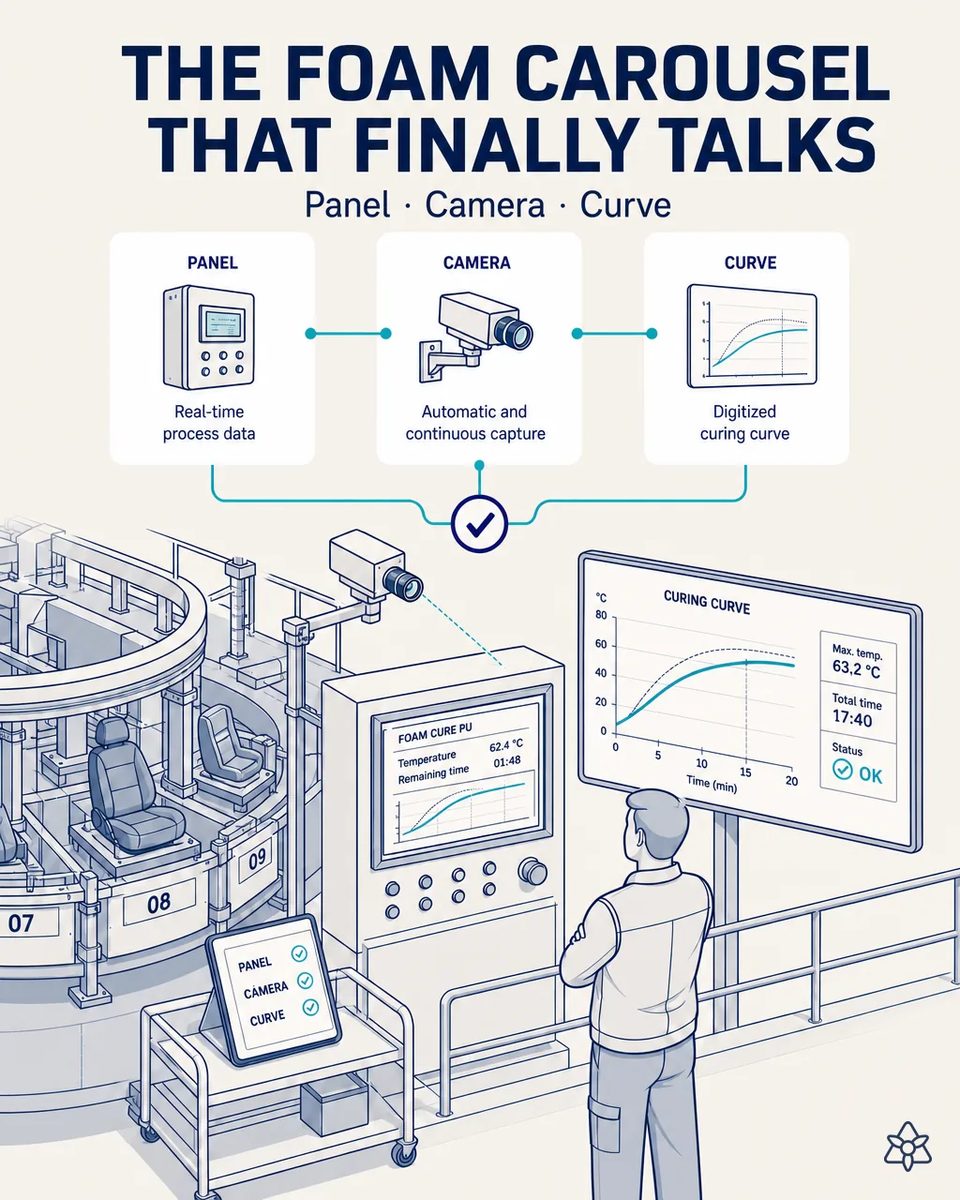
The carousel knows why the cushion collapsed, and forgets it every few seconds.
Replacing it costs a seven-figure sum and weeks of downtime. In a just-in-sequence operation those weeks do not exist. So the machine stays, and the problem stays with it. Foam is where a good share of the comfort defects the customer finds later are born: hardness out of range, collapse, voids, poor demoulding. The panel knows why it happened, low temperature at station seven, curing time cut short to recover cadence. But that data dies on the screen every few seconds.
- The foam carousel is ten to twenty years old and lives on an isolated network by the manufacturer's decision. Replacing it is a seven-figure sum and weeks of downtime that a just-in-sequence plant does not have, so the machine stays and the problem stays with it.
- Its panel shows everything that matters: mold temperature per station, curing time, mix ratio, pressure and active alarms. None of it survives the next refresh of the screen.
- Hardness out of range, collapse, voids, poor demolding: a good share of the comfort defects the customer finds later are born right here, and by the time they show at trim the cushion has left the mold and the cause has left the screen.
- Low temperature at station seven, curing time cut short to recover cadence: the cause was on the panel, but nobody can correlate it with the defect found at trim or with the claim that comes back weeks later.
Connect in photo mode on the panel — read from outside, the machine stays exactly as it is.
Connect in photo-on-panel mode. A fixed industrial camera with a stable frame, a grounded reading model interpreting every capture, and the reading structured as a time series per station and per mold. We do not touch the controller, we do not touch the machine network, we do not open an integration project with the manufacturer, we do not void the warranty. That is the elegant part: the carousel remains exactly the same machine. It simply talks now. And what it says gets cross-referenced with the manufacturing system to know which reference was running at each moment. From there you can do what you cannot do today: correlate foaming parameters with defects found at trim, and with the claim that comes back from the customer. Root-cause analysis per mold in minutes, not weeks.
No controller touched, no machine network touched, no integration project with the manufacturer, no warranty voided. The carousel stays the same machine; it simply talks now, and what it says is cross-referenced with the reference that was running on each mold at each moment. The correlation between a cold station seven and the collapsed cushions found two hours later at trim becomes a query, not a theory.
Today's carousel versus the carousel being read
| Aspect | Today | With iLEAN Connect |
|---|---|---|
| Mold temperature and curing time | On the screen, then gone | Time series per station and per mold |
| Comfort defect found at trim | No link to the foaming curve | Correlated with the mold that produced it |
| Root cause on a customer claim | Weeks, if at all | Minutes |
| Curing cut short to recover cadence | Invisible | A deviation with a timestamp |
| Carousel controller and network | — | Untouched, warranty intact |
| Replacement CAPEX | In the plan | Deferred |
Impact estimate — to be validated with your numbers.
The block below is an estimate to be validated against your plant's actual data. We put it forward so the committee has an order of magnitude; we refine it during the assessment.
- Estimated payback 5-10 months.
- Replacement CAPEX for the carousel deferred indefinitely, because the problem was never the machine.
- Comfort scrap reduced from the parameter-to-defect correlation that is impossible to make today: hardness, collapse and voids traced back to the station and the cure that caused them.
- And a root-cause analysis per mold in minutes instead of weeks, which is what the customer's quality team measures you on.
Estimated payback 5-10 months · defers the CAPEX of replacing the carousel Estimated payback of five to ten months, an estimate to validate, plus the replacement CAPEX deferred indefinitely. Because the real problem was never the machine: it was that it did not talk.
And the fair question from the production manager
“Does a camera reading a panel hold up as process evidence?” — the task is anchored: a fixed screen, fields in known positions and expected physical ranges for temperature and curing time, where the best models drop below 1.5% error [1]. And any frame whose value falls outside the possible range for that mold is discarded instead of accepted, which is what would invalidate the series in front of the customer.
[1] OpenAI paper "Why Language Models Hallucinate", 2025 — on the reliability of AI in anchored tasks.
What people ask about reading the foam carousel panel
Does it void the carousel's warranty?
No. Nothing is installed on the machine, no port is opened and the controller is never touched. The camera looks at the panel the same way the foaming operator does, from a fixed bracket outside the guard.
Does it capture every station or an average?
Every station, mold by mold: temperature, curing time, mix ratio, pressure and alarms, as a time series. An average would hide exactly the station that is running cold, which is the one producing the collapsed cushions.
Can it tell us which mold produced a collapsed cushion?
Yes, once the reading is cross-referenced with the manufacturing system to know which reference was on which mold at that moment. That is what turns a comfort claim into a maintenance action on one mold.
Does it catch a curing time cut short?
That is where it pays most: an operator recovering cadence by shortening the cure shows up as a deviation with a timestamp, before the hardness test fails and long before the customer feels it.
Does the same pattern work for the frame welder or the cover lamination press?
Yes, any isolated panel fits: a fixed camera, a stable frame and a reading model grounded on that specific screen. You start with the carousel because that is where the sub-sector's comfort defects are born and where the replacement CAPEX is largest.
More cases from this series
- The audit stops being a two-week projectAgents organizes by standard and serial number the evidence Connect and Edge already capture: the audit…
- Four rings between the broadcast and the truckFour verification rings (sequence, preparation, build and loading) cross-checked: if they disagree, the…
- Shift knowledge stops dying at clock-outThe supervisor dictates while walking what dies at end of shift today; iLEAN structures it with line,…
- Nothing enters the master without a human sign-offNothing the AI captures enters the traceability master without a human validating it in two taps from a…
- The lab stops transcribing into the ERPiLEAN reads the test sheet the moment it is saved and, once validated, writes it to the ERP. Typical…
- Receiving stops blocking the dockOne photo of the delivery note and roll labels: batch, quantity and certificate enter the ERP after one…
Tell us whether you can tie a comfort claim to a mold and a station today.
We work on your plant's real data, not ours. Assessment with no commitment.
Request estimated ROI within 48h ‹ See all cases of automotive seating See automotive