Nothing enters the master without a human sign-off
This is what separates iLEAN from an autonomous agent that writes data unsigned: nothing the AI captures enters the central system without a human having seen it first.
The blocker is not cost. It is accountability.
In a seating plant the traceability master ties the part serial number to the vehicle, and it carries the legal responsibility for a safety component. Contaminating that master is simply unthinkable. That is why the blocker to digitalisation in an account like this is never cost. It is accountability. Nobody signs off a system that writes on its own into the master of a part that carries the seat belt anchorage. It is a legitimate objection. At the same time the operator cannot type either: every second at their station is balanced to the customer's takt. Any solution costing them twenty seconds per unit is dead before it starts.
- The traceability master ties the seat serial number to the vehicle, and it carries the legal responsibility for a safety component: belt anchorage, structure, side airbag in the backrest. Contaminating that master is simply unthinkable.
- Nobody signs off a system that writes on its own into that master. It is a legitimate objection, and the one that kills digitalization projects in automotive accounts, long before anyone discusses cost or cadence.
- At the same time the operator cannot type: every second at the station is balanced to the customer's takt. A solution that costs twenty seconds per seat is dead before it starts, however good its data.
- So the plant is left choosing between unvalidated data contaminating the master, or data not captured at all out of mistrust. The project never gets signed off.
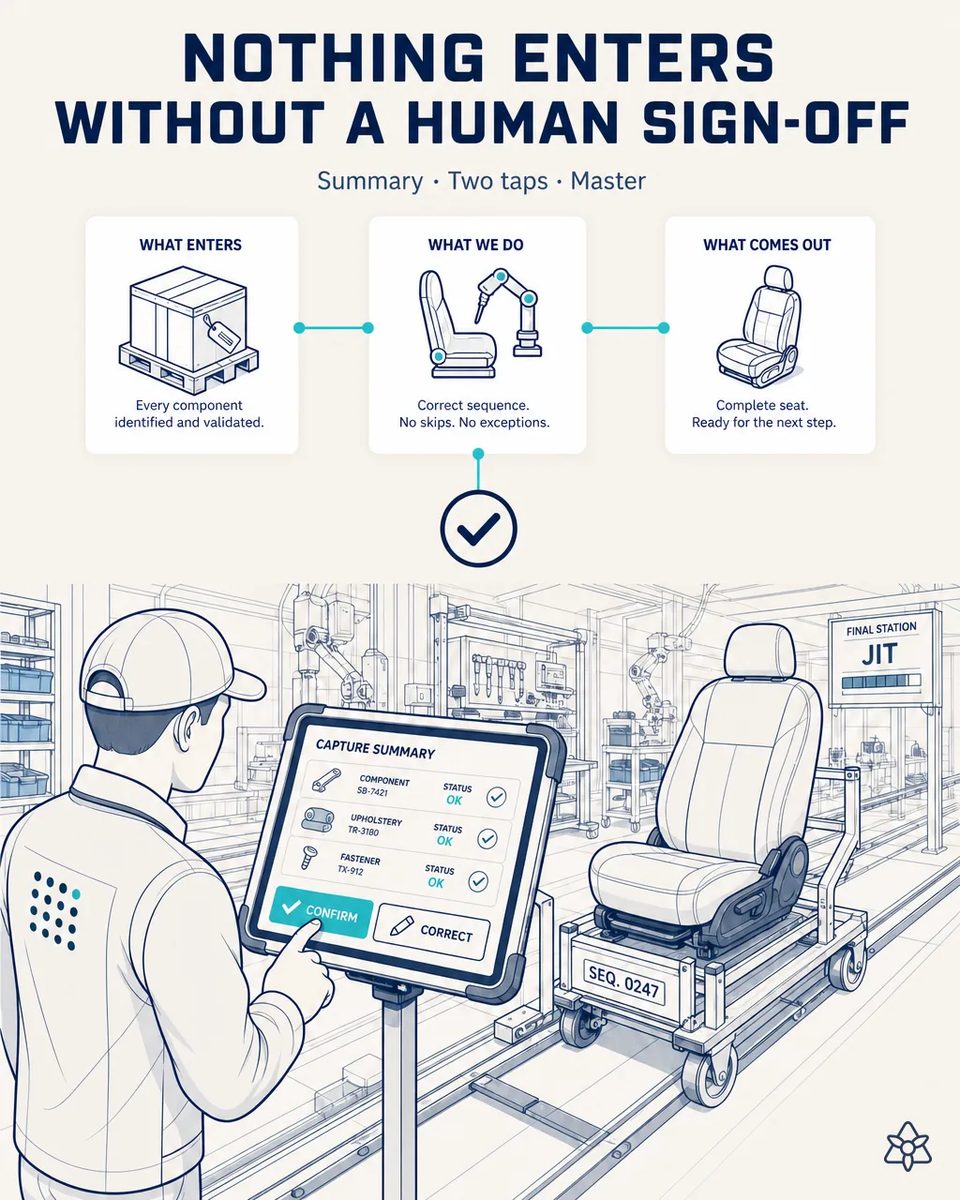
Connect with early human verification — a two-second summary, two taps, then the master.
The answer is an industrial tablet at the line. When iLEAN parses the start-up sheet, when the supervisor dictates an issue, when a supplier alert arrives, when the camera reads the foaming panel, it all shows up there as a two-second visual summary. The operator confirms or corrects with two taps. Only then does the data cross into the manufacturing system, signed, with traceability of who validated what. What gets corrected is stored as a correction, and that correction retrains the system's criteria. The interface is designed for two-second validation, not for data entry.
It is the piece that separates iLEAN from an autonomous agent writing data unsigned. Whatever the AI captured — the start-up sheet, the dictated issue, the supplier alert, the foaming panel — shows up on the tablet as a summary; a person confirms or corrects; only then does it cross, signed, with traceability of who validated what. The interface is designed for two-second validation at takt, not for data entry.
Today's dilemma versus the verification gate
| Aspect | Today | With iLEAN |
|---|---|---|
| Who writes to the master | A person typing, late | A person confirming, in seconds |
| Operator's time per seat | Twenty seconds nobody has | Two taps |
| What the signature proves | That somebody signed | Which summary they saw and what they corrected |
| A wrong extraction | Enters the master | Corrected before it crosses, stored as a correction |
| The project | Never signed off | Approvable in an automotive account |
| Master integrity | At risk | Clean by construction |
Impact estimate — to be validated with your numbers.
The block below is an estimate to be validated against your plant's actual data. We put it forward so the committee has an order of magnitude; we refine it during the assessment.
- No standalone payback — an enabling piece. On its own it does not have one, and we will not invent it: its value is strategic and compliance value, measured in the eleven cases it makes possible.
- Without early human verification the other eleven cases do not get signed off in an automotive account: this is the gate the start-up sheet, the torque curve and the supplier alert all pass through.
- Every correction is stored as a correction and retrains the system's criteria, so extraction improves exactly where it failed.
- And it defuses the cultural objection on the shop floor before it is even raised: the operator sees that nothing is written in their name without them.
Enabling piece · strategic and compliance value, not directly monetizable I am not going to put a payback on this one, because on its own it does not have one. It is the enabling piece: without early human verification the other eleven do not get signed off in an automotive account. And it is also what defuses the cultural objection on the shop floor before it is even raised.
And the fair question from the production manager
“If a person confirms in the end, what is the AI saving?” — the work is not in deciding, it is in assembling. Today somebody would have to walk to a terminal, find the serial number and type the fields. With the gate it arrives assembled, and the extraction behind it is an anchored task where the best models drop below 1.5% error [1]; the two taps are the second net, and every correction is stored with its author.
[1] OpenAI paper "Why Language Models Hallucinate", 2025 — on the reliability of AI in anchored tasks.
What people ask about the human sign-off gate
Can the AI ever write into the master on its own?
No, and it is not configurable: it is the architecture. Data crosses into the manufacturing system only after a person confirms it on the tablet, and the record of that confirmation travels with the data.
How long does validation take at takt?
Two seconds to read the summary and two taps. The interface is designed for validation, not for data entry, because the station is balanced to the customer's takt and nobody has twenty seconds per seat.
What exactly gets recorded?
Which summary was shown, who confirmed it, when, and what they corrected. That is what serves when the customer asks who validated a safety part on a specific vehicle.
Does this cover the belt anchorage and airbag data as well?
Yes, and that is the point: the safety-part master is exactly the one nobody would let a system write into unsigned. The gate is the same for the torque curve as for the start-up sheet.
Should we deploy this before the other cases?
In practice yes. It is the piece that makes everything else approvable, and the reason the accountability objection never gets raised on the shop floor or in the boardroom.
More cases from this series
- The audit stops being a two-week projectAgents organizes by standard and serial number the evidence Connect and Edge already capture: the audit…
- Four rings between the broadcast and the truckFour verification rings (sequence, preparation, build and loading) cross-checked: if they disagree, the…
- The foam carousel that finally talksAn external camera digitizes mold temperature, curing and alarms from an isolated foam carousel,…
- Shift knowledge stops dying at clock-outThe supervisor dictates while walking what dies at end of shift today; iLEAN structures it with line,…
- The lab stops transcribing into the ERPiLEAN reads the test sheet the moment it is saved and, once validated, writes it to the ERP. Typical…
- Receiving stops blocking the dockOne photo of the delivery note and roll labels: batch, quantity and certificate enter the ERP after one…
Tell us who appears today as the author of the data in your traceability master.
We work on your plant's real data, not ours. Assessment with no commitment.
Request estimated ROI within 48h ‹ See all cases of automotive seating See automotive