Four rings between the broadcast and the truck
The capital pain of any sequenced seating plant is always the same: zero customer line stops. A seat arriving out of sequence, with the wrong variant or non-conforming, stops the assembly plant's line, and that is billed by the minute. But the expensive part is not the invoice: it is the mark it leaves on the commercial relationship, which lasts years and is paid at the award of the next program.
The expensive part is not the invoice. It is the mark on the relationship.
The window between the customer signal and line-side delivery is ninety minutes to a few hours. Within it you must build the right variant, in the right order, defect-free, with material that may not have arrived. First ring, the sequence. The customer schedule defines which variant is due and in what order. Connect keeps that ring alive with what electronic data interchange does not carry: the supplier delay, the mix change announced by email, the issue the supervisor dictated while walking. If a component's coverage does not reach the window, you know hours ahead.
- A seat arriving out of sequence, with the wrong variant or non-conforming stops the assembly plant's line, and that is billed by the minute.
- The mark it leaves on the commercial relationship lasts years and is paid at the award of the next program.
- The window between the customer broadcast and line-side delivery is ninety minutes to a few hours: build the right variant, in the right order, defect-free, with material that may not have arrived.
- Each control exists in some form today, and the seat still escapes, because the failure is a concatenation: a delay nobody read, a fixture not confirmed, a wrinkle sampled out, a cart loaded in the wrong order. Each link passes its own check.
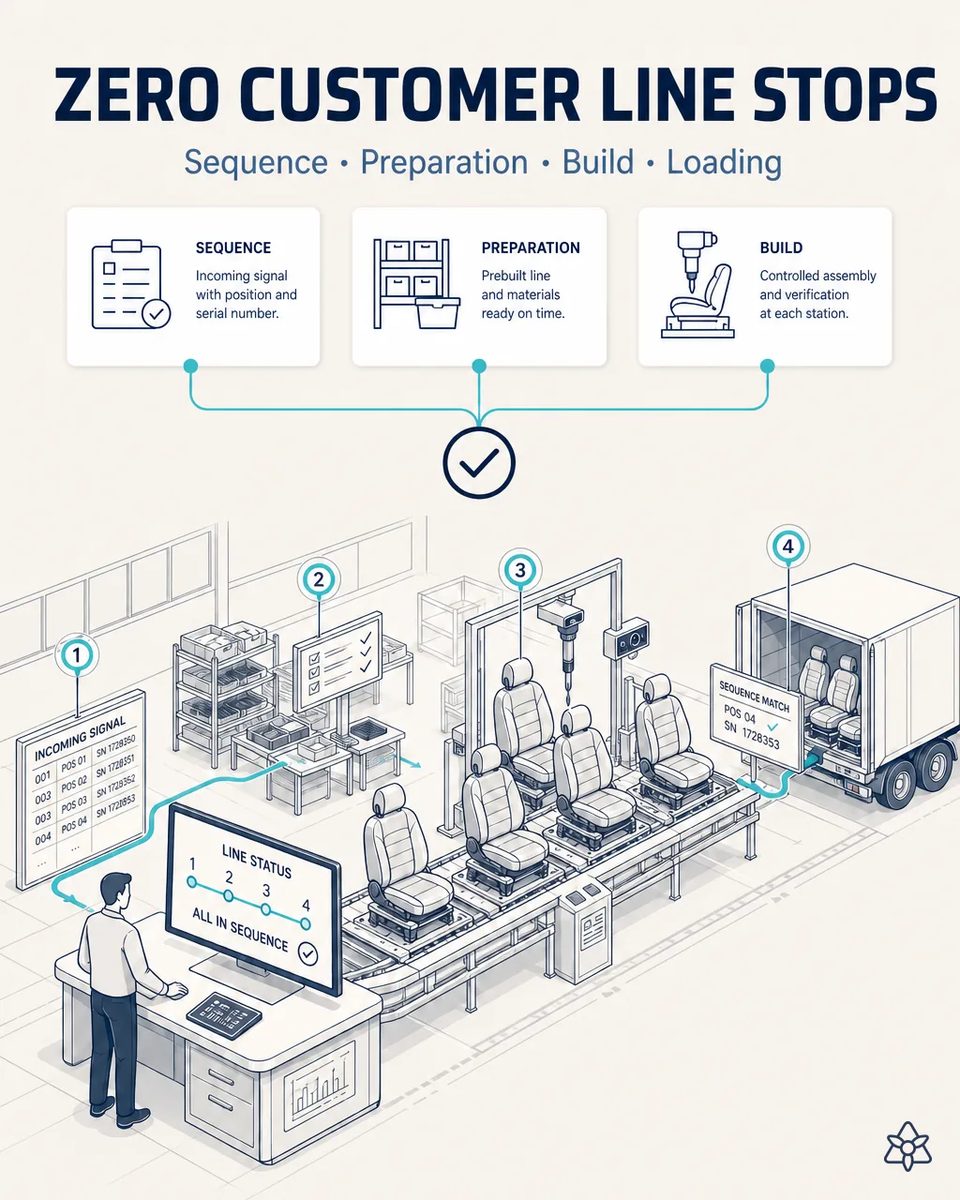
Four rings that cross-check — sequence, preparation, build and loading.
Second ring, preparation. Edge confirms the line is in the right state for the variant due, fixture, kit, references and torque program, before start-up. If not, JIDOKA AI blocks it. Third ring, the build. The camera verifies trimming at cadence and the torque tool integration ties every safety joint curve to the serial number. A non-conforming tightening or a trim defect stops the unit before it enters sequence. Fourth ring, shipping. Before loading, each seat's serial number is matched against its position in the truck sequence. If they do not match, loading stops. And every unit travels with its dossier already built. That is the sentence that sums up the whole system: if the four rings do not agree, the unit does not move on. And it stops here, in your plant, where it costs minutes, not on the customer's line, where it costs the relationship. SMED AI closes the loop from the other side: using the changeover evidence, it shortens changeover time so the four rings are not paid for in cadence.
Ring one keeps the sequence alive with what EDI does not carry. Ring two confirms the line is in the state for the variant due. Ring three verifies trim and ties every safety tightening to the serial number. Ring four matches each seat against its position in the truck. If the four do not agree, the unit does not move on — and it stops in your plant, where it costs minutes.
The four rings, and what each one closes
| Ring | Which cases it draws on | What it closes |
|---|---|---|
| 1 · Sequence | Supply alert (3) + receiving (7) + supervisor headset (4) | Coverage of every component against the window, known hours ahead |
| 2 · Preparation | Changeover validation (10) + shift start (1) | Fixture, kit, references and torque program confirmed before start-up |
| 3 · Build | Trim defects (9) + torque traceability (8) + foam panel (2) | A non-conforming tightening or trim defect stops the unit before sequence |
| 4 · Loading | Human sign-off (5) + the traceability master | Serial number matched to its truck position; if not, loading stops |
| Dossier | Lab tests (6) + evidence pack (11) | Every seat travels with its evidence already built |
| Cadence | SMED AI on the changeover history | The four rings are not paid for in cadence |
Impact estimate — to be validated with your numbers.
The block below is an estimate to be validated against your plant's actual data. We put it forward so the committee has an order of magnitude; we refine it during the assessment.
- Estimated payback 6-12 months — it pays for itself with the first customer line stop avoided.
- A single sequence incident usually has a direct impact far above the cost of the full deployment, before counting the mark it leaves on the relationship.
- The discrepancy is caught in your plant with room to correct, and the evidence is available in minutes.
- And protection of the commercial relationship and the supplier rating, which is what the next program award is decided on.
Estimated payback 6-12 months · it pays for itself with the first line stop avoided The return is calculated against the first line stop avoided: a single incident of that kind usually has a direct impact far above the cost of the full deployment. Estimated payback of six to twelve months, an estimate to validate against your history of sequence incidents and the per-minute stop cost agreed with your customer.
And the fair question from the production manager
“Do we have to deploy all twelve cases to get this?” — no, and framing it that way is how you never start. The rings are built in layers and each case pays on its own. With the supply alert and the shift start you already have ring one, which is where the supply break lives; and none of it is a leap of faith, because every reading underneath is an anchored task where the best models drop below 1.5% error [1], with a person confirming at the gate.
[1] OpenAI paper "Why Language Models Hallucinate", 2025 — on the reliability of AI in anchored tasks.
What people ask about the complete system
Where do you start?
With the human sign-off gate, because it makes everything else approvable, and then the supply alert, which is the highest direct-return case and closes half of ring one. Each layer pays on its own before the next is added.
What does the cross-check give that each control does not?
The concatenation. A delay read late passes, a changeover signed in a hurry passes, a wrinkle sampled out passes, and the seat that adds the three stops the customer line. Four independent sources ceasing to agree is what gives it away.
What happens at loading if a serial number does not match its position?
Loading stops. The seat stays in your plant, where the correction costs minutes, instead of reaching the customer line where it costs the relationship.
Does it replace the manufacturing system or the broadcast?
No. Ring one rests on the customer broadcast being the truth. iLEAN cross-checks the systems against each other and against what actually happens on the line.
Can the return be estimated before committing?
Yes: with your sequence incident history and the per-minute stop cost agreed with your customer, the return per ring is estimated before deciding the order.
More cases from this series
- The audit stops being a two-week projectAgents organizes by standard and serial number the evidence Connect and Edge already capture: the audit…
- The foam carousel that finally talksAn external camera digitizes mold temperature, curing and alarms from an isolated foam carousel,…
- Shift knowledge stops dying at clock-outThe supervisor dictates while walking what dies at end of shift today; iLEAN structures it with line,…
- Nothing enters the master without a human sign-offNothing the AI captures enters the traceability master without a human validating it in two taps from a…
- The lab stops transcribing into the ERPiLEAN reads the test sheet the moment it is saved and, once validated, writes it to the ERP. Typical…
- Receiving stops blocking the dockOne photo of the delivery note and roll labels: batch, quantity and certificate enter the ERP after one…
Tell us your sequence incident history and the per-minute stop cost agreed with your customer.
We work on your plant's real data, not ours. Assessment with no commitment.
Request estimated ROI within 48h ‹ See all cases of automotive seating See automotive