The line cannot start wrong
In a plant running five lines with different variants at the same time, the model changeover is the moment of maximum risk of the day. And it happens many times per shift.
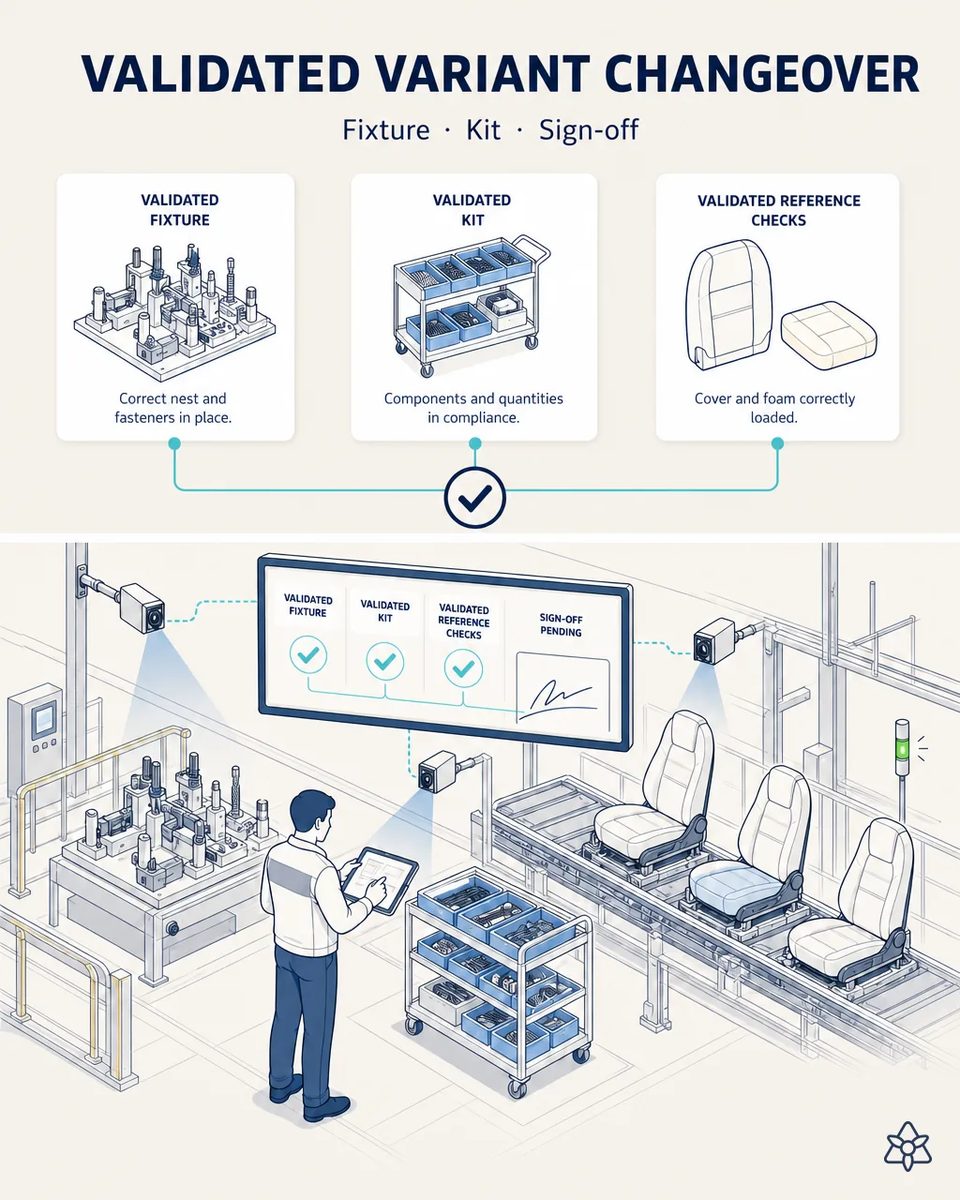
The changeover is the riskiest moment of the day, and it happens many times per shift.
If the line starts with the previous variant's fixture, the wrong kit on the cart or the wrong torque program, the first units come out non-conforming. And in a just-in-time regime those first units are already committed to a specific vehicle on the customer's line. Today the guarantee that the changeover was done right is a human signature with no objective evidence, from someone under time pressure, because every minute of changeover is lost cadence. This is precisely the scenario where human error is expected, not exceptional.
- If the line starts with the previous variant's fixture, the wrong kit on the sequencing cart or the wrong torque program, the first seats come out non-conforming, and they are discovered later, if at all.
- In just-in-sequence those first seats are already committed to a specific vehicle on the customer's line. There is no buffer to absorb them.
- Today the guarantee that the changeover was done right is a human signature with no objective evidence, from someone under time pressure, because every minute of changeover is lost cadence on a line already behind the broadcast.
- This is precisely the scenario where human error is expected, not exceptional, and the plant runs five lines with different variants at once, each with its own changeovers through the shift.
Edge with JIDOKA AI — the line does not start until every point confirms and a person signs.
Edge iLEAN places fixed cameras on the critical points of the changeover: the fixture nest, the component kit on the sequencing cart, the loaded foam and cover references, the tool and its program. The manufacturing system says which variant is due; the cameras confirm the line is in that state. And if any point fails to confirm, the line does not start. That is JIDOKA AI: the error is not announced, it is prevented. The system does not let it through. The AI provides the evidence point by point, the responsible person signs on that evidence, and can override and start if their judgment justifies it, leaving a reasoned record. The decision is never taken away from the person: only the blindness is. There is a side effect people usually like more than the main one. With the history of how long each point takes to confirm, the changeover itself gets shorter. The evidence we collect to avoid starting wrong becomes the raw material for SMED.
The manufacturing system says which variant is due; the cameras confirm the line is in that state. If a point fails, the line does not start: the error is prevented, not announced. And the responsible person can override with a reasoned record if their judgment justifies it — only the blindness is taken away, never the decision. The evidence collected to avoid starting wrong becomes the raw material for SMED.
Today's changeover versus the validated changeover
| Aspect | Today | With iLEAN Edge |
|---|---|---|
| Fixture nest | Assumed correct | Confirmed against the variant due |
| Kit on the sequencing cart | Checked by eye, in a hurry | Confirmed point by point |
| Foam and cover references loaded | A signature | Image evidence with a timestamp |
| Torque program | Whatever is on the controller | Confirmed for the variant |
| If a point fails | The line starts anyway | The line does not start |
| Changeover duration | Unknown per point | History per point, raw material for SMED |
Impact estimate — to be validated with your numbers.
The block below is an estimate to be validated against your plant's actual data. We put it forward so the committee has an order of magnitude; we refine it during the assessment.
- Estimated payback 5-10 months, to validate against the number of changeovers per shift and the cost of a non-conforming start-up.
- The line cannot start wrong: no first seats committed to a vehicle with the previous variant's fixture, the wrong kit or the wrong torque program.
- A reasoned override record whenever a person decides to start anyway, so the decision is never taken away, only the blindness.
- And the side effect people like most: with the history of how long each point takes to confirm, the changeover itself gets shorter.
Estimated payback 5-10 months · the line cannot start wrong, and changeover gets shorter Estimated payback of five to ten months, an estimate to validate against the number of variant changeovers per shift and the average cost of a non-conforming start-up.
And the fair question from the production manager
“What if the camera blocks the line for no reason?” — that is the right objection, because every minute of changeover is lost cadence. Each point is checked against the reference state of that specific variant, which is an anchored task where the best models drop below 1.5% error [1]; and in case of doubt the system does not block silently: it escalates to the responsible person, who signs on the evidence or overrides with a reasoned record.
[1] OpenAI paper "Why Language Models Hallucinate", 2025 — on the reliability of AI in anchored tasks.
What people ask about validating the variant changeover
Which points are checked?
The fixture nest, the component kit on the sequencing cart, the loaded foam and cover references, and the tool with its torque program. The list is defined at commissioning with your process engineers, variant by variant.
Can the responsible person start anyway?
Yes, with an override that leaves a reasoned record of who decided and why. What cannot happen is starting up with no trace of that decision, which is what a signature under time pressure amounts to today.
Does it make the changeover longer?
The check takes seconds. What lengthens it today is the margin added for lack of evidence, and the history of how long each point takes to confirm is what shortens the changeover afterwards.
Does it work with five lines running different variants?
That is the design case: each line is checked against the variant the manufacturing system says is due on that line, not against a generic state, and the changeovers on one line do not interfere with the others.
Where does SMED come in?
The evidence collected to avoid starting wrong tells you how long each point takes to confirm. That is the raw material SMED AI uses to shorten the changeover, which is the side effect people usually like more than the main one.
More cases from this series
- The audit stops being a two-week projectAgents organizes by standard and serial number the evidence Connect and Edge already capture: the audit…
- Four rings between the broadcast and the truckFour verification rings (sequence, preparation, build and loading) cross-checked: if they disagree, the…
- The foam carousel that finally talksAn external camera digitizes mold temperature, curing and alarms from an isolated foam carousel,…
- Shift knowledge stops dying at clock-outThe supervisor dictates while walking what dies at end of shift today; iLEAN structures it with line,…
- Nothing enters the master without a human sign-offNothing the AI captures enters the traceability master without a human validating it in two taps from a…
- The lab stops transcribing into the ERPiLEAN reads the test sheet the moment it is saved and, once validated, writes it to the ERP. Typical…
Tell us how many variant changeovers you run per shift and how many start-ups went wrong last quarter.
We work on your plant's real data, not ours. Assessment with no commitment.
Request estimated ROI within 48h ‹ See all cases of automotive seating See automotive