Every safety tightening, tied to its part
In a seat there are joints that are not just another joint: the belt anchorage, the structure joint, the side airbag module fixing in the backrest. They are tightened with torque and angle controlled tools, and every tightening produces a curve.
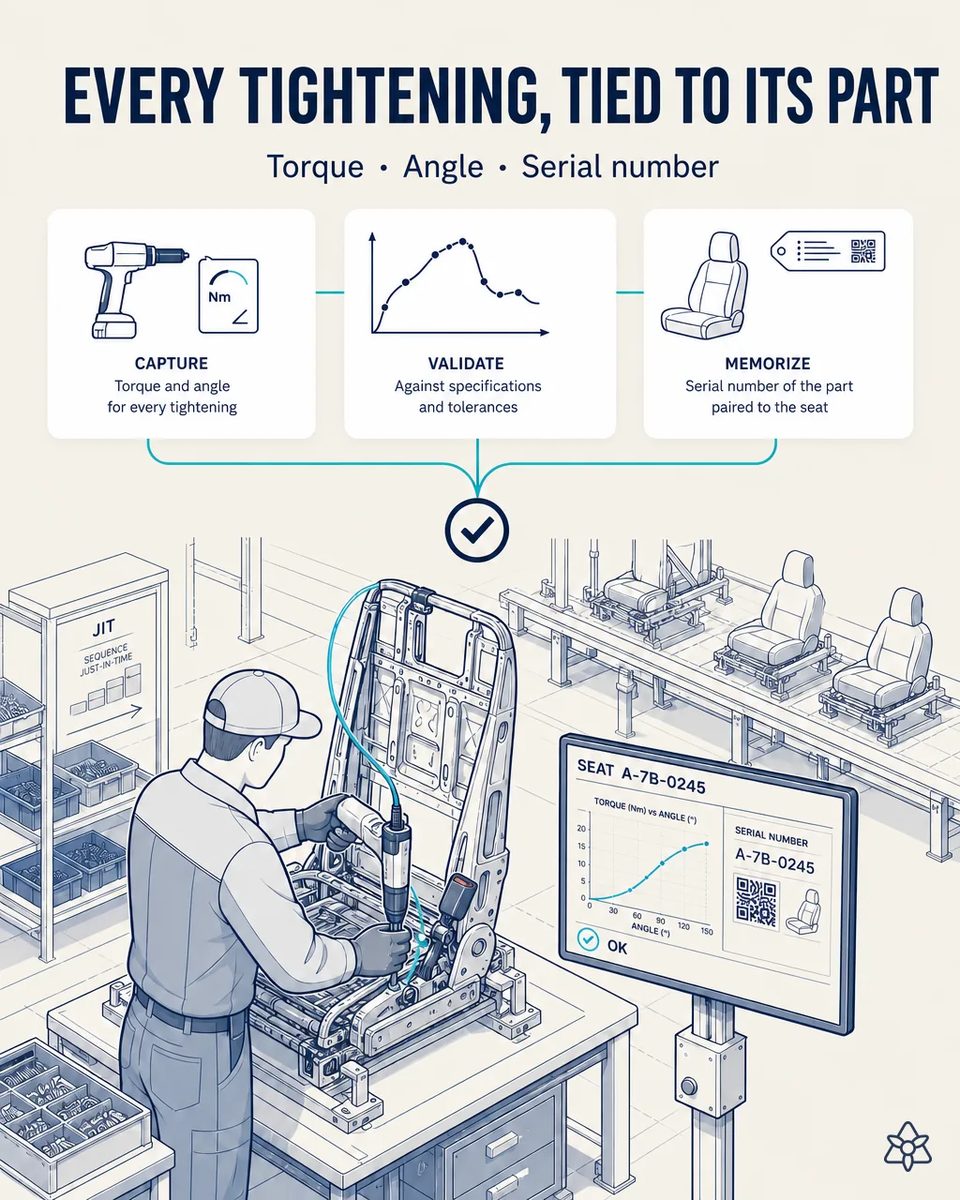
The curve exists. It is just not attached to the seat.
Those controllers are relatively modern and almost always already expose a programming interface or an open protocol. But in many plants they remain islands. It is the classic almost-integrated-but-not case: the data exists, the tool generates it, the interface is there, and the project to stitch it properly never rises up the priority list. The result: the evidence that the safety joint was tightened correctly does exist, but disconnected from the part. When the customer asks about a specific serial number, the answer is built by hand cross-matching files by timestamp, with the margin of error that implies. There is a second, more serious problem. When the variant changes and the torque program changes with it, today that change is made by hand on the controller. A wrong program means a safety joint out of specification.
- The belt anchorage, the frame joint, the side airbag module fixing in the backrest: safety joints tightened with torque- and angle-controlled nutrunners, and every tightening produces a curve.
- The controllers are modern and expose an interface or an open protocol, and they remain islands. The project to stitch them never rises up the priority list, because nothing is visibly broken.
- So when the customer asks about a specific serial number, the evidence is built by hand, cross-matching files by timestamp, with the margin of error that implies. The data exists, the tool generates it, and it is still disconnected from the seat.
- Worse: when the variant changes and the torque program changes with it, that change is made by hand on the controller. A wrong program is a safety joint out of specification.
Connect stitches controller and manufacturing system through their APIs, in both directions.
Connect stitches the two systems through their programming interfaces, in both directions. Inbound: every tightening event, torque, angle, result, retries, is captured and tied to the serial number active at that station. Outbound: when the manufacturing system announces the next variant in sequence, the correct torque program is published to the controller with no keying in between. And let me be clear about what is not needed: neither the tools nor the manufacturing system get replaced. We stitch what you already have.
Inbound, every tightening — torque, angle, result, retries — lands tied to the serial number active at that station. Outbound, when the sequence announces the next variant, the correct torque program is published to the controller with no keying in between. Neither the tools nor the manufacturing system get replaced: we stitch what you already have.
The isolated controller versus the stitched controller
| Aspect | Today | With iLEAN Connect |
|---|---|---|
| Torque curve | In the controller, disconnected from the part | Tied to the seat serial number as it happens |
| Evidence for a serial number | Cross-matched by timestamp, by hand | In seconds |
| Torque program at variant change | Keyed by hand on the controller | Published from the sequence |
| Wrong program on a safety joint | A permanent exposure | Eliminated by construction |
| Retries and NOK tightenings | A count, at best | Each one, with its curve |
| Tools and manufacturing system | — | Neither replaced |
Impact estimate — to be validated with your numbers.
The block below is an estimate to be validated against your plant's actual data. We put it forward so the committee has an order of magnitude; we refine it during the assessment.
- Estimated payback 3-6 months, mostly from engineering and quality time spent today reconstructing evidence by timestamp.
- The wrong-torque-program error between variants disappears, and that is a failure mode with safety consequences, which is the big value here even if it never shows in the hours saved.
- Evidence for any belt anchorage or airbag module fixing in seconds, by serial number, instead of a hand cross-match by timestamp.
- And the torque program travels with the sequence, so a variant change stops being a moment of exposure.
Estimated payback 3-6 months · removes wrong-torque-program errors between variants Fast payback, three to six months, mostly from the engineering and quality time spent today reconstructing evidence, an estimate to validate. But the big value is risk: the wrong-torque-program error between variants disappears, and that is a failure mode with safety consequences.
And the fair question from the production manager
“Isn't a classic MES integration cleaner?” — it is, the day it reaches the top of the list, and that is the problem: the interface has been there for years and the project never starts. This stitching replaces neither system, asks for no shutdown window and is bounded to one station in the trial. And there is no camera reading in the loop here: the curve arrives through the controller's own interface, so the reliability question does not even arise — unlike the photo cases, where the best models already drop below 1.5% error on anchored tasks [1].
[1] OpenAI paper "Why Language Models Hallucinate", 2025 — on the reliability of AI in anchored tasks.
What people ask about torque traceability
Do we have to replace the nutrunners or the manufacturing system?
Neither. Connect leans on the interface the controllers already expose and on what the manufacturing system announces when the next variant enters the sequence. It is the classic almost-integrated-but-not case, and stitching is all that was missing.
What gets captured per tightening?
Torque, angle, result, retries and the curve, tied to the serial number active at that station at that moment. Not a summary, every event, including the NOK that was retried and passed on the second attempt.
How does the torque program get to the controller?
The manufacturing system announces the next variant; Connect publishes the matching program to the controller. Nobody keys anything, so the wrong program cannot be selected at a variant change.
Can we start with one station?
Yes, and that is the recommendation: pick the most critical joint, usually the belt anchorage, stitch its controller in a bounded trial and measure before extending to the airbag module fixing and the frame joints.
Does it help with a customer investigation on a specific vehicle?
That is the moment it was built for: from the seat serial number to every safety tightening curve, in seconds instead of a hand cross-match by timestamp with the margin of error that implies.
More cases from this series
- The audit stops being a two-week projectAgents organizes by standard and serial number the evidence Connect and Edge already capture: the audit…
- Four rings between the broadcast and the truckFour verification rings (sequence, preparation, build and loading) cross-checked: if they disagree, the…
- The foam carousel that finally talksAn external camera digitizes mold temperature, curing and alarms from an isolated foam carousel,…
- Shift knowledge stops dying at clock-outThe supervisor dictates while walking what dies at end of shift today; iLEAN structures it with line,…
- Nothing enters the master without a human sign-offNothing the AI captures enters the traceability master without a human validating it in two taps from a…
- The lab stops transcribing into the ERPiLEAN reads the test sheet the moment it is saved and, once validated, writes it to the ERP. Typical…
Tell us how you build the torque evidence for a serial number when the OEM asks today.
We work on your plant's real data, not ours. Assessment with no commitment.
Request estimated ROI within 48h ‹ See all cases of automotive seating See automotive