The critical alert stops waiting in an inbox
Electronic data interchange brings the official schedule. Perfect, structured, on time. But the reality of a plant day does not travel there: it travels by email and by messaging.
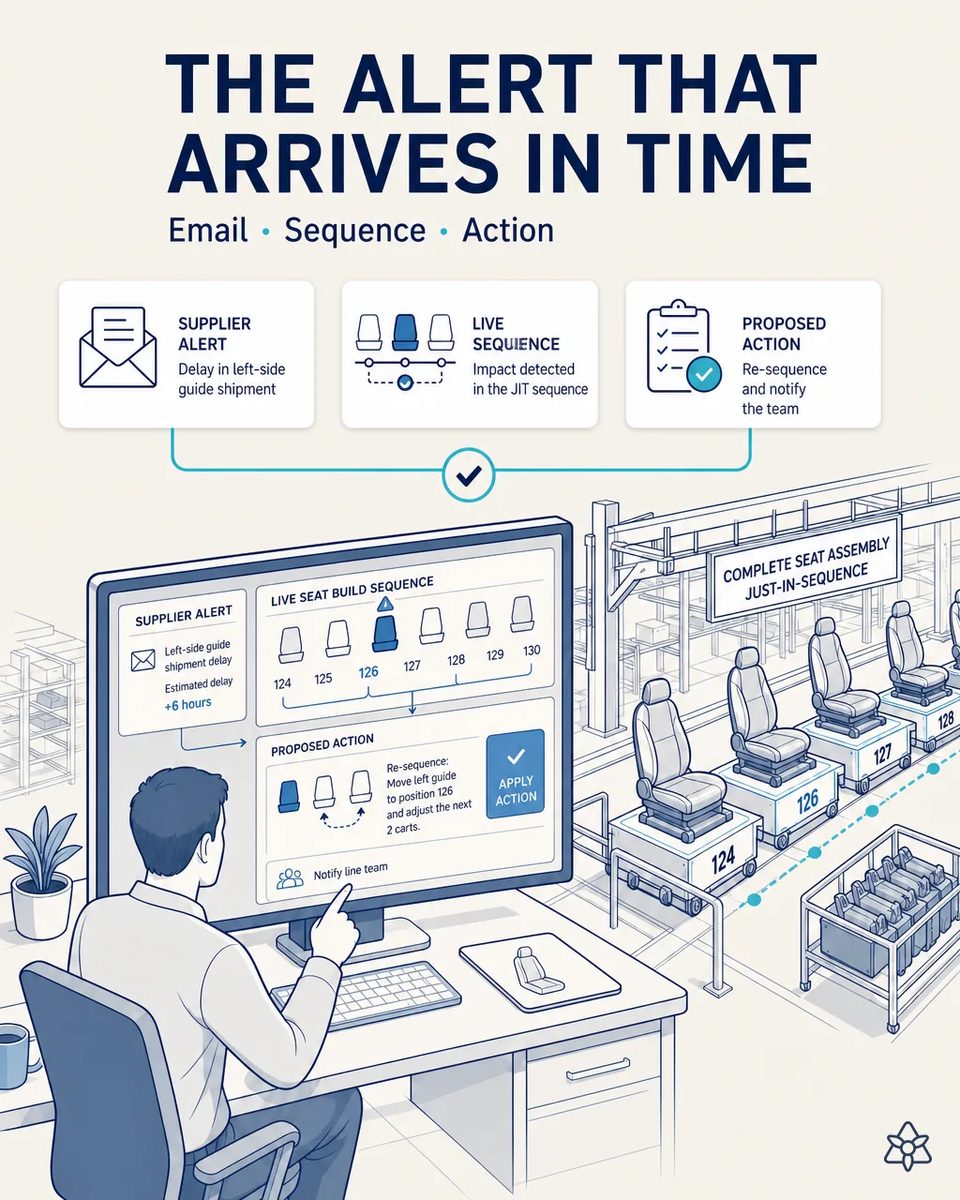
The official schedule travels by EDI. The reality of the day travels by email.
The mechanisms supplier warns the truck is leaving six hours late. The leather supplier warns the new batch has a shade difference. The carrier warns about a road closure. A customer planner warns of a mix change for the afternoon shift. All those messages land in one specific person's inbox, and they read them when they can. In an operation with a ninety-minute sequencing window, when they can is always too late. The missing material gets discovered when the operator reaches for it and it is not there, with the sequence already launched.
- The mechanisms supplier warns the truck leaves six hours late. The leather supplier warns the new batch has a shade difference. The carrier warns of a road closure. A customer planner changes the mix for the afternoon shift. None of it is in EDI, and all of it changes what the line can build in the window.
- All of it lands in one person's inbox, and they read it when they can. In a ninety-minute sequencing window, when they can is always too late.
- The shortage is discovered when the operator reaches for the rail or the foam pad and it is not there, with the sequence already launched and the truck slot already fixed.
- From there every option is expensive: a resequencing improvised under pressure, special freight, or the customer line stop everybody was trying to avoid. And the email that would have prevented it had been sitting there for three hours.
Connect in chaotic-sources mode — copied into the supply mailbox, twenty-four seven.
Connect in chaotic-sources mode. iLEAN sits copied into a dedicated mailbox and a business messaging number, twenty-four seven. The moment a message arrives it extracts intent, supply delay, quality deviation, schedule change, and entities: supplier, part number, quantity, time window. And here is the difference from any generic alert: it cross-checks against the live schedule and the real stock of the affected component. It gives the planner and the supervisor which sequence variants are affected, how much coverage is left measured in hours of production, and which resequencing still protects the delivery. The system does not touch the schedule. It proposes, and it alerts the right role with a concrete action. The decision belongs to the person, always. Humans in command is not a slogan here: nobody resequences without a human signing off.
The difference from a generic alert is the cross-check: it is not enough to read the email sooner. iLEAN checks it against the live schedule and the real stock of the affected component, and returns which sequence variants are hit, how many hours of coverage remain and which resequencing still protects the delivery. Nobody resequences without a human signing off.
Today's alert versus the cross-checked alert
| Aspect | Today, in the inbox | With iLEAN Connect |
|---|---|---|
| When it is read | 2-4 h after it arrives | In seconds |
| What it says | A supplier email | Intent, part number, quantity, time window |
| Impact on the sequence | Worked out by hand, if at all | Affected variants and hours of coverage |
| What you receive | One more message | A resequencing that protects the delivery |
| Who it reaches | Whoever it was addressed to | Planner and supervisor, the roles that act |
| Who decides | Nobody, until it is too late | The person — iLEAN proposes |
Impact estimate — to be validated with your numbers.
The block below is an estimate to be validated against your plant's actual data. We put it forward so the committee has an order of magnitude; we refine it during the assessment.
- Estimated payback 3-7 months, depending on how often critical alerts arrive.
- From 2-4 hours of human latency down to seconds, with the affected variants and the hours of coverage already worked out.
- Special freight and improvised resequencing you stop paying for, because the shortage is known hours ahead instead of at the station.
- And this is likely the highest direct-return case in the set, because the value is measured in customer line stops avoided, not in office hours saved.
Estimated payback 3-7 months · from 2-4 h of human latency to seconds From two to four hours of human latency down to seconds. Estimated payback of three to seven months depending on how often critical alerts arrive, an estimate to validate. And this is probably the highest direct-return case in the set, because the value is not measured in office hours saved: it is measured in line stops avoided.
And the fair question from the production manager
“Are you going to read my planners' email?” — no. iLEAN sits copied into a dedicated supply mailbox and a business messaging number: it only sees what suppliers, carriers and customer planners send to those operational channels. On extraction, classifying the intent of a delay or a mix change is an anchored task where the best models drop below 1.5% error [1] — and the resequencing is executed by a person.
[1] OpenAI paper "Why Language Models Hallucinate", 2025 — on the reliability of AI in anchored tasks.
What people ask about the supply alert
Does it replace EDI?
No. EDI carries the official broadcast and schedule, which is its job, and it keeps doing it. This case covers the reality that never travels there: the delay, the shade deviation, the road closure, the mix change sent by hand from a customer planner's phone.
How does it know how much coverage is left?
By cross-checking the affected part number against the real stock and the live schedule. Coverage comes back in hours of production, which is the unit a planner thinks in, and it names the sequence variants that run out first.
Can it resequence on its own?
No, and that is architecture, not configuration. It proposes the resequencing that protects the delivery and alerts the right role; a person decides and signs. Humans in command is not a slogan here.
Does it handle a leather shade deviation the same way as a delay?
It classifies them differently. A shade difference is a quality deviation that quality has to see before that batch enters a variant; a delay is a coverage problem for planning.
What if suppliers write in another language?
That is normal with an international supply base and it is designed for. Intent extraction does not depend on the language of the message, and the carrier's road closure counts the same as the mechanisms supplier's delay.
More cases from this series
- The audit stops being a two-week projectAgents organizes by standard and serial number the evidence Connect and Edge already capture: the audit…
- Four rings between the broadcast and the truckFour verification rings (sequence, preparation, build and loading) cross-checked: if they disagree, the…
- The foam carousel that finally talksAn external camera digitizes mold temperature, curing and alarms from an isolated foam carousel,…
- Shift knowledge stops dying at clock-outThe supervisor dictates while walking what dies at end of shift today; iLEAN structures it with line,…
- Nothing enters the master without a human sign-offNothing the AI captures enters the traceability master without a human validating it in two taps from a…
- The lab stops transcribing into the ERPiLEAN reads the test sheet the moment it is saved and, once validated, writes it to the ERP. Typical…
Tell us what the last shortage discovered at the line with the sequence launched cost you.
We work on your plant's real data, not ours. Assessment with no commitment.
Request estimated ROI within 48h ‹ See all cases of automotive seating See automotive