Shift start-up stops living on a piece of paper
Every line starts its shift on paper. A start-up sheet with the variants to be run and the state the line was left in, and a first-off record that quality signs by hand before releasing production. Those two documents are the birth certificate of the shift.
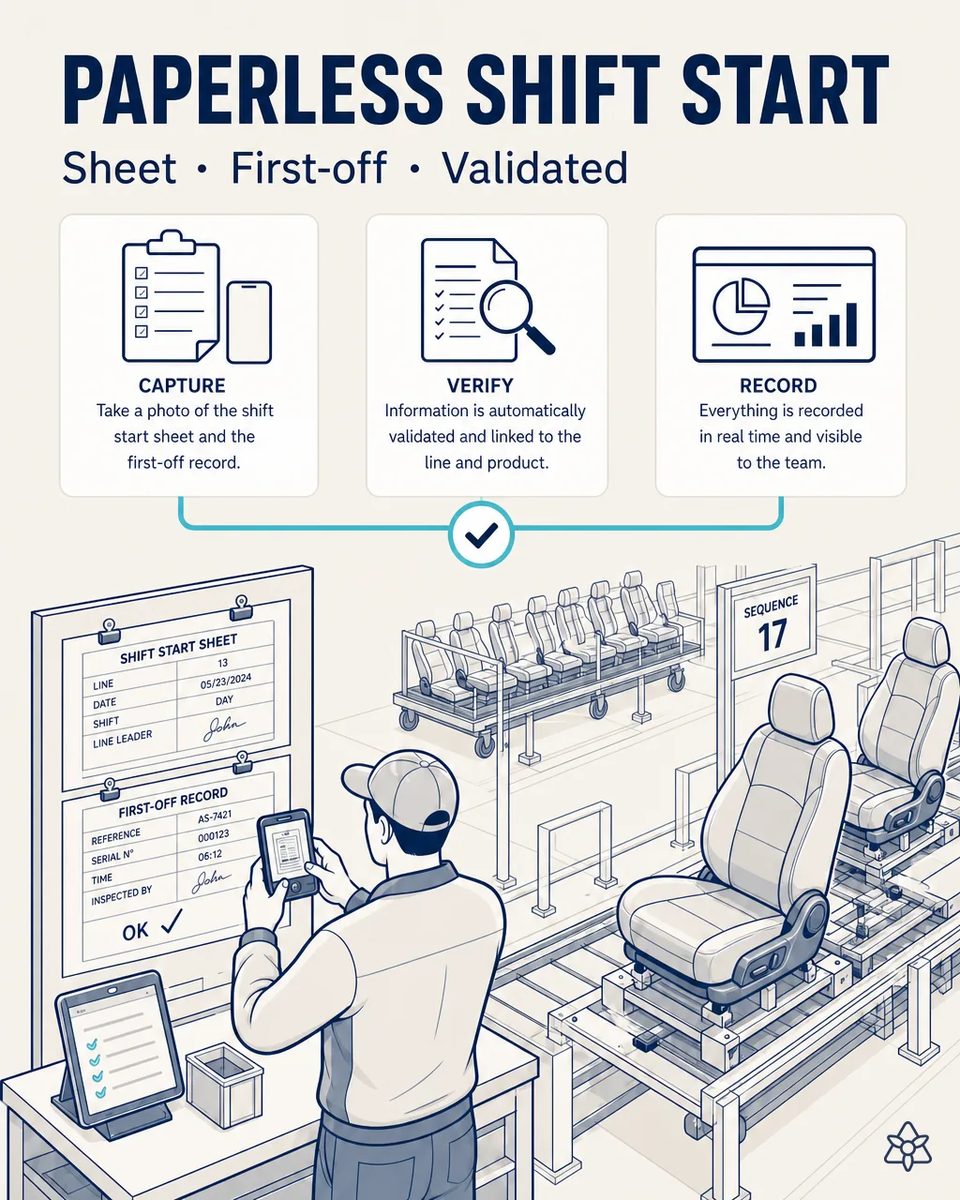
The birth certificate of the shift sits in a drawer.
The problem is not that it is filled in by hand. The problem is what happens next: the sheet gets annotated with what actually happened, that station four is running a temporary fixture, that an operator is missing, that the light leather variant runs after the break. And then it sits in a drawer for a full shift, or forever. When the customer raises a claim about a seat three weeks later, reconstructing what happened at that start-up depends on finding that piece of paper. And on whoever wrote it remembering. That is not traceability, that is archaeology.
- The start-up sheet says which variants run this shift and the state the line was left in; the first-off record is what quality signs before releasing production. Both are handwritten, and both get annotated with what actually happened during the first hour.
- Station four on a temporary fixture, one operator short, the light leather variant moved to after the break: that is the information that matters later, and it lives only on that sheet.
- Between the signature and any system, eight to twelve hours pass — or it never gets digitized at all.
- When the customer raises a claim on a seat three weeks later, reconstructing that start-up means finding the paper and trusting the memory of whoever wrote it, if they are still on that shift. That is not traceability, that is archaeology.
Connect in photo mode — the line leader adds two photos, nothing else changes.
With iLEAN Connect the line leader takes two photos at start-up, with the same phone already in their pocket. A grounded model recognizes the layout and extracts the fields: line, shift, planned variants, manning, inherited issues, first-off result and signature. All of it lands in central memory, tied to that line and that shift. And I want to stress this, because it is what makes it work: the operator learns nothing new, types nothing, changes not one gesture of their routine. They keep filling in the same sheet. All we add are two photos.
It is the lowest-friction case of the twelve and usually the first one signed off: nobody learns a tool, nobody types. The sheet stays the same sheet. What changes is that from now on a history of shift start-ups exists, and every root-cause analysis on foaming, trim or torque later leans on it. The first question in any customer claim — what was this line running and who was on it — stops being a question.
Start-up on paper versus start-up captured
| Aspect | Today, on paper | With iLEAN Connect |
|---|---|---|
| Latency to a system | 8-12 h, or never | Second zero |
| Planned variants and manning | Handwritten, in a drawer | Structured per line and shift |
| Inherited issues | Lost unless someone remembers | Extracted and tied to the shift |
| First-off result and signature | A page in a folder | Attached to the shift record |
| Answering a customer claim | Find the paper, ask who wrote it | One query by line and shift |
| Line leader's routine | — | Unchanged: two photos |
Impact estimate — to be validated with your numbers.
The block below is an estimate to be validated against your plant's actual data. We put it forward so the committee has an order of magnitude; we refine it during the assessment.
- Estimated payback 4-9 months, depending on the number of lines and shifts.
- Supervision time spent today transcribing and filing start-up sheets, recovered — and the drawer of paper stops growing.
- From 8-12 hours of latency — or none at all — down to second zero, queryable by line and shift.
- And a history of shift start-ups that did not exist before, which is what feeds every root-cause analysis on foaming, trim and torque later.
Estimated payback 4-9 months · from 8-12 h of latency to second zero The direct return is the supervision time spent today transcribing and filing: estimated payback of four to nine months depending on the number of lines and shifts, an estimate to validate with your own figures. But the real value is different: from here on there is a history of shift start-ups that simply did not exist before, and it feeds every root-cause analysis we will talk about later.
And the fair question from the production manager
“What if it misreads the manning or the variant list on a sheet full of crossings-out?” — reading fields from a document with a known layout is an anchored task, where the best models drop below 1.5% error [1]. And there is a second net: the summary goes to the line tablet and the line leader confirms or corrects it before the record enters central memory.
[1] OpenAI paper "Why Language Models Hallucinate", 2025 — on the reliability of AI in anchored tasks.
What people ask about the paperless shift start
Do we have to redesign the start-up sheet?
No. The model recognizes the layout you use today, crossings-out included, and each line can keep its own version. Changing the sheet is the fastest way to lose the line leader, so we do not touch it.
Does it read the first-off record as well as the start-up sheet?
Yes, both, and the first-off is the one that matters most: it carries the result and the quality signature that released production on that line. It stays attached to the shift, so a claim on any seat built that shift reaches it in one query.
What about the handwritten notes on a temporary fixture or a missing operator?
They are the most valuable fields, because that is where what actually happened is written. They are extracted like any other field, and a low-confidence value is flagged for a person to confirm rather than guessed.
Does the line leader need a new device?
No. Two photos with the phone already in their pocket, taken where the sheet already hangs, not at a terminal. If the plant prefers the line tablet, it works the same way.
Do we need to integrate with the manufacturing system on day one?
No. The shift record lives in iLEAN's central memory from the first start-up, queryable by line and shift, and the push to the manufacturing system comes later, once the value is demonstrated on one line.
More cases from this series
- The audit stops being a two-week projectAgents organizes by standard and serial number the evidence Connect and Edge already capture: the audit…
- Four rings between the broadcast and the truckFour verification rings (sequence, preparation, build and loading) cross-checked: if they disagree, the…
- The foam carousel that finally talksAn external camera digitizes mold temperature, curing and alarms from an isolated foam carousel,…
- Shift knowledge stops dying at clock-outThe supervisor dictates while walking what dies at end of shift today; iLEAN structures it with line,…
- Nothing enters the master without a human sign-offNothing the AI captures enters the traceability master without a human validating it in two taps from a…
- The lab stops transcribing into the ERPiLEAN reads the test sheet the moment it is saved and, once validated, writes it to the ERP. Typical…
Tell us how long a shift start-up takes to exist in a system on your lines today.
We work on your plant's real data, not ours. Assessment with no commitment.
Request estimated ROI within 48h ‹ See all cases of automotive seating See automotive