The supplier alert that no longer wastes time
Mid-morning, an email from the recycled lead supplier warns of a 48-hour delay on the ingot scheduled for that afternoon. It lands in an inbox nobody watches in real time. With iLEAN Connect, the system reads the email at zero-second latency, cross-references the active casting schedule, and alerts the casting lead with the concrete action to take.
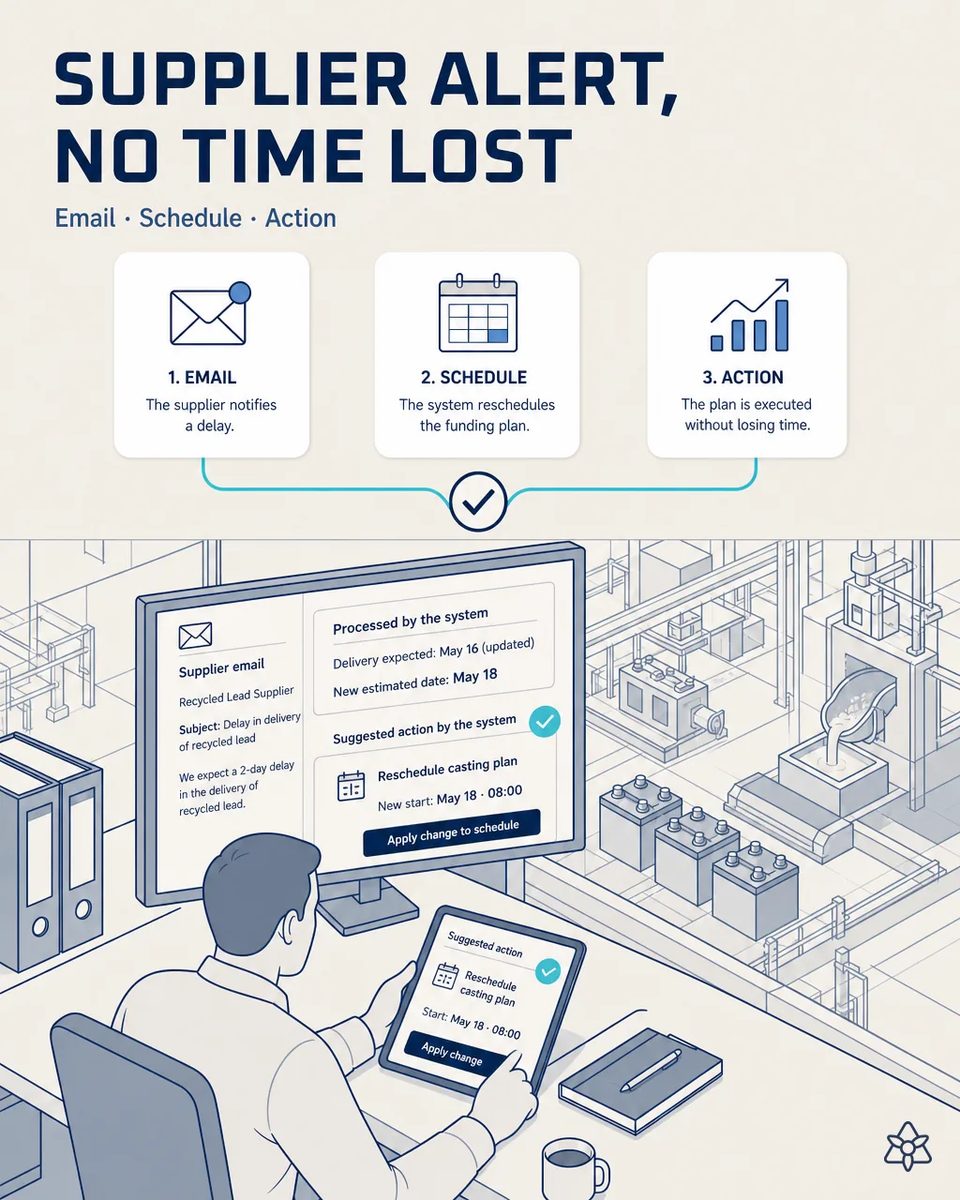
The ingot delay arrives in an inbox nobody reads in real time.
Critical raw-material supplier alerts arrive by email to specific people who can't watch their inbox in real time; by the time they're read, scheduling decisions have already been made and broken, and casting ends up idle waiting for a call.
- Mid-morning, the recycled lead supplier emails a 48-hour delay on the ingot scheduled for that afternoon's casting run. Nothing unusual for a secondary lead smelter, which juggles furnace campaigns and transport of its own.
- It lands in the mailbox of one buyer who is in a meeting, competing with a hundred other messages, written in free text with no fixed format. If that buyer is on leave or on the road, the message may wait even longer.
- By the time it is read, two or three hours later, the casting schedule and the pasting sequence behind it have already been committed. Pasting and curing have their own sequence, so a casting gap ripples down the line for days.
- The grid casting line ends up idle, waiting for someone to call the supplier and decide which alloy or which battery model to bring forward. Meanwhile the alloy that could have been run instead was already scheduled for another day.
Connect in chaotic-sources mode — a mailbox in silent copy of every lead supplier, 24/7.
Connect "chaotic sources" mode — a dedicated mailbox (or the supplier's WhatsApp Business line) in silent copy, 24/7. An LLM extracts the intent (supply delay), the material and date, instantly cross-references it with the ERP's active schedule, and returns a concrete action to the right role.
The supplier keeps writing the way it always has. iLEAN reads the intent, the material and the date, checks them against the live casting schedule and tells the casting lead what to move, while there is still time to move it. The difference between a resequence and an idle shift is usually measured in those first two hours.
A recycled lead delay today versus read at zero latency
| Aspect | Today | With iLEAN Connect |
|---|---|---|
| Time until the ingot delay is acted on | 2-3 hours of human latency | Seconds |
| Who learns about it | The buyer, when he opens his inbox | The casting lead, with a concrete action |
| Check against the casting schedule | Manual, after the fact | Automatic against the ERP's active schedule |
| Grid casting line during the delay | Idle, waiting for a call | Resequenced to another alloy or model |
| Supplier channel | Email or WhatsApp to one person | Same channel, read in silent copy |
| Rescheduling based on | What was read hours earlier | Live data |
2-3 hours of human latency → seconds. Rescheduling based on real-time data, not on what was read hours earlier.
Impact estimate — to be validated with your numbers.
The block below is an estimate to be validated against your plant's actual data. We put it forward so the committee has an order of magnitude; we refine it during the assessment.
- Estimated payback 3-7 months, depending on how often critical supplier alerts occur.
- From 2-3 hours of human latency to seconds on alerts about recycled lead, oxide, acid or separators. The same mailbox covers every critical supplier, so the value grows with each one added.
- Fewer idle hours on the grid casting line waiting for someone to decide. Pasting and curing keep their sequence instead of absorbing a casting gap.
- And the reschedule is decided on live data, not on a message read too late. We size it with you from the delays logged over the last two quarters.
Estimated payback 3-7 months depending on how often critical supplier alerts occur. *Figure to validate*.
And the fair question from the production manager
“What if it misreads the date or confuses the material?” — extracting intent, material and date from a supplier message is an anchored task, where the best models drop below 1.5% error [1]. And it never reschedules on its own: it proposes the action to the casting lead, who confirms or adjusts it before anything changes in the plan. Every proposal it makes is logged next to the original message.
[1] OpenAI paper "Why Language Models Hallucinate", 2025 — on the reliability of AI in anchored tasks.
What people ask about recycled lead supplier alerts
Do our lead suppliers have to change how they notify delays?
No. They keep emailing or messaging as they do now. A dedicated mailbox or a WhatsApp Business line sits in silent copy and reads whatever arrives, in whatever format. Nothing is installed on the supplier's side and nobody on their end needs to know the mailbox exists.
Does it only cover recycled lead ingots?
It starts there because that is where a delay stops the grid caster. The same mode reads alerts about lead oxide, sulfuric acid, separators or containers. Each material is mapped once to the lines and runs that depend on it, so the alert always lands in context.
How does it know which casting run is affected?
It cross-references the material and date in the message with the active casting schedule in the ERP, and identifies which runs and which battery models depend on that ingot. If the ERP schedule is incomplete, it says so in the alert rather than guessing the impact.
Who on the casting side receives the lead delay alert?
The role that has to act, typically the casting lead or the planner, with the affected runs and a proposed resequence, not just a forwarded email. The proposal includes what to bring forward and what to push back, so the decision takes minutes, not a meeting.
Does it read messages in other languages?
Yes. Many recycled lead suppliers write in their own language; the extraction is the same and the alert reaches the casting lead in yours. The original message is kept with the alert, so anyone can check the wording behind the action.
More cases from this series
- Zero critical defects, fully traced4 coordinated verification rings — ERP, marking, Edge vision and evidence pack — against the critical…
- The audit dossier that builds itselfEvery critical change generates a pre/post photo, log and sign-off. Agents builds the audit dossier by…
- The serial marker that no longer gets hand-typedThe ERP publishes lot, date and model straight to the marker via API. Lot change = one tap, not manual…
- Grid casting start, no paperThe grid casting shift log gets photographed with a phone and lands in the central system at zero-second…
- What the line lead knows now stays on recordThe line lead dictates an incident while walking the floor; iLEAN structures it and replies in seconds,…
- The lab Excel sheet that's already in the ERPILEAN reads the lab's quality Excel sheet and pushes it to the ERP after human validation. Up to -80% on…
Tell us how much unplanned casting downtime a late lead alert cost you last quarter.
We work on your plant's real data, not ours. Assessment with no commitment.
Request estimated ROI within 48h ‹ See all cases of automotive batteries See automotive