The operator has the best idea of the shift — and it stays in their head because the suggestion box is in the office.
Continuous improvement is won when the operator's kaizen arrives whole: photo, context, voice, at the exact moment they see the opportunity. iLEAN Connect lets the operator send the idea over WhatsApp in five seconds; Agents cross-check it against plant data, estimate ROI as a range, open the record and hand it to the manager. The person decides which ones move up — and the operator sees that their idea no longer gets lost.
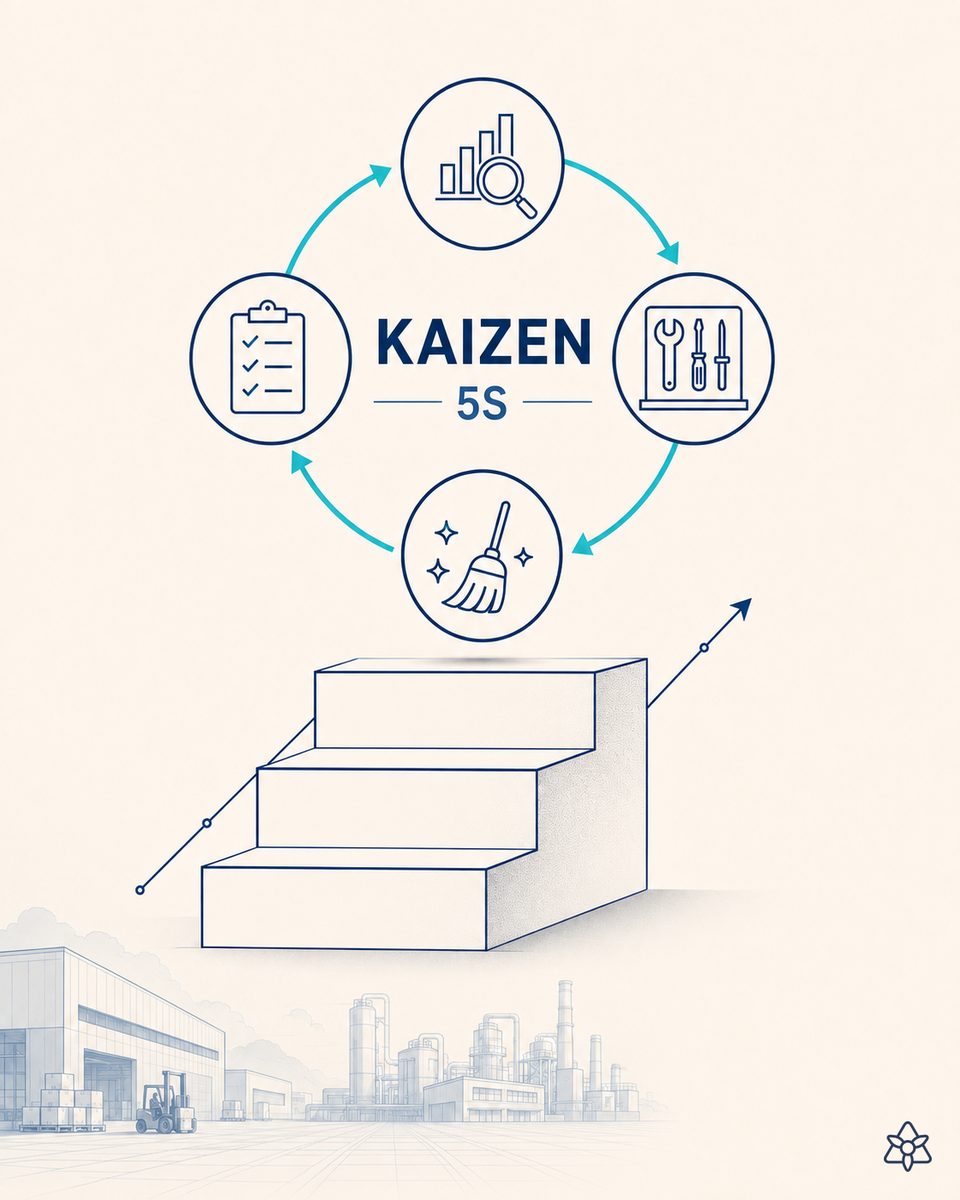
Capture friction kills more kaizen than any shortage of ideas.
The operator on the line sees things nobody else sees. They see the fixture that takes two minutes longer to change because the clamp screw is out of square. They see the part that always goes back to rework for the same defect they already know how to avoid. They see the andon light on the next line stuck on amber every Monday at 11am. They see the low-hanging fruit.
The problem is almost never a shortage of ideas. It is that the capture system is built for the office, not for the line:
- The suggestion box — paper, in the common room, a pencil that never writes.
- The continuous improvement intranet — login, long form, mandatory fields that do not apply to what the operator wants to say.
- The improvement meeting — once a month, talking in the abstract about things that were seen in the concrete weeks ago.
The result is the familiar one: a small fraction of the ideas the operator had in mind ever becomes a record. And of those, another fraction ever becomes an implementation. The biggest island is not the ERP — it is the veteran's knowledge, and almost the entire current system is designed to keep it there.
Connect captures over WhatsApp — Agents rank by ROI — the manager signs off.
Kaizen is not a motivation problem: it is a capture and ranking problem. The critical information (the improvement the operator has in mind) enters the factory through a photo and a voice, not through a sensor. iLEAN acts as the filler that seals the crack between the line and continuous improvement, without replacing your lean system or your intranet — it uses the channel the operator already uses.
Connect receives the WhatsApp message at second zero. Agents transcribe the audio, read the photo, estimate ROI with plant data and open the record. The person ranks and signs off. No long form, no forgotten box, no meeting weeks later.
The three iLEAN pieces applied to operator kaizen:
- Connect — receives the WhatsApp message (photo + audio + free text) from the operator in their own language. It transcribes the audio, identifies which line or machine it comes from, and keeps the capture tied to its context without asking the operator to fill in any fields. The app is where the operator already is: on their phone.
- Agents — match the proposal against plant data (average changeover time, frequency, line cost per hour, rework history), estimate ROI as a range, flag whether something similar was already tried, and open the record in the continuous improvement system. The manager receives it already ranked.
- Three rings — the idea enters ring 3 (capture) fast. It is validated in ring 2 (does this line exist? is the cross-checked data real? has this already been done?). The decision to move the proposal into production is signed off by a person — ring 1.
Suggestion box vs. WhatsApp kaizen ranked by iLEAN
| Aspect | Classic suggestion system | With iLEAN Connect + Agents |
|---|---|---|
| Entry channel | Paper, intranet, monthly meeting | WhatsApp on the operator's phone |
| Operator effort | Long form, login, mandatory fields | Photo + audio + free text — 5 seconds |
| Record creation | Manual, at some point | Automatic, second zero |
| Ranking by ROI | Subjective, in the monthly meeting | Cross-checked with plant data, as a range |
| Duplicate detection | The improvement manager's memory | Cross-checked against history by the agent |
| Visibility for the operator | «I sent it months ago, no idea» | Status of their proposal available on the same channel |
Impact estimate for your plant — to be validated with your numbers.
The block below is an estimate to be validated with the specific data of your plant. We put it forward so the committee has an order of magnitude; we refine it during the diagnostic.
- Industrial plant with 50-200 operators, a continuous improvement system that is alive but with few proposals captured per month relative to headcount.
- Connect pilot: WhatsApp channel enabled for one line or section, transcription + photo reading + automatic record creation + ROI estimate as a range using plant data. First expected value within a few weeks: the first batch of kaizen ideas captured from the phone with the record already open.
- Indicative payback between 4 and 9 months, counting the savings from the first high-ROI proposals implemented and the current cost of the hours spent keeping the classic suggestion system alive.
- Expected reduction of the time from idea to implementation of ≥ 30%, once the record is opened automatically and the manager receives the proposal already ranked.
- An intangible but very real hard lever: capturing the veteran's knowledge before they retire. It is the biggest island, and the only one that appears in no ERP.
And the operations director's fair objection
«What if the agent gets the ROI wrong and we move up a proposal that does not actually pay off?» — hallucination is a problem of free generation, not of anchored tasks. Cross-checking an idea against real plant data (average changeover time, cost per hour, frequency) and returning a ROI range is exactly an anchored task: the best models pushed the error below 1.5% [1]. And even so, no improvement is implemented on the agent's signature alone. The proposal reaches the manager with its ROI range, its data trace and the person's sign-off as the gate. The three rings are there precisely for this.
[1] OpenAI paper "Why Language Models Hallucinate", 2025 — on the reliability of AI in anchored tasks.
What people ask about WhatsApp kaizen ranked by ROI
Why do classic kaizen suggestion boxes almost never work?
Because the operator's natural flow on the shop floor is not filling in a form: it is seeing something, taking a photo with the phone, or mentioning it out loud to a colleague. If the only way to propose an improvement is walking to the office, asking for a sheet of paper and filling a box on the way out of the shift, almost nobody does it. The idea is lost. Classic lean studies in industry show that the share of proposals actually implemented, measured against the ones the operator really has in mind, is very low — not for lack of ideas, but because of friction in the capture step.
How does iLEAN Connect capture an operator kaizen idea over WhatsApp?
The operator opens WhatsApp on a personal or company phone, sends a photo of what they have seen, records an audio explaining it in their own language, and hits send to the plant number. At second zero, Connect receives the message. The agent transcribes the audio, reads the photo, identifies which line or machine it comes from (from the sender or from context), and opens an improvement proposal record. Friction is as low as it gets: the operator does what they already know how to do with their phone.
How do you rank a kaizen by estimated ROI without turning it into a black box?
Agents match the idea against data already in the plant: if the operator points at a change to a fixture, the agent cross-checks the average changeover time, the line cost per hour and the frequency of use. If the idea is about reducing rework, the agent cross-checks the rework history per shift and its associated cost. The estimated ROI comes out as a range (not a magic number), with the trace of which data was used. The continuous improvement manager validates, ranks with their own judgement and signs off. The agent proposes, the person decides.
Isn't there a risk that people propose anything and the system gets flooded?
Quite the opposite: the risk with the classic suggestion box is exactly the reverse — almost nobody proposes anything because friction is high. When friction drops, many more ideas arrive, and that makes a ranking layer necessary. That is precisely what the agent adds: separating the high-return, low-effort idea (the low-hanging fruit) from the interesting but expensive one, and from the one that was already tried and did not work. The operator does not get tired: they see that their proposals are no longer lost and that the ones that make sense move up fast.
What impact can the plant expect on continuous improvement?
The estimate to be validated is a significant rise in the number of kaizen proposals captured per shift (because friction drops) and a reduction of the time from idea to implementation of ≥ 30% (because the agent opens the record and ranks it on the spot). The business lever is twofold: hard savings from the high-ROI proposals that get implemented, and capture of the veteran's knowledge that would otherwise walk out the day they retire. We fine-tune it with the data from your current continuous improvement system.
More cases in ilean connect
- WhatsApp andon in tier-1 automotive — the red light that does find the manager.iLEAN Connect pushes the tier-1 automotive andon over WhatsApp, escalates to the manager in a 5-minute…
- WhatsApp HACCP in an artisan PDO cheese dairy — the master reports as always; the system records underneath.iLEAN Connect captures the HACCP deviation the master cheesemaker sends by WhatsApp, links it to the…
- The operator's WhatsApp in the meat cutting room — the report already exists; what's missing is a system that reads it.iLEAN Connect transcribes the meat cutting operator's WhatsApp reports — line stoppages, yield loss,…
- Windows NT screen in pharma packaging — read the HMI without touching the machine.iLEAN Connect reads the Windows NT HMI of a pharma packaging line by vision and pushes counts to your…
- Fill out the work order on paper. Your AI agents do the rest.Free printable work order form. Your techs fill it in by hand, snap a photo, and an AI agent reads it,…
- The chemical tank has a good pressure gauge — and its reading lives in a shift notebook.iLEAN Connect reads the analog pressure gauge of a chemical tank with a fixed camera and emits the…
Tell us about your case and within 48h we'll send you the estimated ROI of this AI project for your continuous improvement system.
We work on the real data of your plant, not on ours. Diagnostic with no strings attached.
Request estimated ROI within 48h See Connect