A shade complaint should not take weeks — the bag, the injection machine and the part have to talk.
Traceability for a color masterbatch breaks at the most expensive moment: when the end customer calls because a part is off tone and nobody knows which bag went into which hopper. iLEAN Tracer links the pigment batch, the bag, the injection machine parameters and the molded part with a single identifier, and returns the root cause in hours. The person signs — no batch is closed out without their approval.
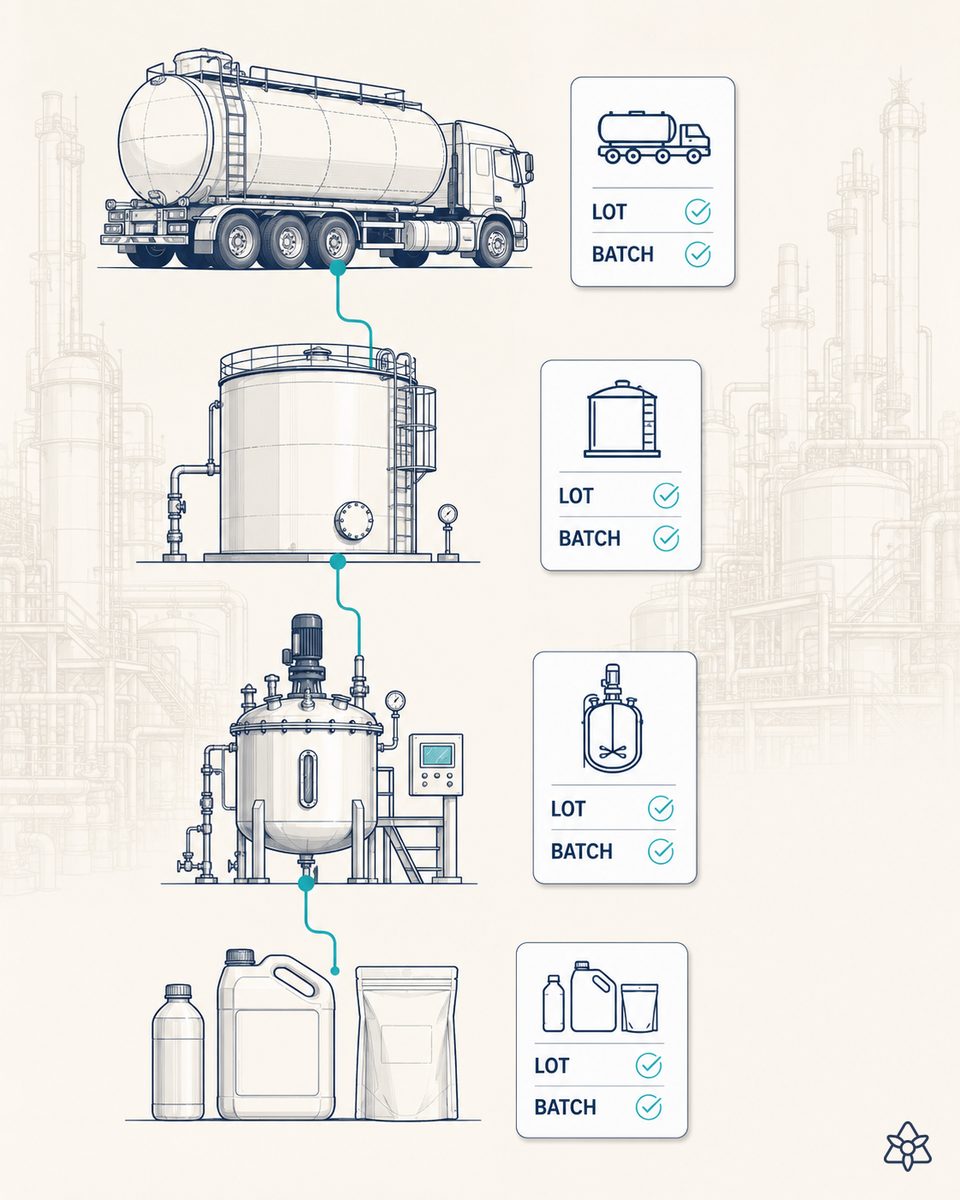
Shade gets argued over by email when it should be argued over by data.
Producing color masterbatch means stitching four worlds together: the chemical one (pigment, carrier, dispersants), the compounding one (extruder, pelletizer, mixer), the logistics one (bag, pallet, container, carrier) and the customer's (injection machine, mold, parameters, part). Each has its own system, and between them there is air.
When a shade complaint comes in from the end customer — "this run of caps does not match the previous one" — the quality manager starts the odyssey: talk to the customer so they send the batch and the part reference, open your own ERP to find which masterbatch batch shipped on that date, look at the recipe, call the lab to review the pigment incoming inspection, ask the customer for the injection machine parameters and, with luck, reach the root cause two weeks later. Meanwhile, the customer is deciding whether to pay you for the next order.
The problem is not a lack of will or rigor: it is that the bag does not talk to the injection machine, and it never did. Connecting them at every customer cost more than it was worth. That has just changed.
iLEAN Tracer is not a new ERP — it is the putty between the bag and the part.
Traceability for a masterbatch already exists in pieces: in your ERP, in the LIMS, in the lab spreadsheet and in the customer's MES. iLEAN Tracer is the specialization of Edge + Connect + Agents that seals those cracks with a unique batch identifier, drags it all the way to the physical bag (QR/RFID label) and picks it up again when the bag goes into the customer's hopper. It does not ask you to throw away anything you already have.
Edge sees the bag as it is loaded. Connect reads the recipe, the pigment COA, the delivery note from transport and the injection data, whether it comes from an MES or from a spreadsheet. The agent closes the loop: from pigment to part.
The iLEAN pieces applied to this chain:
- Edge — a vision-equipped terminal (CNN) over the pelletizer and over the bagging area. It links the bag being sealed to the mixer recipe currently running. If the customer wants to install it over their own hopper, the same Edge reads the bag as it is loaded. It works with no network: traceability cannot depend on the converter's WiFi.
- Connect — the putty between your systems and the customer's. It captures the pigment certificate of analysis that arrives by email from the supplier; it reads your LIMS and your ERP; it picks up the daily injection spreadsheet the customer exports from their MES; it integrates the transport data. What used to live on islands enters the system at second zero.
- Agents — they cross-reference the four links (pigment → masterbatch recipe → bag → injection), build the dossier for every batch, and when a complaint arrives they return the root cause with the evidence behind it. They propose a batch hold when a pigment COA comes in out of band. The person signs — the final decision is human.
Traceability by email vs. traceability by data with iLEAN Tracer
| Aspect | Classic traceability | With iLEAN Tracer |
|---|---|---|
| Bag identifier | ERP batch printed, not linked to the pigment | QR/RFID carrying pigment, recipe and mixer |
| Customer complaint | Reopen the ERP, emails, lab, phone calls | Batch dossier with root cause in hours |
| Pigment COA | A PDF in an email nobody cross-checks against the batch | Captured and checked against the historical band |
| Customer's injection data | Asking for it by email every time | Daily MES spreadsheet read automatically |
| Batch hold when a COA is out of band | Reactive, after the complaint | Proactive, before bagging — with a human signature |
| File for an IATF 16949 / ISO 9001 audit | Rebuilt by hand, batch by batch | Generated per batch, with the evidence attached |
Impact estimate for your plant — to be validated with your numbers.
The block below is an estimate to be validated with the specific data of your plant. We put it forward so the committee has an order of magnitude; we refine it during the diagnostic.
- Producer of concentrated masterbatch for injection molding with a multi-customer portfolio (PE/PP/ABS carrier), recurring shade complaints with 1-2 large converters.
- Tracer pilot on one mixer (QR label on the bag + pigment COA read by Connect + integration with the customer's daily injection spreadsheet). First value expected within a few weeks: the next complaint is closed with a dossier, not with an email.
- Indicative payback between 4 and 9 months, depending on the frequency and average cost of documented complaints. Expected reduction in complaint closure time above 30% on the worst quartile — the easy case you already close; what Tracer fixes is the hard case.
- The hard lever is a complaint closed before it affects the next order: the converter who keeps the contract because they see your root cause arrive before their purchasing decision.
And the quality manager's reasonable doubt
“What if the AI makes up the root cause?” — hallucination is a problem of free generation, not of anchored tasks. In tasks where the AI merely recontextualizes a piece of data (reading a COA, cross-referencing it with a batch, finding the bag that was loaded at a specific time), the best models brought error below 1.5% [1]. And even so, what is critical is never decided alone: Tracer builds the dossier, the person signs it. The three safety rings exist precisely for this.
[1] OpenAI paper “Why Language Models Hallucinate”, 2025 — on the reliability of AI in anchored tasks.
What people ask about masterbatch traceability all the way to the molded part
What data chain do you need to close a shade complaint?
Four links that are almost never joined up: the supplier's pigment and carrier batch, the masterbatch batch that comes out of the mixer with its recipe, the bag and pallet shipped to the converter, and the injection machine parameters used to mold the final part. If one link is missing, it gets argued over by email for weeks. iLEAN Tracer ties them together with a single identifier, from raw material to the customer's part.
How is the bag linked to the customer's part without the converter changing anything?
The converter does not change their flow. Tracer captures the bag code by photo or scan as it is loaded into the hopper (Connect in the operator's app, or an Edge device with a camera above the hopper), and cross-references that timestamp with the injection traceability the customer already has in their MES — machine number, mold, parameters, part batch. If the customer exports that data in a daily spreadsheet, Tracer reads it as usable data. There is no need to connect two ERPs or sign an integration contract.
How long does Tracer take to find the suspect batch when a complaint comes in?
From weeks to hours. The complaint arrives with the customer's part reference; the agent works backwards to the injection machine, the date, the bag that was in the hopper, the masterbatch batch, the recipe and the pigment/carrier batch. It all shows up on one screen with the photo/PDF for every step. The quality manager calls the customer with the root cause in front of them, not with a “we'll look into it”.
What if the problem is a pigment change at the upstream supplier?
Tracer cross-references the pigment batch against the recipe history — if that consignment has a Delta E outside the historical band, it flags it before it goes into production and alerts the purchasing lead. Connect will already have the supplier's certificate of analysis (it came in by email, nobody has to forward it), so the agent can check the COA against your own incoming inspection. If there is a deviation, the batch is held pending the human signature.
Does it work with masterbatch concentrated in a polymer different from the end customer's?
Yes. Tracer assumes nothing about chemistry — it stores the carrier (PE, PP, PS, ABS, PC) and the suggested letdown ratio, and the agent correlates the customer's molded part with the real carrier+host combination. In complaints caused by carrier/host interaction (migration, dispersion, streaking) that saves hours of technical argument: the real carrier data sits next to the part data, not in a separate PDF.
More cases in petrochemical
- 2K dosing of MS polymer sealant — a badly measured ratio is a pallet of cartridges to destroy.How iLEAN Edge sees the base-to-catalyst ratio on a 2K MS polymer sealant dosing unit and stops the line…
- Acrylic latex emulsion polymerization — two batches from the same reactor do not land the same way on the golden batch.How iLEAN Edge corrects the exotherm profile and monomer feed in an acrylic latex reactor to hit the…
- Between the wire break and the biocide overdose — dosing a paper circuit needs one head with every signal in front of it.iLEAN Connect integrates ATP, redox and microbial load across the paper circuit and adjusts biocide…
- ΔE color control on multi-customer flexo ink — start-up cannot keep being the scrap of the day.iLEAN Vision measures ΔE inline on flexo ink, adjusts dosing and stores a signed per-customer recipe —…
- SDS, GHS label and Ecolabel dossier per SKU and format — without rewriting them by hand for every can.iLEAN Writer generates the SDS, GHS label and EU Ecolabel dossier for every SKU and pack format straight…
- Color-change CIP in multipigment production — a trace of blue in a yellow is an off-shade batch.How iLEAN Vision validates visual cleanliness and rinse conductivity between pigment batches to prevent…
Tell us your case and in 48h we'll send you the estimated ROI of this AI project for your masterbatch plant.
We work on the real data of your chain, not ours. Diagnostic with no commitment.
Request estimated ROI in 48h See specialty chemicals